

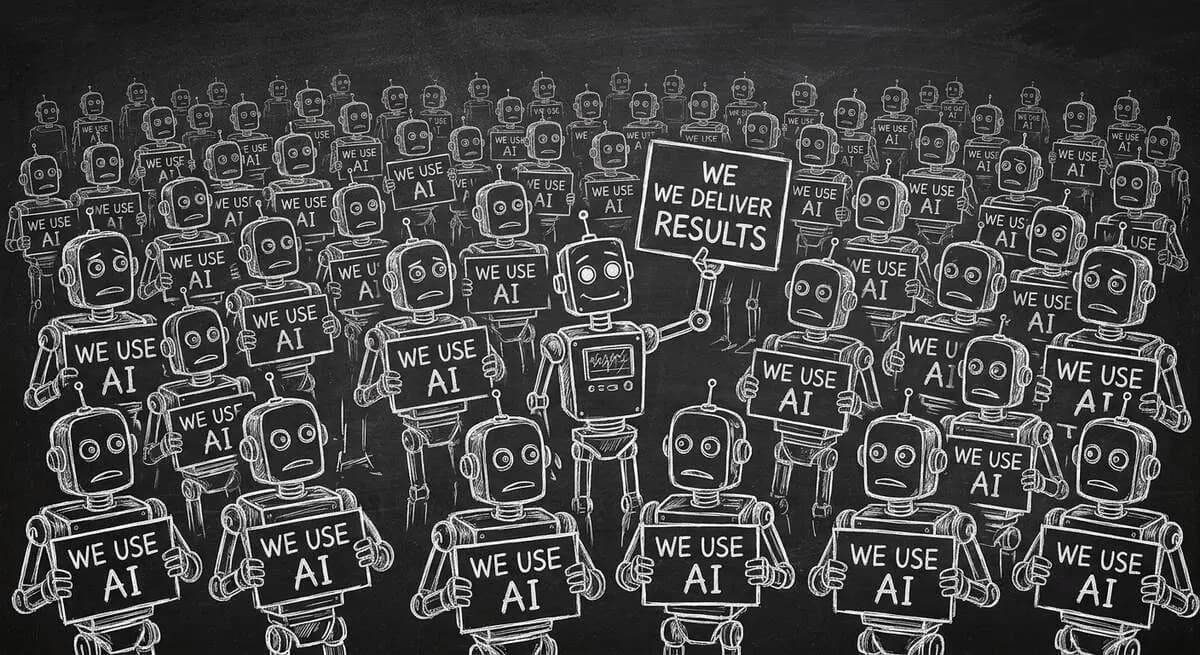
According to HubSpot's 2026 State of Marketing, 80% of marketers now use AI for content creation. That means when your agency pitches "we use AI to create content faster and better," you're saying the same thing as 4 out of 5 competitors in the room.
AI adoption was a competitive advantage in 2023. By 2025, it was table stakes. In 2026, claiming to "use AI" in your pitch is like claiming to "use email." It tells the prospect nothing about why they should choose you.
So what are the agencies that are actually winning new business in 2026 selling? Not AI as a capability. They're selling AI as an outcome -- specific, measurable results that their competitors can't replicate because they haven't built the right service infrastructure. Here are the five differentiators that matter.
Agency Differentiators: 2023 vs 2026
| Differentiator | 2023 Value | 2026 Value | Why It Changed |
|---|---|---|---|
| "We use AI" | High | Zero | 80% of agencies now use AI -- it's commodity |
| AI visibility services | Didn't exist | Very high | 94% of B2B buyers use AI for research; most sites invisible |
| Interactive lead qualification | Medium | High | Quiz funnels convert 10-20x vs PDFs; data-rich leads |
| Full-funnel attribution | Medium-high | Critical | 84% of marketers can't measure cross-platform performance |
| Vertical specialization | High | Very high | Generic agencies drowning in AI commodity content |
| Agent economy readiness | Didn't exist | Emerging (first-mover) | AI agents now book services autonomously |
The AI Commoditization Curve: Where We Are Now
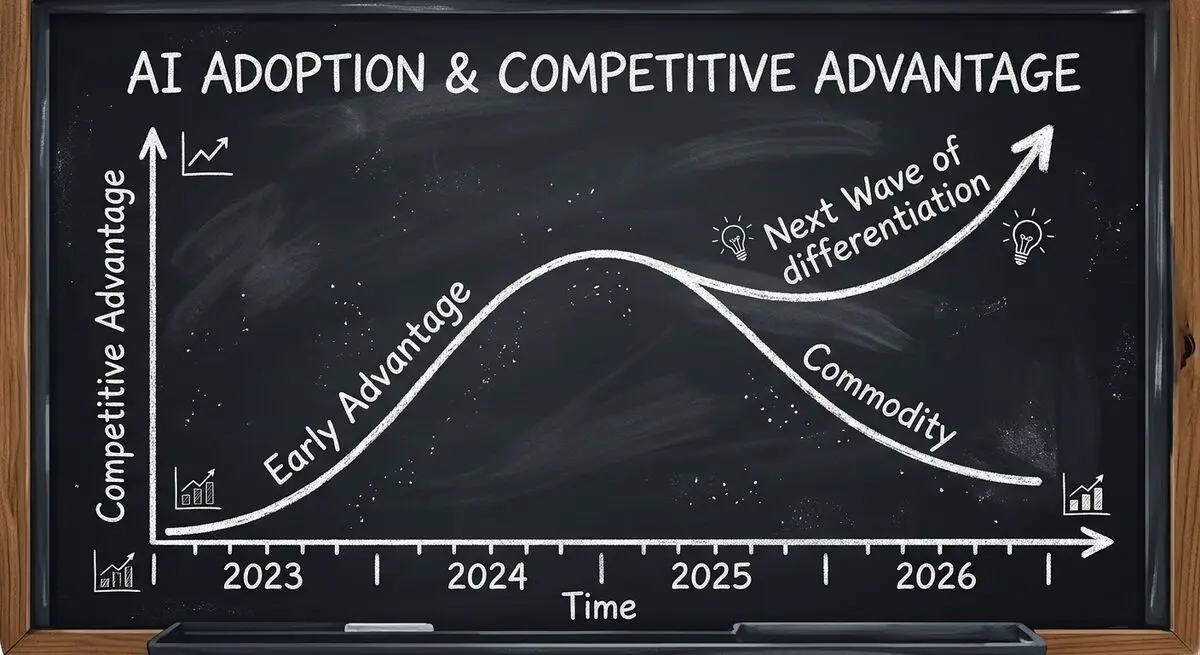
Every technology follows the same adoption curve for competitive advantage. In the early phase, adopters gain an edge. As adoption spreads, the advantage flattens. When adoption becomes universal, the technology becomes invisible infrastructure.
AI for content marketing hit the universal phase in 2025. Here's the evidence:
- 80% adoption: HubSpot reports that 80% of marketers use AI for content creation and 75% for media production.
- Quality convergence: 79% of businesses report higher content quality from AI tools (Semrush). When everyone's content quality improves, nobody's stands out.
- Speed convergence: Marketers using AI produce long-form content in under 60 minutes versus 2-3 hours without AI. But when everyone is fast, speed isn't a differentiator either.
- Consumer backlash: HubSpot SVP Kieran Flanagan notes: "Today, more content is generated by AI than by humans. But it's mostly average. Consumers seek human-created content."
The agencies still leading with "we use AI" are fighting the last war. The question isn't whether you use AI. It's what you use it for that nobody else has figured out yet.
The Five Differentiators That Actually Win Business in 2026
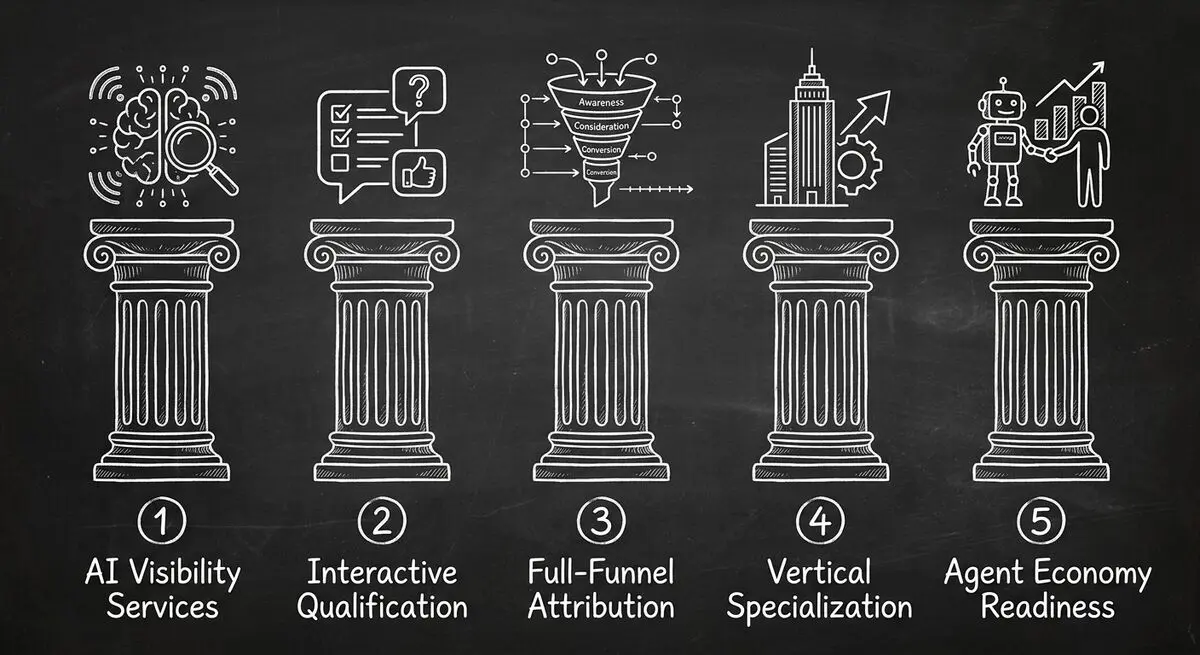
Differentiator 1: AI Visibility Services
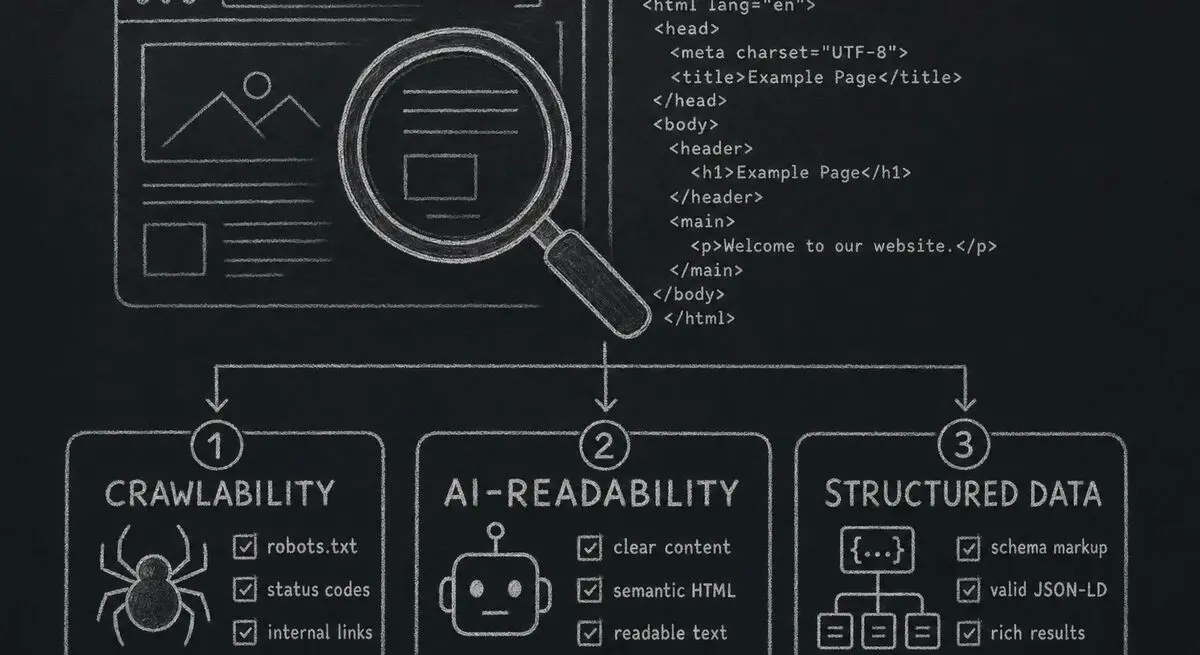
With 94% of B2B buyers using AI in purchasing decisions (Forrester), the biggest gap in most companies' digital strategy is AI visibility. Their websites are invisible to AI agents -- blocked by robots.txt, missing llms.txt files, lacking structured data, and absent from AI marketplaces.
Agencies that offer AI readiness audits and implementation are filling a gap that didn't exist 18 months ago. The tool is simple: run a free AX Audit on a prospect's website, show them their score, and sell the fix. Agencies report $12K+ in monthly revenue from this single productized service.
Differentiator 2: Interactive Lead Qualification
Static forms and gated PDFs are relics. Quiz funnels convert 10-20x more visitors into qualified leads while simultaneously scoring lead quality in real time. Agencies that build interactive qualification experiences for clients are delivering measurably better pipeline -- not just more content.
The numbers speak for themselves: 2x discovery call show rates, 161% more qualified leads, and 67% higher close rates. No amount of AI-generated blog posts delivers that kind of pipeline impact.
Differentiator 3: Full-Funnel Attribution
84% of B2B marketers struggle to measure content performance across platforms (Semrush). Nearly two-thirds of marketing leaders report low trust in their measurement data (Forrester). The agency that can draw a clear line from content asset to pipeline to revenue wins the retainer renewal -- every time.
This means going beyond traffic and engagement metrics. Track MQL-to-SQL conversion by content source. Measure discovery call show rates by lead origin. Calculate revenue attribution per campaign. Interactive content makes this dramatically easier because every quiz answer is a trackable data point tied to a downstream conversion outcome.
Differentiator 4: Vertical Specialization
In an AI-saturated content landscape, generic agencies are struggling. When anyone can produce "5 Tips for B2B Lead Generation" in 60 seconds, the agency that knows the nuances of healthcare compliance, manufacturing supply chains, or SaaS product-led growth models has an unfillable knowledge moat.
Vertical specialization compounds with the other differentiators: an agency that specializes in SaaS AND offers AI visibility audits AND builds interactive qualification funnels is virtually unchallengeable in their niche.
Differentiator 5: Agent Economy Readiness
This is the emerging frontier. AI agents are beginning to autonomously search for, evaluate, and book services on behalf of users. The agent economy is still early enough that first-mover agencies will establish authority before the market gets crowded.
What this looks like in practice: helping clients set up MCP-compatible service endpoints (via Dashform's Agent Funnel), listing in AI agent marketplaces, and optimizing for AI agent discovery. As Google's search share continues to decline from its former dominance, this capability will become essential.
The Agency Evolution: From Content Factory to AI Visibility Architect
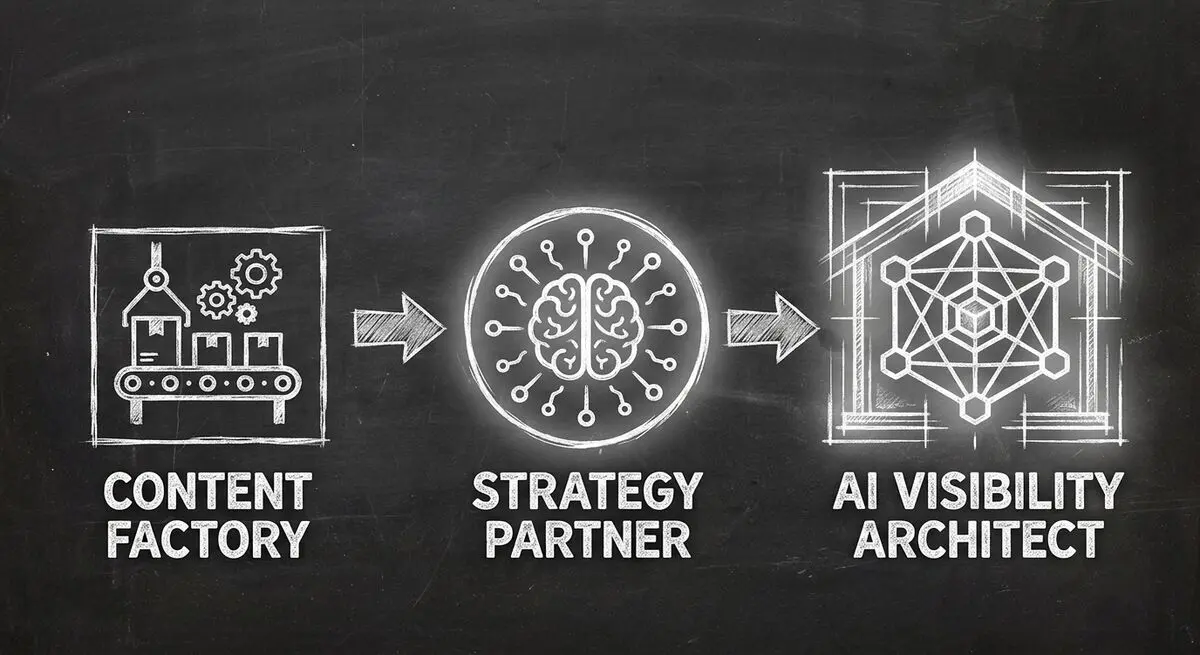
The agency industry is going through its third major evolution:
- Phase 1 (2015-2020): Content Factory. Agencies competed on volume. More blog posts, more social updates, more email sequences. The agency that could produce the most content won.
- Phase 2 (2020-2024): Strategy Partner. Content volume became commodity. Agencies competed on strategy -- editorial calendars, buyer journey mapping, ABM targeting. The agency with the best strategic framework won.
- Phase 3 (2024-present): AI Visibility Architect. Strategy is being commoditized by AI planning tools. The new value is in making clients visible to AI systems, building interactive experiences that capture qualified leads, and connecting human-led strategy to measurable pipeline outcomes.
Agencies stuck in Phase 1 or Phase 2 will continue to see margin compression as AI tools make their core services cheaper. Agencies that leap to Phase 3 will command premium pricing because they're solving problems that AI tools alone cannot.
Building Your Differentiated Service Stack
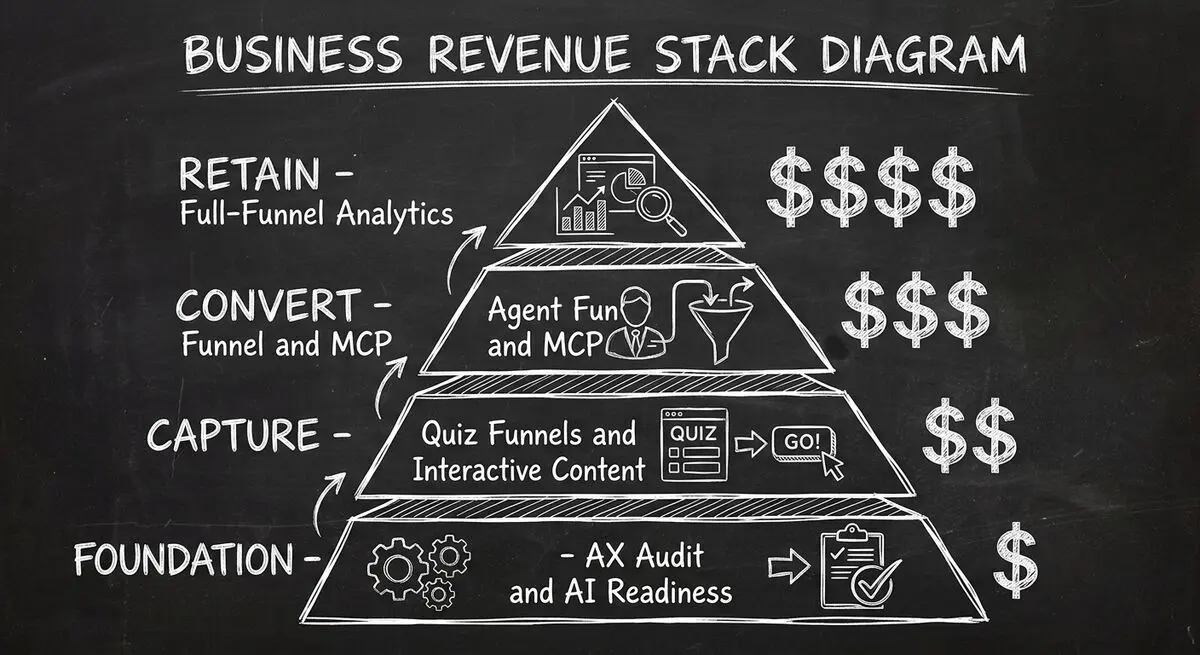
Here's the practical service stack that positions your agency for 2026 and beyond:
Layer 1: Foundation -- AI Readiness (AX Audit)
Start every client relationship with an AX Audit. This establishes your expertise, creates urgency, and opens the door to paid implementation. Pricing: $2,500-$8,500 per engagement.
Layer 2: Capture -- Interactive Lead Qualification (Quiz Funnels)
Replace static lead magnets with AI-powered quiz funnels that capture 10x more leads with 3x better qualification data. Pricing: $2,000-$5,000 per build plus $500-$1,500/month management.
Layer 3: Convert -- Agent Economy Infrastructure (Agent Funnel + MCP)
Make client websites discoverable and bookable by AI agents. This includes MCP endpoint setup, AI marketplace listings, and agent-optimized content. Pricing: $3,500-$7,500 per implementation.
Layer 4: Retain -- Full-Funnel Analytics and Optimization
Ongoing measurement and optimization across all layers. Track AI visibility scores, quiz funnel performance, agent-driven leads, and pipeline attribution. Pricing: $3,000-$6,000/month retainer.
Combined, this four-layer stack generates $11,000-$27,000 per new client in project revenue plus $3,500-$7,500/month in recurring retainer revenue. That's the economics of differentiation.
The Action Plan: This Week, This Month, This Quarter
- This week: Audit your own agency. Run an AX Audit on your website. Build a quiz funnel for your own intake process. You can't sell what you haven't experienced.
- This month: Package your first productized service. Start with AI readiness audits -- they're the fastest to productize and the easiest to sell. Create your three-tier pricing.
- This quarter: Roll out the full service stack to 5 existing clients. Track results obsessively. Build case studies from the first cohort.
- This year: Position your agency as an AI visibility specialist. Publish thought leadership. Speak at events. The agencies that establish authority in this space now will be the default choice when every business needs these services.
The window for first-mover advantage is open but closing. When "we help clients become visible to AI agents" becomes as common as "we use AI for content," the differentiation evaporates. The agencies moving now will be the ones setting the standard.
Frequently Asked Questions
Is 'we use AI' really dead as a differentiator?
Yes, as a standalone pitch. When 80% of marketers use AI, claiming AI adoption is like claiming you have a website. What matters now is what specific outcomes you deliver with AI that others can't -- AI visibility, interactive qualification, full-funnel attribution. The tool is table stakes; the application is the differentiator.
How do I transition my agency's positioning without confusing existing clients?
Frame it as evolution, not revolution. "We've always helped you create great content. Now we're making sure that content is visible to every buyer channel -- including AI assistants that 94% of B2B buyers use. Here's how." Existing services continue; new services layer on top.
What if my team doesn't have technical AI skills?
The tools handle the technical complexity. AX Audits run automatically. Dashform builds quiz funnels with AI assistance. MCP endpoints deploy with a single toggle. Your team needs strategic understanding of these concepts, not engineering skills. Most agencies can start offering these services within 2-3 weeks of training.
Won't these differentiators also become commoditized eventually?
Eventually, yes. Every competitive advantage has a shelf life. But the agencies that establish expertise now build compounding advantages: case studies, client relationships, market positioning, and operational efficiency. First-movers in AI visibility will be the incumbent experts when the market matures -- the same way early SEO agencies became the default choice for search marketing.
How do I prove ROI to skeptical clients?
Start with the numbers. Run the AX Audit (free, visual, undeniable score). Show the quiz funnel conversion data (10-20x improvement over PDFs). Reference the 94% B2B buyer AI usage stat (Forrester). The data makes the case before you have to.
Should small agencies pursue all five differentiators at once?
No. Pick one to start -- AI visibility services (Layer 1) is the fastest to implement and sell. Master that, build case studies, then expand to Layers 2-4 over the next two quarters. Trying to launch everything simultaneously dilutes focus and slows execution.