

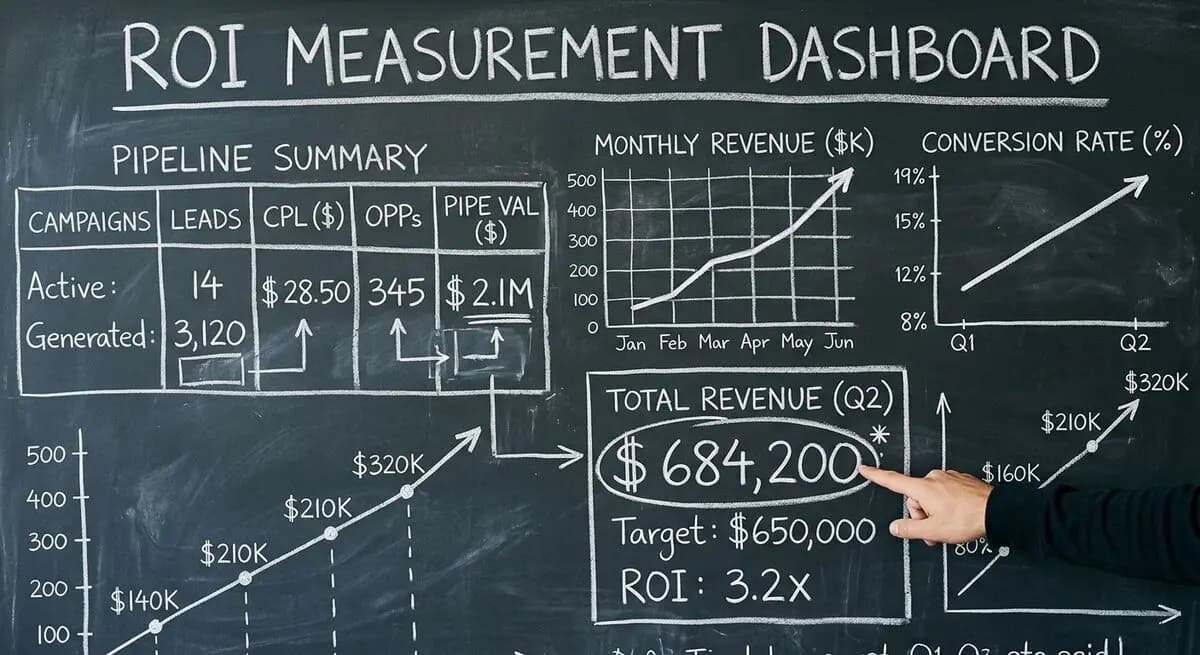
"What's the ROI of content marketing?" It's the question that has ended more agency-client relationships than any other.
And for most agencies, the honest answer is: "We don't know." Not because content marketing doesn't work, but because the measurement infrastructure is broken. You're tracking pageviews and social shares while your client's CFO is asking about pipeline and revenue.
According to a 2026 Demand Gen Report survey, 50% of marketing leaders can't explain their ROI methodology to their executive team. For agencies, this isn't just an awkward conversation -- it's an existential threat. Clients who can't see ROI cut budgets. They bring things in-house. They replace you with AI tools that cost $20 a month.
This guide gives you the framework to answer the ROI question with data, not hand-waving. It covers the metrics that matter, the measurement infrastructure you need, and the tools that connect content to pipeline in a way your client's CFO will understand.
Content Marketing Metrics: What Your Client's CFO Actually Cares About
| Metric | What It Measures | CFO Impact Score | How to Track |
|---|---|---|---|
| Content-assisted pipeline | Revenue in pipeline that touched content | 10/10 | Multi-touch attribution + CRM |
| Qualified lead volume | Leads scored above ICP threshold | 9/10 | Interactive qualification + scoring |
| Cost per qualified lead | Total content spend / qualified leads | 9/10 | Budget tracking + funnel analytics |
| Lead-to-SQL rate | % of leads that become sales-qualified | 8/10 | CRM pipeline stage tracking |
| Content-to-close cycle | Days from first content touch to deal | 7/10 | First-touch attribution + CRM |
| Assessment completion rate | % of visitors who complete qualification | 6/10 | Funnel analytics |
| Pageviews | Number of page loads | 2/10 | Google Analytics |
| Social shares | Number of social media shares | 1/10 | Social monitoring tools |
Why Traditional Content Metrics Don't Prove ROI
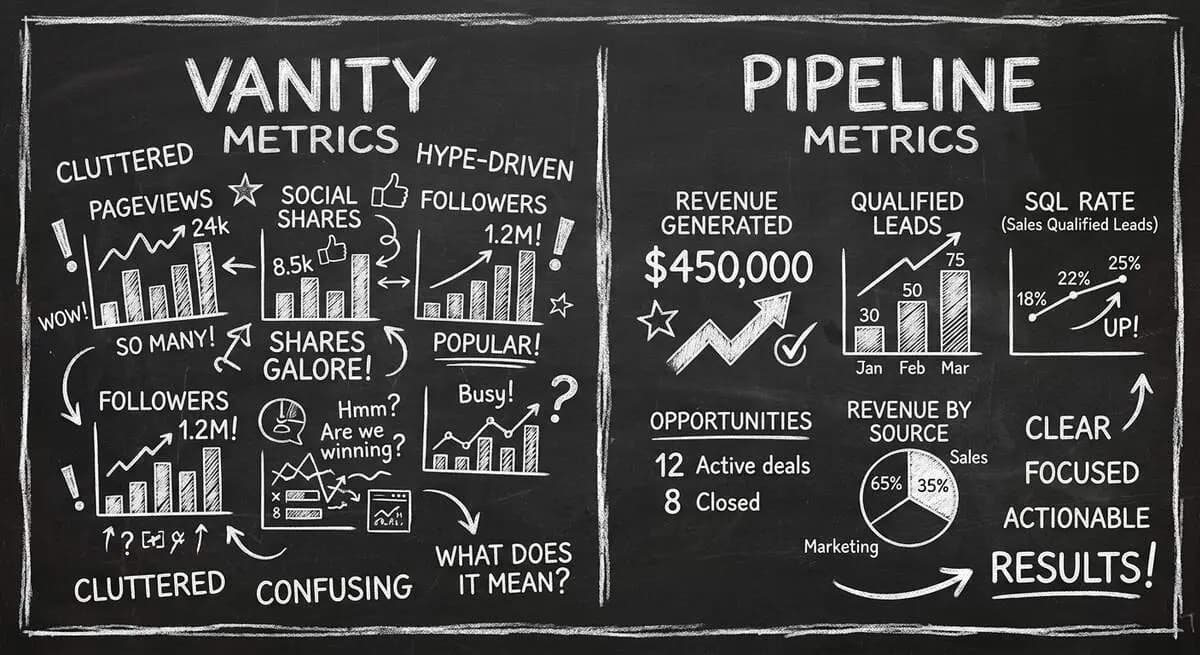
The core problem: agencies report on activity metrics (traffic, engagement, downloads) while clients evaluate based on outcome metrics (pipeline, revenue, growth). These two measurement frameworks don't connect.
Here's what typically happens: Your agency sends a monthly report showing 50,000 pageviews (up 15%), 2,000 social shares, 500 email subscribers added, and 200 whitepaper downloads. Your client's CFO reads it and asks: "How much pipeline did this generate?" Silence.
The gap isn't your fault. For years, the content marketing industry told us that these metrics mattered. But in 2026, with AI tools commoditizing content production and budgets under scrutiny, activity metrics are no longer enough. You need to connect content to pipeline -- or lose the client.
The Content-to-Pipeline Measurement Framework
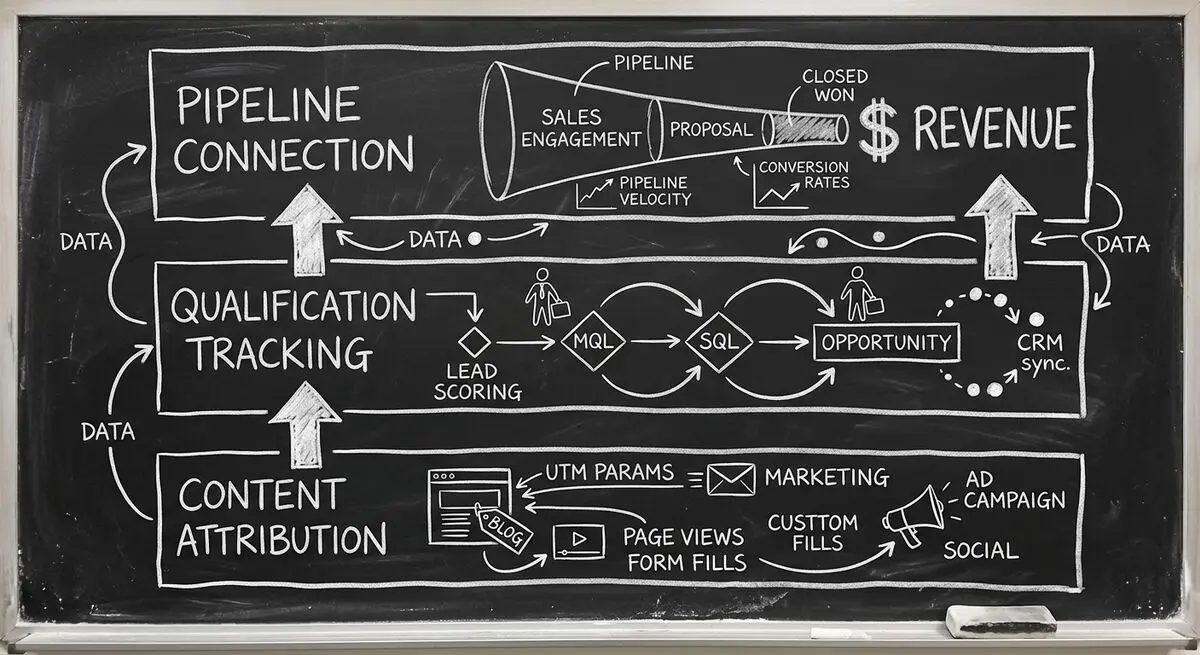
Proving content ROI requires three layers of measurement infrastructure:
Layer 1: Content Attribution
Track which content pieces a buyer interacts with before entering the pipeline. This requires first-touch tracking (which content first brought them to the site), multi-touch attribution (every content piece they consumed during their journey), and last-touch tracking (which content directly preceded conversion).
Layer 2: Qualification Tracking
This is where most agencies miss the crucial step. You need to track not just who consumed content, but who qualified themselves through an interactive assessment. When a visitor completes a qualification quiz, you capture their ICP fit score, their specific needs and pain points, their buying timeline, and their budget range -- all before they ever talk to sales.
Layer 3: Pipeline Connection
The final layer connects qualification data to CRM pipeline stages. When a lead moves from MQL to SQL to Opportunity to Closed-Won, you can trace back through every content touchpoint and qualification interaction. This is what lets you say: "Content piece X contributed to $Y in closed revenue."
Building the ROI Measurement Infrastructure
Here's the practical setup for proving content ROI to your B2B clients:
Step 1: Implement Interactive Qualification
Replace static forms with interactive quiz funnels built on Dashform. These capture qualification data that forms can't: ICP fit score, pain point identification, buying stage, and decision-maker status. Every completed assessment creates a rich data record you can track through the entire funnel.
Step 2: Connect Content to Qualification
Embed assessments in your highest-traffic content pages. Use UTM parameters and referral tracking to connect each qualification completion to the content piece that drove it. This creates a direct, trackable link between content consumption and lead qualification.
Step 3: Integrate with CRM
Push qualification data and content attribution into your client's CRM. When a sales rep opens a lead record, they should see: which content pieces the lead consumed, their qualification score and responses, the content piece that triggered the qualification, and the full timeline from first visit to qualification.
Step 4: Build the Revenue Dashboard
Create a reporting dashboard that shows: total content-assisted pipeline value (monthly and quarterly), qualified leads generated by content piece, average deal size for content-sourced vs other leads, content ROI ratio (pipeline generated / content investment), and time-to-pipeline by content type.
The ROI Presentation That Saves Client Relationships

Here's the exact framework for presenting content ROI to your client's executive team:
Open with pipeline, not traffic. "Last quarter, our content program generated $X in qualified pipeline and contributed to $Y in closed revenue." Lead with the number the CFO cares about.
Show the qualification funnel. "Of the 50,000 visitors our content attracted, 2,000 completed a qualification assessment. Of those, 400 scored as ICP-fit. Of those, 200 entered the sales pipeline. That's a 10% visitor-to-qualified rate."
Break down by content piece. "Our AI readiness assessment generated 150 qualified leads. The industry benchmark report contributed to 80. The weekly blog posts drove 170 assessment starts." This shows which content delivers ROI and which doesn't.
Compare to cost. "At $12,000/month investment, your cost per qualified lead from content is $30. Compare that to $150-250 for paid search and $75-125 for LinkedIn ads." Frame content as the most cost-effective pipeline channel.
Advanced: Measuring ROI from AI Agent Discovery
As more B2B buyers use AI agents for vendor research, you need to track pipeline that originates from AI discovery. With Agent Funnel technology, you can measure how many AI agents discover and interact with your client's qualification funnels, the completion rate for AI-mediated qualifications, and the lead quality and conversion rate for AI-sourced vs direct traffic.
This is a new frontier for content ROI measurement, and agencies that can demonstrate AI agent visibility ROI will have a significant competitive advantage. Run an AX Audit to baseline your client's AI visibility, implement Agent Funnel, then track the incremental pipeline from AI-sourced leads.
What ROI-Focused Agencies Are Actually Seeing
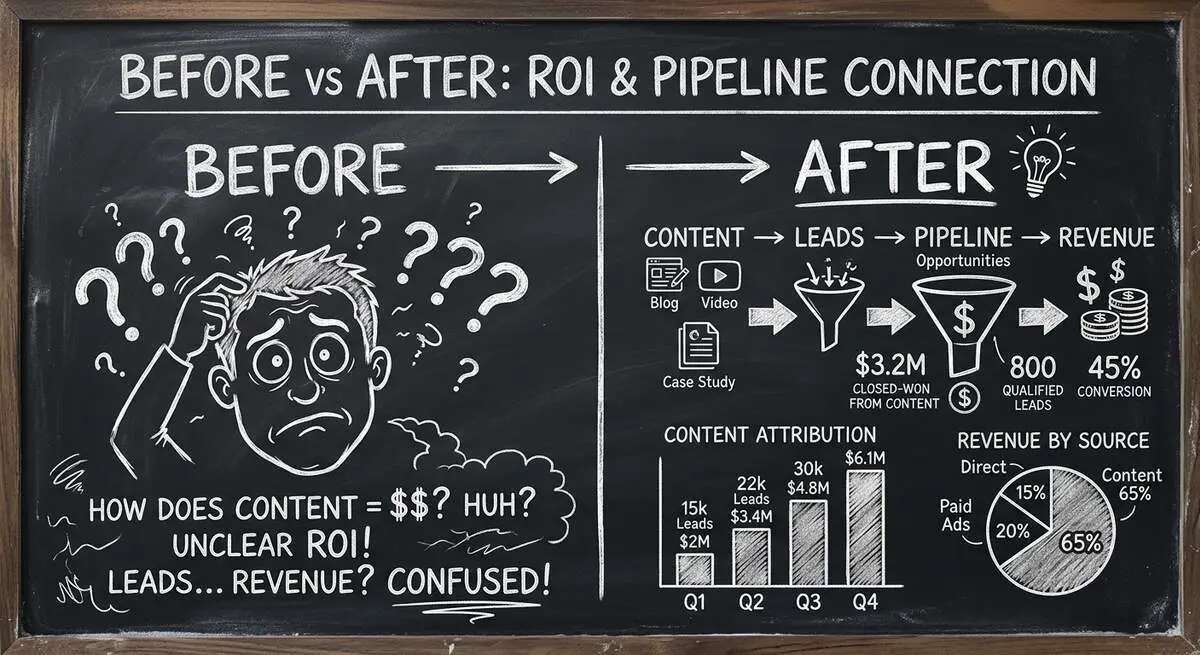
Agencies that have implemented this framework report consistent results. One B2B agency doubled their discovery call show rates within 60 days of adding interactive qualification to their clients' content. Another agency tripled qualified discovery calls by pre-qualifying leads before the sales handoff.
The common pattern: once you can show a direct line from content to qualified pipeline, the ROI conversation shifts from defensive to offensive. Instead of justifying your retainer, you're proposing expansion because the data shows clear, measurable returns.
The agencies thriving in 2026 don't avoid the ROI question. They welcome it -- because they've built the measurement infrastructure to answer it with confidence.
Frequently Asked Questions
How do I prove content marketing ROI to a B2B client?
Build a measurement infrastructure that connects content to pipeline. Replace static forms with interactive qualification funnels that capture ICP fit data, integrate with CRM to track leads through the pipeline, and report on content-assisted pipeline value rather than traffic metrics.
What metrics should I use to show content marketing ROI?
Focus on: content-assisted pipeline value, qualified lead volume, cost per qualified lead, lead-to-SQL conversion rate, and content-to-close cycle time. These are the metrics your client's CFO cares about. Pageviews and social shares are supporting data, not the headline.
Why can't my agency prove content ROI right now?
Most likely because you're missing the qualification layer. Without interactive assessments that score leads against ICP criteria, you can't distinguish valuable leads from noise. And without CRM integration, you can't trace content touchpoints to pipeline.
How long does it take to build content ROI measurement infrastructure?
Allow 30-60 days. The first two weeks cover assessment design and implementation on Dashform. Weeks 3-4 handle CRM integration and attribution setup. By month 2, you'll have enough data to present a meaningful ROI report.
What tools do I need to prove content ROI?
Dashform for interactive qualification funnels and lead scoring, your client's CRM (HubSpot, Salesforce, etc.) for pipeline tracking, Google Analytics or similar for traffic attribution, and a reporting dashboard tool for visualization.
How do I transition from reporting on traffic to reporting on pipeline?
Don't drop traffic metrics cold -- add pipeline metrics alongside them for one quarter. As the pipeline data accumulates, gradually shift the emphasis in your reports. By quarter two, lead with pipeline numbers and use traffic as supporting context.
What if my client's content genuinely isn't generating pipeline?
That's actually useful data. Use the qualification funnel to diagnose where the breakdown is: Is content reaching the wrong audience? Are visitors not engaging with assessments? Are qualified leads not converting to sales? The measurement infrastructure tells you where to fix the problem, not just that there is one.