

'SaaS is dead.' You've probably seen this headline a dozen times in 2026. The narrative goes like this: AI is eating SaaS, per-seat pricing is collapsing, and the era of $10B unicorns built on subscription software is over. And you know what? There's some truth to it.
But here's the real story: SaaS isn't dead. It's evolving. The old playbook—build generic software, charge per seat, pray for viral growth—is dying. But a new playbook is emerging, and it's built on AI-powered product-led growth (PLG), usage-based pricing, and intelligent qualification funnels.
The SaaS companies winning in 2026 aren't fighting the AI wave. They're riding it. And one of the key tools in their arsenal is quiz funnels that qualify users before the free trial, ensuring product-market fit from day one.
Traditional SaaS vs Product-Led Growth with Quiz Funnels
| Metric | Traditional SaaS Sales | PLG with Quiz Funnels |
|---|---|---|
| Customer Acquisition Cost | $200-500 | $20-80 |
| Time to First Value | Days (demo + onboarding) | Minutes (quiz result) |
| Free-to-Paid Conversion | 2-5% | 10-25% |
| Sales Team Required | Yes — SDR + AE | Minimal — self-serve |
| Lead Qualification | Manual scoring | AI auto-scoring |
| User Activation Rate | 20-40% | 60-80% |
| Viral Coefficient | Low | High (shareable quizzes) |
Want to see AI lead qualification in action? Try Dashform's AI form builder for free, or explore our template gallery.
OpenAI's COO Says 'AI Hasn't Penetrated Enterprise Yet'—But It's Coming Fast
In a recent interview, OpenAI's COO Brad Lightcap made a striking comment: 'AI hasn't really penetrated enterprise yet.' He's right. Despite all the hype, most large enterprises are still in the experimentation phase with AI. Pilot projects, proof-of-concepts, small-scale deployments—but not full-scale transformation.
But that's changing in 2026. The February 2026 AI model releases (GPT-5.3, Gemini 3.1 Pro, Claude Opus 4.6) have pushed AI capabilities to the point where enterprises can confidently deploy at scale. And when that happens, traditional SaaS companies are in trouble.
Why? Because AI can automate many of the workflows that SaaS tools currently handle. Customer support? AI agents. Data analysis? AI-powered BI tools. Lead qualification? AI quiz funnels. The value proposition of traditional SaaS—software that makes workflows more efficient—is being disrupted by AI that eliminates workflows entirely.
This doesn't mean SaaS is doomed. It means SaaS companies need to evolve. They need to embed AI into their products, shift to usage-based pricing models that align with customer value, and adopt product-led growth strategies that focus on demonstrating value before asking for payment.
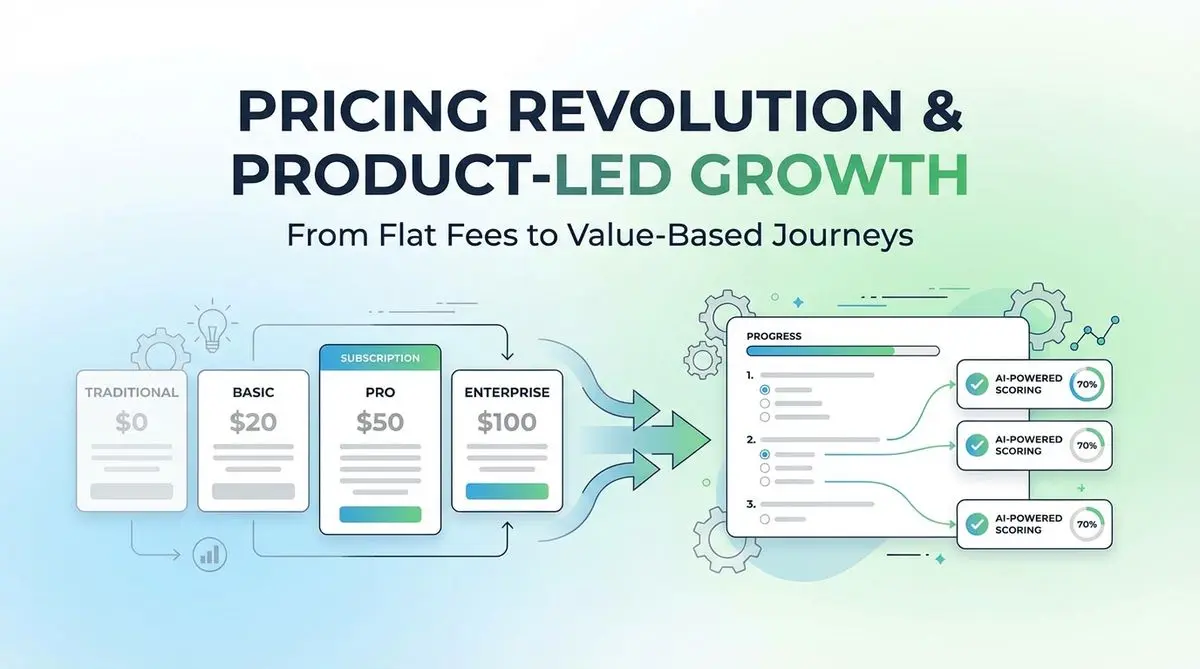
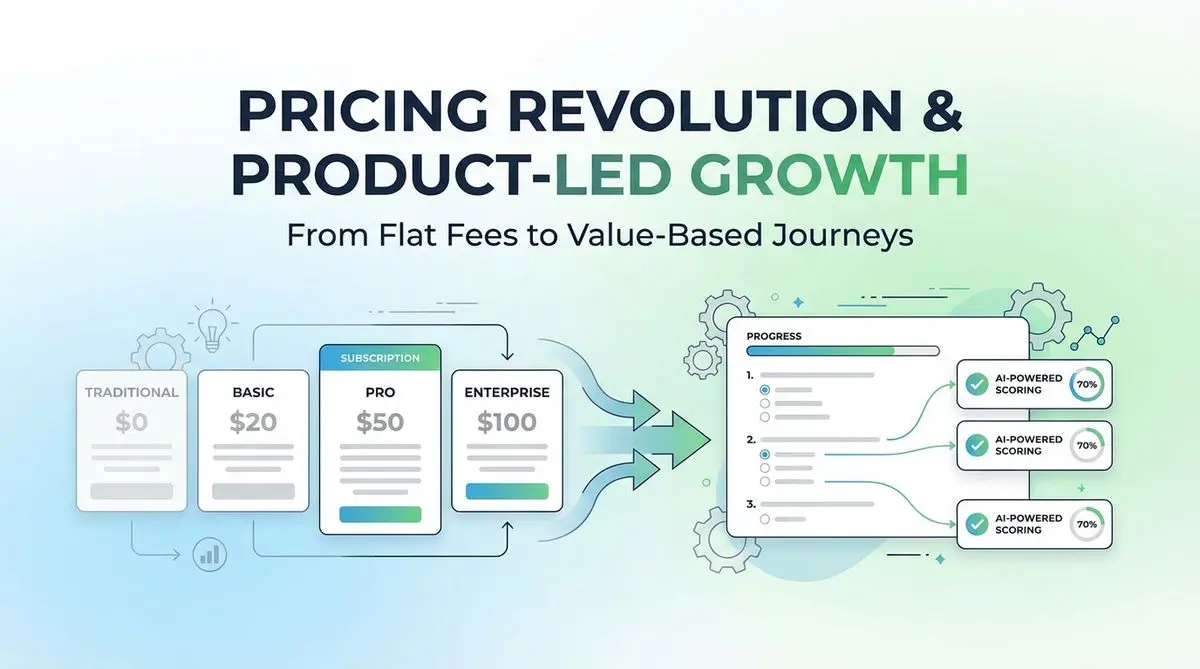
The SaaS Pricing Revolution: Per-Seat → Usage-Based → Results-as-a-Service
Let's talk about how SaaS pricing is evolving in 2026:
Per-seat pricing (dying): The traditional model where you pay $10/user/month is collapsing. Why? Because AI tools often don't have 'users' in the traditional sense. An AI agent that qualifies leads doesn't need a seat license. It just runs.
Usage-based pricing (rising): Pay for what you use. If you process 1,000 leads, you pay for 1,000 leads. If you process 10,000, you pay for 10,000. This model aligns cost with value and scales naturally with business growth.
Results-as-a-Service (emerging): The most disruptive pricing model. Instead of paying for software or usage, you pay for outcomes. 'We'll qualify 100 leads for you this month for $500.' If the software doesn't deliver, you don't pay. This model is terrifying for traditional SaaS companies but incredibly attractive to customers.
The companies winning in 2026 are those that embrace usage-based or results-based pricing. It requires rethinking product architecture, billing systems, and value propositions—but it's essential for survival in the AI era.
PLG 2.0: AI-Powered Onboarding, Lead Scoring, and Churn Prediction
Product-led growth (PLG)—the strategy where the product itself drives acquisition, conversion, and expansion—has been the dominant SaaS growth model for the past five years. Slack, Notion, Figma, and Calendly all used PLG to achieve massive scale.
But PLG 1.0 had problems: free trials with 2-5% conversion rates, users who sign up but never activate, and poor product-market fit leading to high churn.
PLG 2.0 solves these problems with AI:
AI-powered onboarding: Instead of generic product tours, AI agents guide new users through personalized onboarding based on their role, use case, and goals. 'I see you're a marketing manager at a B2B SaaS company. Let me show you how to set up your first email campaign.'
Intelligent lead scoring: AI analyzes user behavior during the trial to predict who's likely to convert and who's likely to churn. High-intent users get sales outreach. Low-intent users get automated nurture emails.
Churn prediction: AI identifies users at risk of churning before they hit the cancel button. The system can trigger automated intervention—personalized emails, feature highlights, or human outreach.
The result? PLG 2.0 converts 10-15% of free trial users, compared to 2-5% for PLG 1.0. The product is still the primary growth driver, but AI amplifies its effectiveness.
The Problem: Free Trials Have Terrible Conversion Rates
Let's be honest about free trials. The traditional SaaS free trial—'Sign up now, no credit card required, 14 days free'—has abysmal conversion rates. Industry average is 2-5%. That means 95-98% of people who sign up for your free trial never become paying customers.
Why? Because most free trial users aren't qualified. They're tire-kickers, competitors doing research, students exploring tools for a school project, or people who saw your ad and clicked out of curiosity. They were never going to buy.
The problem is that SaaS companies treat every sign-up equally. They spend resources onboarding, supporting, and following up with users who have zero intent to purchase. It's a waste of time and money.
The solution? Qualify users before they start the trial.
Solution: Quiz Funnels Before the Trial—Qualify Users on Use Case, Budget, and Timeline
Here's the new playbook for SaaS companies in 2026: instead of letting anyone sign up for a free trial, require prospects to complete a qualification quiz first. The quiz asks questions about:
Use case: What problem are they trying to solve? Is your product the right fit?
Team size: Are they a solo founder or a 50-person team? This determines pricing tier and sales approach.
Budget: What's their budget range? If they say $50/month and your product costs $500/month, they're not qualified.
Timeline: Are they ready to make a decision now, or just exploring options? Immediate buyers get trial access. Researchers get nurture content.
Technical requirements: Do they have the integrations, data sources, or technical setup required for your product to work?
Based on their responses, the quiz routes users to different paths:
Qualified, high-intent users: Immediate free trial access + personalized onboarding + sales outreach.
Qualified, low-intent users: Free trial access + automated email nurture sequence.
Unqualified users: Polite message explaining why they might not be a fit + alternative resources or product recommendations.
The result? Your free trial is now filled with qualified, interested prospects rather than random internet users. Conversion rates jump from 2-5% to 10-20%.
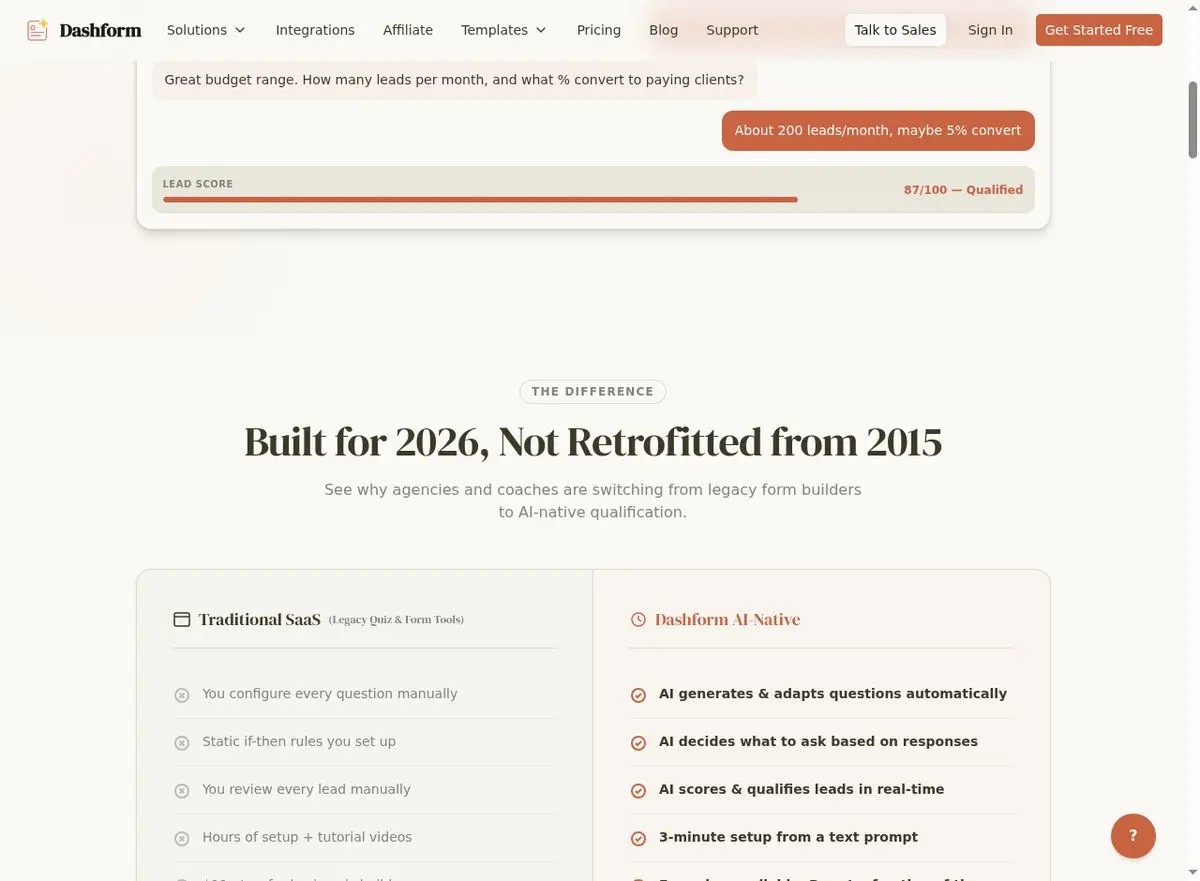
Dashform for SaaS: Generate a Product-Fit Quiz That Routes Users Intelligently
This is exactly what Dashform does for SaaS companies. You describe your product, target customer, and qualification criteria, and Dashform's AI generates a complete product-fit quiz in 3 minutes.
Here's how it works:
Step 1: Describe your SaaS product. Tell Dashform about your product's use case, ideal customer profile, pricing, and must-have qualification criteria.
Step 2: AI builds the quiz. Dashform generates a multi-step quiz with questions about use case, team size, budget, timeline, and technical requirements.
Step 3: Set up routing logic. Define what happens for each qualification outcome. Qualified users get free trial access, unqualified users get nurture content or alternative recommendations.
Step 4: Embed and launch. Replace your generic 'Start Free Trial' button with a 'Take Product-Fit Quiz' button. Users complete the quiz, and qualified leads are automatically sent to your product signup flow or CRM.
The impact is immediate. Instead of 95% of your free trial users being unqualified, 80-90% are now qualified and genuinely interested. Your onboarding team can focus on helping people who are actually going to buy.
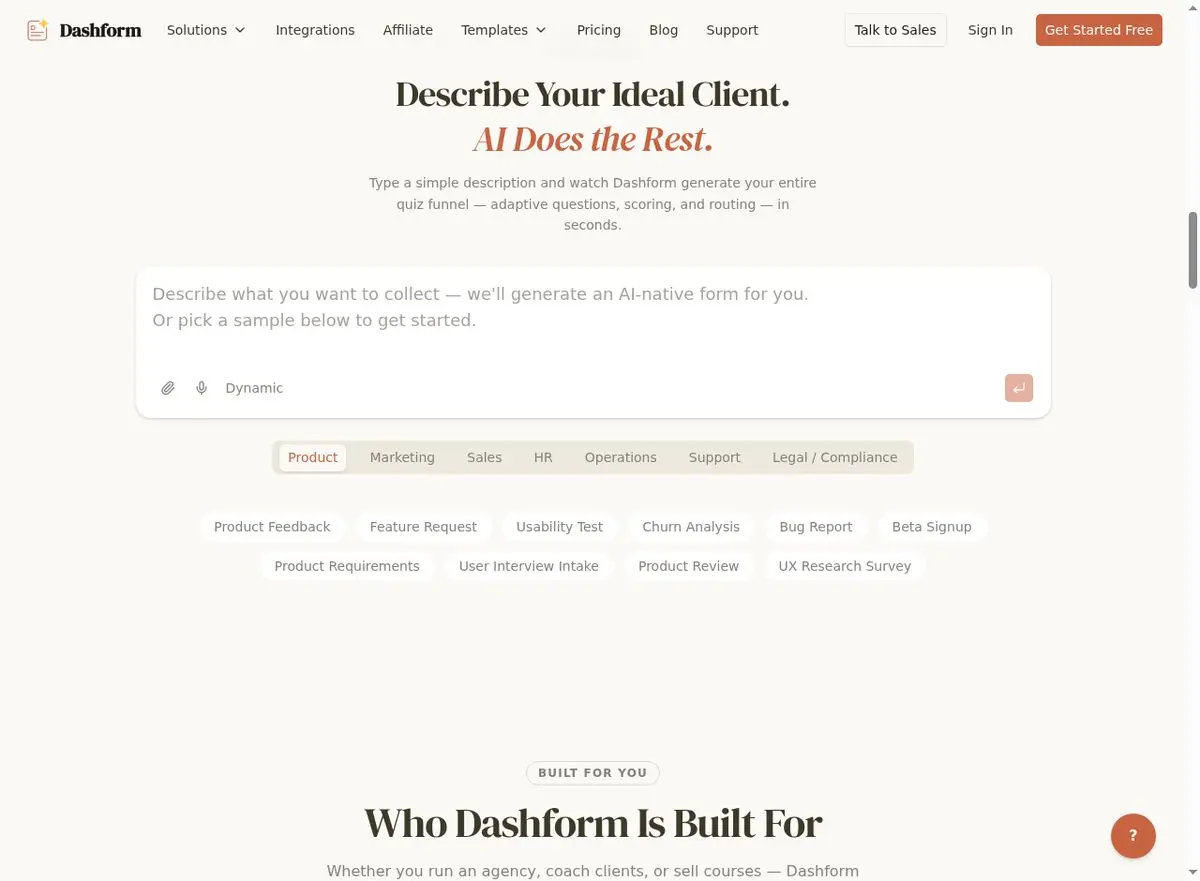
The Micro SaaS Trend: Niche Tools Beating All-in-One Platforms
One of the most interesting trends in SaaS in 2026 is the rise of micro SaaS—small, focused tools built for specific niches. These products do one thing really well, rather than trying to be everything to everyone.
Examples:
A SaaS tool that only does AI-powered lead qualification for solar installers.
A tool that only manages client intake for fitness coaches.
A tool that only tracks product usage metrics for PLG SaaS companies.
Why is micro SaaS winning? Because all-in-one platforms (HubSpot, Salesforce, Monday.com) are bloated, expensive, and over-engineered for most users. Micro SaaS tools are faster, cheaper, and easier to use. They focus on solving one specific problem really well.
For micro SaaS companies, quiz funnels are even more important than for traditional SaaS. Why? Because micro SaaS products are hyper-targeted. You don't want just any user—you want the exact right user. A quiz ensures you're only attracting and onboarding people in your specific niche.
Related business growth articles: Solar Lead Generation | Fitness Coach AI Intake | Why Agencies Leave GoHighLevel.
Frequently Asked Questions
Q: Won't requiring a quiz before the free trial hurt conversion rates?
A: It depends on what you're measuring. Yes, fewer people will complete the quiz than would click a 'Start Free Trial' button. But the people who do complete it are far more qualified. Your trial-to-paid conversion rate will skyrocket, which is the metric that actually matters. Would you rather have 1,000 unqualified trial users with a 2% conversion rate (20 customers), or 300 qualified users with a 15% conversion rate (45 customers)? Quality over quantity.
Q: What do we do with people who don't qualify? Just reject them?
A: No. You create nurture paths. If someone doesn't qualify because their team is too small, offer them a lower-tier product or a self-serve option. If they're not ready to buy yet, add them to an email sequence with educational content. If they're in the wrong market, recommend an alternative product. The quiz isn't about rejection—it's about routing people to the right path.
Q: Can quiz funnels work for enterprise SaaS, or is this only for SMB products?
A: Quiz funnels work great for enterprise SaaS, but the use case is slightly different. For enterprise, the quiz is used to qualify leads for demo requests rather than free trials. You ask about company size, use case, budget, decision timeline, and technical requirements. Qualified leads book a demo with a sales rep. Unqualified leads are routed to self-serve resources or nurture campaigns. This ensures your sales team only spends time with legitimate enterprise prospects.
Conclusion: SaaS Isn't Dead, It's Evolving
The 'SaaS is dead' narrative is overblown. Yes, traditional SaaS is under pressure from AI. Yes, per-seat pricing is collapsing. Yes, customers are demanding more value for less money. But SaaS companies that adapt will thrive.
The winning formula in 2026: AI-powered products, usage-based pricing, product-led growth with intelligent qualification, and a focus on niche markets rather than trying to be everything to everyone.
Quiz funnels are a critical piece of this puzzle. They ensure you're attracting and onboarding the right users, not just any users. If you're building or growing a SaaS product in 2026, you need Dashform. Generate your product-fit quiz in 3 minutes and start qualifying users the smart way.
For SaaS growth benchmarks, OpenView's SaaS Benchmarks Report shows that product-led growth companies grow 30% faster. See also Bessemer's State of the Cloud for industry context.
Related Reading
Best Typeform Alternative for Lead Generation in 2026
The February 2026 AI Model War: What It Means for Your Business
How to Create a High-Converting AI Quiz Lead Magnet