

Five frontier AI models shipped in one week of February 2026: GPT-5.3-Codex (OpenAI), Gemini 3.1 Pro (Google), Claude Opus 4.6 (Anthropic), DeepSeek V4 (DeepSeek), and Grok 4.20 (xAI). The most competitive week in AI history.
What changed in seven days isn't just benchmark scores. Every major lab now ships agents that browse, reason multi-step, and act through tools — and the gap between "experimental" and "production-ready" closed for the first time. Here's the side-by-side breakdown of what each model is best at, where the bets differ, and the practical capabilities that matter for builders shipping AI features in 2026.
February 2026 AI Model Comparison: Key Capabilities
| Capability | GPT-5 | Gemini 3.1 | Claude Opus 4.6 |
|---|---|---|---|
| Multimodal Input | Text, Image, Audio, Video | Text, Image, Audio, Video | Text, Image |
| Context Window | 256K tokens | 2M tokens | 200K tokens |
| Coding Ability | Excellent | Very Good | Excellent |
| Reasoning | Advanced | Advanced | Best-in-class |
| Tool Use / MCP | Function calling | Native MCP | Native MCP |
| Business Use Case | General AI apps | Data + enterprise | Agent workflows |
| Best For Forms/Leads | Good | Good | Excellent (with Dashform MCP) |
The February 2026 AI Model Releases: A Rapid-Fire Breakdown
Let's quickly recap what was released and why it matters:
GPT-5.3-Codex (OpenAI): Enhanced reasoning and coding capabilities, with a focus on multi-step problem solving and code generation. OpenAI claims 40% improvement in coding benchmarks over GPT-4.5.
Gemini 3.1 Pro (Google): Google's answer to GPT-5, with native multimodal capabilities (text, image, video, audio) and ultra-long context windows (2 million tokens). Positioned as the 'enterprise AI' for Google Cloud customers.
Claude Opus 4.6 (Anthropic): Focused on nuanced reasoning, safety, and instruction following. Anthropic emphasizes Claude's ability to handle ambiguous business scenarios where precision and ethics matter.
DeepSeek V4 (DeepSeek): The open-source disruptor. DeepSeek V4 is released with permissive licensing, making it attractive for companies that want full control and on-premise deployment.
Grok 4.20 (xAI): Elon Musk's xAI released Grok 4.20 with real-time web access and 'anti-woke' positioning. Performance benchmarks are competitive, but adoption is primarily in X (formerly Twitter) ecosystem.
What's remarkable isn't just that five frontier models were released in one week—it's that they're all genuinely good. We're not talking about incremental improvements. Each model represents a significant leap in capability, reliability, and usability.
What This Means for Businesses: AI Agents Are Production-Ready
For the past two years, businesses have been hearing about AI agents—autonomous systems that can complete multi-step tasks without human intervention. Book a meeting, qualify a lead, update a CRM, send follow-up emails. In theory, it sounded great. In practice, it was flaky. The models weren't reliable enough, the error rates were too high, and the cost was prohibitive.
That changed in February 2026. The new generation of AI models—GPT-5.3, Gemini 3.1 Pro, Claude Opus 4.6—are reliable enough for production use.
What does 'production-ready' mean in practical terms?
Error rates below 2%: When an AI agent qualifies a lead or schedules a meeting, it gets it right 98%+ of the time. That's acceptable for business use.
Cost efficiency: Per-token pricing has dropped dramatically. Running an AI agent to qualify 1,000 leads now costs under $10, compared to $100+ six months ago.
Speed: Response times are under 2 seconds for most tasks. Fast enough for real-time customer interactions.
Integration: The Model Context Protocol (MCP), now adopted by OpenAI, Google, Anthropic, and others, makes it trivial to connect AI agents to business tools like CRMs, calendars, and support systems.
This is the inflection point. AI agents are no longer experimental—they're tools you can (and should) deploy today.
The MCP Protocol: Universal AI-to-Tool Connection
One of the most underrated developments in the February 2026 AI release cycle is the widespread adoption of the Model Context Protocol (MCP). Initially developed by Anthropic, MCP is now supported by OpenAI, Google, DeepSeek, and other major AI providers.
What is MCP? Think of it as a universal plug for AI agents. Before MCP, connecting an AI model to external tools (CRMs, calendars, payment systems) required custom integrations for each model and each tool. It was a mess.
MCP standardizes how AI models access external data and tools. A single MCP integration now works across GPT-5, Gemini 3.1, Claude Opus 4.6, and others. This is huge for businesses, because it means you're not locked into one AI provider. You can switch models based on performance, cost, or capability without rebuilding integrations.
Practical example: Let's say you're using an AI agent to qualify leads and book consultations. With MCP, the agent can access your CRM (HubSpot, Salesforce, GoHighLevel), your calendar (Google Calendar, Outlook), and your payment system (Stripe) using a single protocol. If you decide to switch from GPT-5 to Claude Opus for cost reasons, the integrations don't break. Everything keeps working.
MCP is the infrastructure layer that makes AI agents practical for business. It's not flashy, but it's essential.
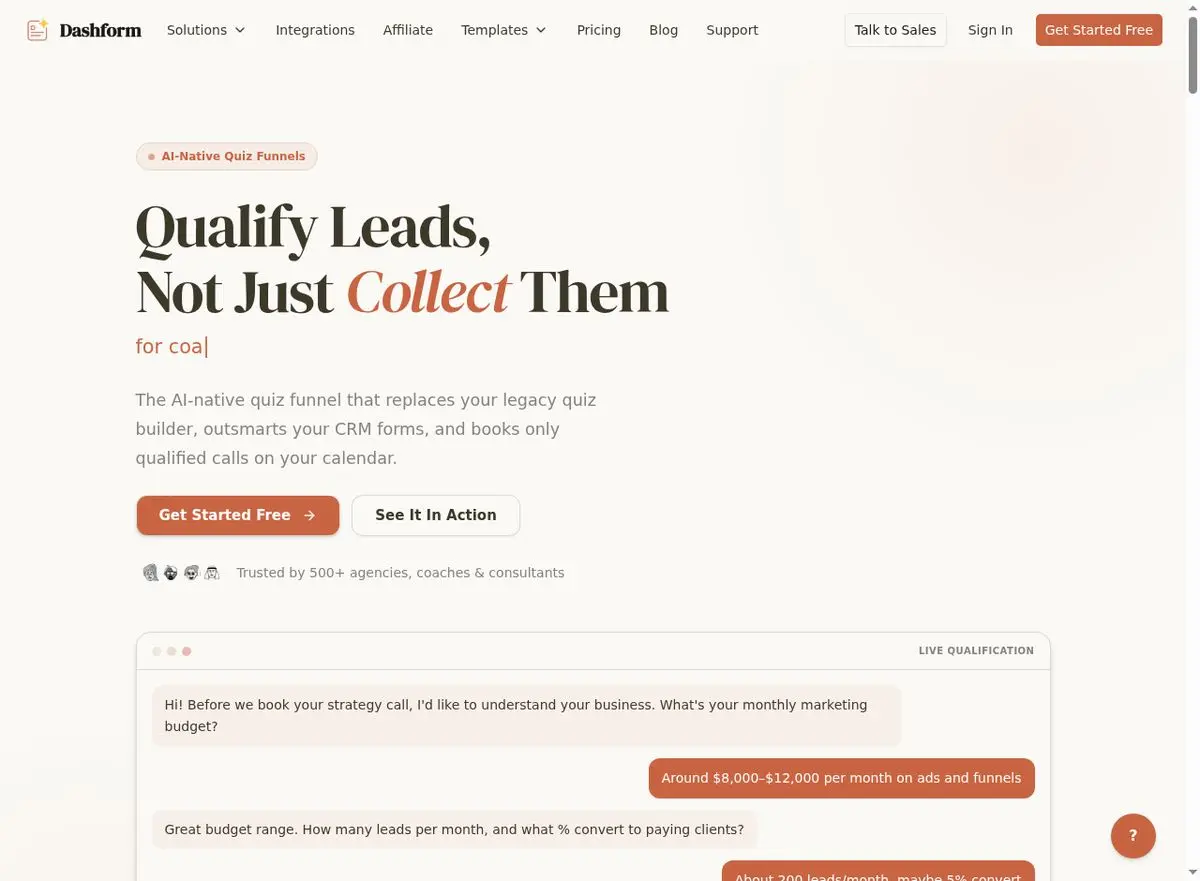
Practical Impact: AI Agents Handling Lead Qualification, Scheduling, and Follow-Ups
Let's talk about what this actually looks like in practice. Businesses using AI agents in February 2026 are automating workflows that were manual just six months ago:
Lead qualification: An AI agent asks prospects a series of qualifying questions via a chat interface or quiz funnel. Based on the responses, the agent determines if the prospect is qualified and routes them to the appropriate next step (calendar booking, nurture email, sales rep hand-off).
Scheduling: The agent checks your calendar availability in real-time and books meetings directly with qualified prospects. No back-and-forth emails, no scheduling links that expire.
Follow-ups: If a prospect doesn't respond or complete the intake process, the agent sends personalized follow-up messages. Not generic templates—actual personalized messages based on where the prospect dropped off.
Customer support: AI agents are handling tier-1 support inquiries (password resets, billing questions, feature explanations) with 95%+ accuracy, escalating complex issues to human agents.
The common thread: these are all tasks that used to require human labor but are now reliably automated. The February 2026 AI models are good enough to handle these workflows at scale, with minimal human oversight.
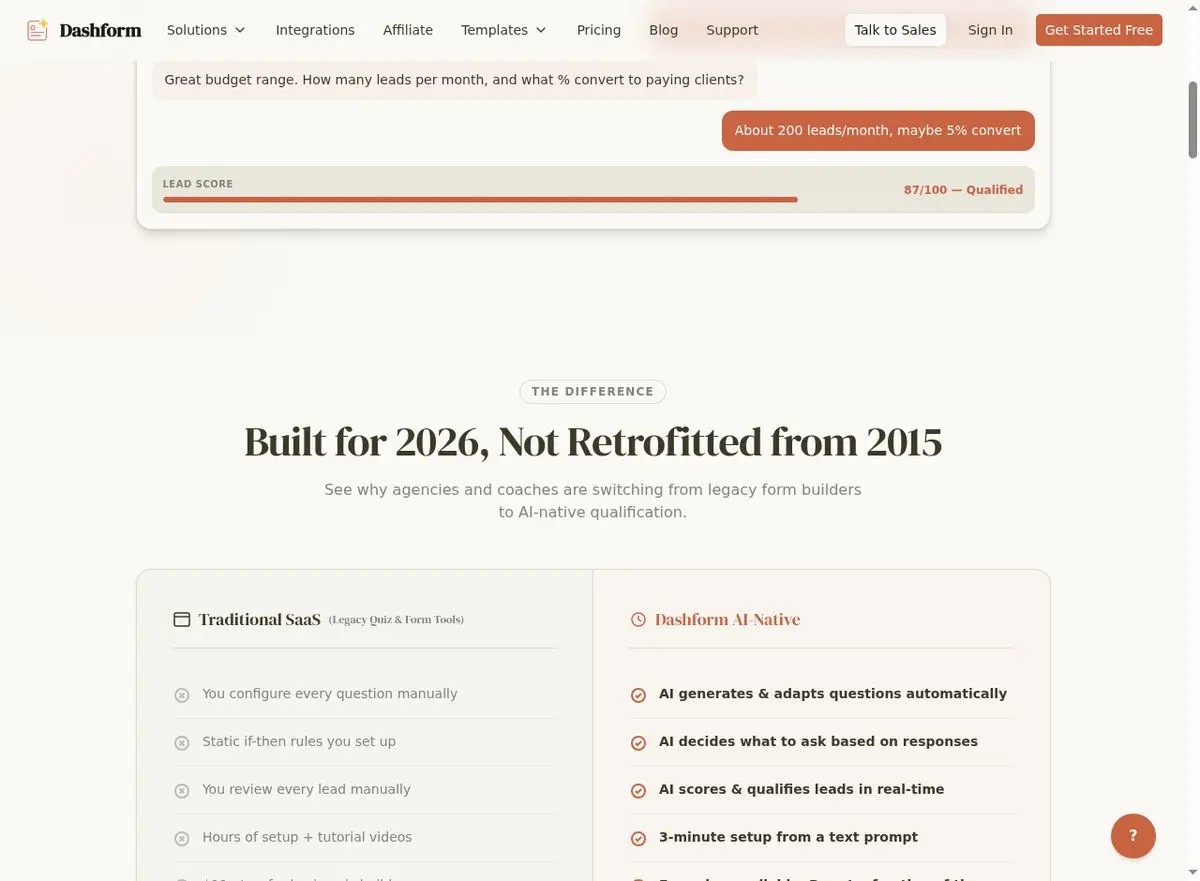
How Dashform Leverages the New AI Models
This is where Dashform comes in. Dashform is an AI-native quiz funnel builder that leverages the latest AI models (GPT-5.3, Claude Opus 4.6, Gemini 3.1) to create intelligent lead qualification funnels.
Here's what makes Dashform different from traditional quiz builders:
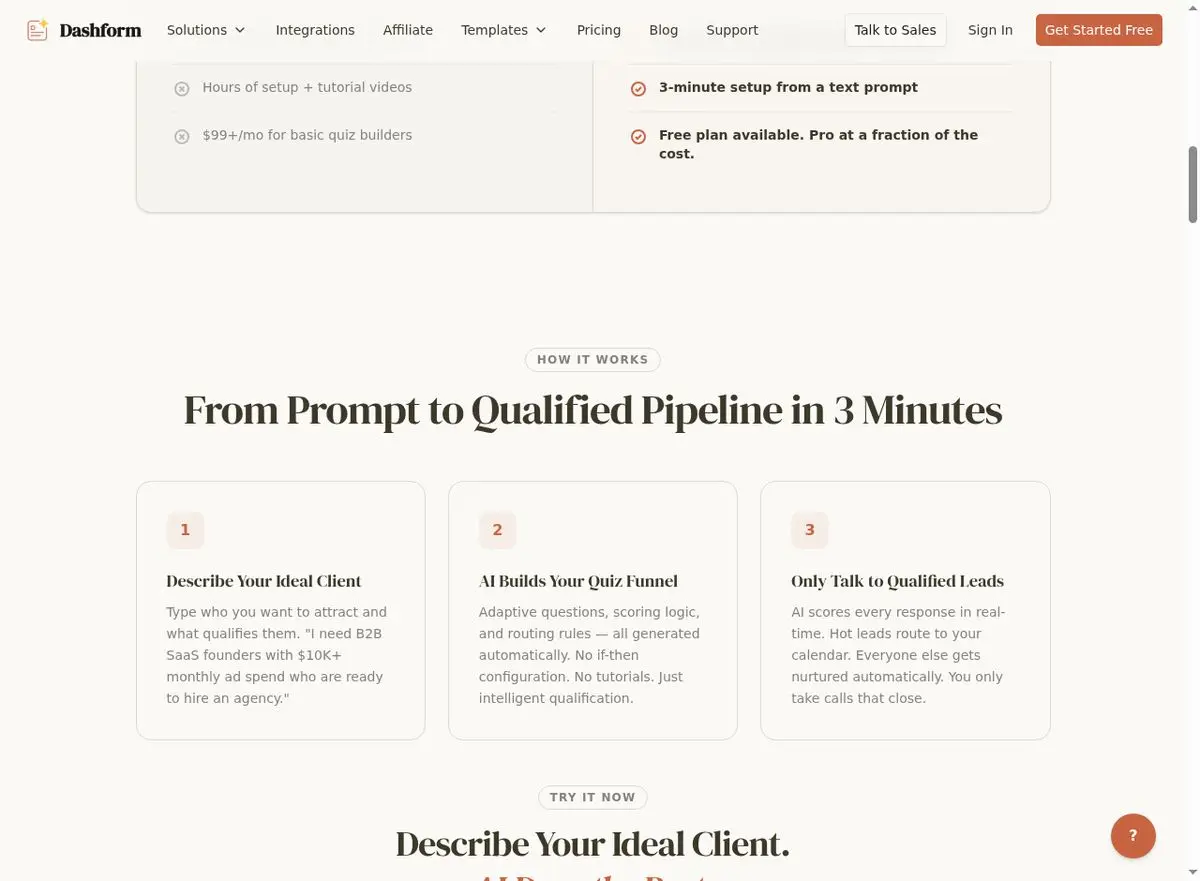
AI-generated quizzes: You describe your business, and the AI builds a complete quiz funnel in 3 minutes. No manual question writing, no guessing at what to ask.
Dynamic question paths: The AI adapts questions in real-time based on previous responses. If a prospect says they're budget-conscious, the quiz adjusts to focus on ROI and value rather than premium features.
Multi-model support: Dashform supports GPT-5.3, Claude Opus 4.6, and Gemini 3.1. You can switch between models based on cost, speed, or performance needs. Thanks to MCP, integrations work across all models.
Automated lead routing: Qualified leads are automatically sent to your CRM or calendar. Unqualified leads go to nurture sequences. No manual data entry.
The February 2026 AI model releases make Dashform dramatically more powerful. The quizzes are smarter, the responses are more accurate, and the cost is lower. This is what 'AI-native' means—built from the ground up to leverage the latest AI capabilities.
Stop Waiting for AI to Be 'Ready'—It's Here Now
One of the biggest mistakes businesses are making in 2026 is waiting. Waiting for AI to be more reliable, waiting for prices to drop further, waiting for best practices to emerge. Meanwhile, their competitors are deploying AI agents today and capturing market share.
The February 2026 AI model releases are the signal: AI is ready. Not 'almost ready' or 'getting there.' Ready. Right now.
If you're running a business that involves lead generation, sales, customer support, or any form of customer interaction, you should be deploying AI agents this month. Not next quarter, not next year. Now.
The barriers that existed six months ago—cost, reliability, complexity—are gone. The tools are accessible, the pricing is reasonable, and the error rates are acceptable. The only barrier now is inertia.
Related business growth articles: Solar Lead Generation | Fitness Coach AI Intake | SaaS Quiz Funnels.
Frequently Asked Questions
Q: Which AI model should I use—GPT-5, Claude Opus 4.6, or Gemini 3.1?
A: It depends on your use case. GPT-5.3-Codex excels at coding and structured data tasks. Claude Opus 4.6 is best for nuanced reasoning and safety-critical applications. Gemini 3.1 Pro shines with multimodal inputs and ultra-long context. The good news is that with MCP, you can switch between models without rebuilding integrations, so you can experiment and optimize based on performance and cost.
Q: Are AI agents going to replace human sales and support teams?
A: Not entirely, but they will dramatically change what humans spend time on. AI agents handle tier-1 tasks (lead qualification, basic support, scheduling) so humans can focus on high-value activities (closing deals, handling complex issues, building relationships). Think of it as augmentation, not replacement.
Q: What if the AI makes a mistake and qualifies an unqualified lead or misses a qualified one?
A: Error rates for the February 2026 models are below 2%, which is acceptable for most business use cases. You can also set up human-in-the-loop workflows where high-value or edge-case leads are flagged for manual review. The key is that 98% of leads are handled automatically, freeing up your team to focus on the 2% that need human judgment.
Conclusion: The AI Model War Is Great for Business
The February 2026 AI model war—GPT-5.3, Gemini 3.1 Pro, Claude Opus 4.6, DeepSeek V4, Grok 4.20—isn't just a tech industry story. It's a business transformation story. The competition between OpenAI, Google, Anthropic, and others has driven AI capabilities to the point where agents are production-ready for business use.
If you're not deploying AI agents in your business right now, you're behind. The tools are ready, the pricing is reasonable, and the results are proven. Whether you're qualifying leads, scheduling consultations, or handling customer support, AI can do it reliably and at scale. Try Dashform to see how AI-native quiz funnels can transform your lead generation process.
For AI industry analysis, see Stanford's AI Index Report 2025 and McKinsey's State of AI Report.
Related Reading
Agentic AI and MCP Are Reshaping Business Automation in 2026
Dashform CLI: The First Form Builder Made for AI Agents
Dashform MCP: Let AI Agents Build Forms for You