


A potential customer asks ChatGPT: "Find me a massage therapist near downtown Austin with availability this Saturday under $150." The AI scans, compares, qualifies, and books -- all in under 30 seconds. No Google search. No scrolling through Yelp. No phone call.
This is not a hypothetical. According to BrightLocal's 2026 Local Consumer Review Survey, 45% of consumers now use AI tools like ChatGPT and Gemini to find and evaluate local businesses -- up from just 6% in 2025. That is a 7.5x increase in a single year.
If your business offers appointments, consultations, or bookings online, you are facing a fundamental shift in how customers find and choose you. The question is no longer whether you have a website. It is whether AI agents can find your website, understand your services, and complete a booking on behalf of the customer.
This article breaks down exactly what is happening, why most local businesses are invisible to AI, and the concrete steps you can take today to become "agent-bookable."
The AI Local Search Revolution at a Glance
| Metric | 2025 | 2026 | Change |
|---|---|---|---|
| Consumers using AI for local business discovery | 6% | 45% | +7.5x |
| Google's share of local search | 83% | 71% | -14.5% |
| Consumers who trust AI recommendations | -- | 40% | New metric |
| Consumers expecting 24/7 service availability | 61% | 74% | +21% |
| U.S. adults using AI for personal tasks | 32% | 54% | +69% |
Sources: BrightLocal 2026, Zendesk CX Trends 2026, PYMNTS 2026
The Shift: From Search Engines to AI Agents
For two decades, local businesses optimized for one thing: Google. Get on page one, collect reviews, and wait for the phone to ring. That playbook is not dead, but it is no longer enough.
Google's share of local business discovery dropped from 83% to 71% in a single year. Meanwhile, ChatGPT has become the third most popular way consumers discover local services, behind only Google and direct recommendations from friends and family.
What is driving this shift? Three things:
Speed. When someone asks an AI assistant to "find a dentist accepting new patients near me that takes Blue Cross insurance," they get a filtered, qualified answer in seconds. No scrolling through 10 blue links. No opening five tabs.
Specificity. AI agents handle complex, multi-criteria queries that search engines struggle with. "Find a spa in Manhattan with couples massage under $300 this Saturday" is a natural request for an AI assistant but nearly impossible to Google efficiently.
Action. The newest AI agents do not just find businesses -- they qualify, compare, and book. The consumer never visits your website. The agent does the work.

Why Most Local Businesses Are Invisible to AI Agents
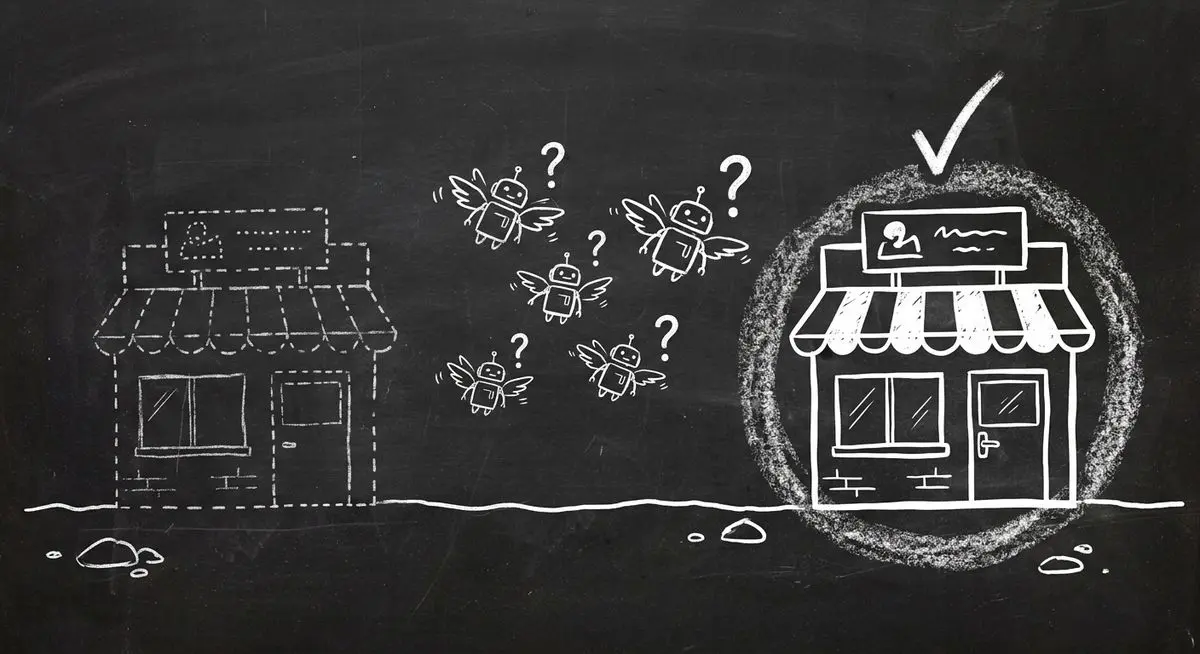
Here is the uncomfortable truth: even if your business ranks well on Google, it may be completely invisible to AI agents.
A recent audit of 100 business websites found that 93% scored below the threshold for AI agent readiness. The reasons are structural, not cosmetic.
No machine-readable service catalog. Your website might beautifully display your services with photos and pricing. But if that information is locked inside images, JavaScript animations, or PDF menus, an AI agent cannot parse it. Agents need structured data -- Schema.org markup, JSON-LD, or a programmatic API -- to understand what you offer.
AI crawlers are blocked. Many websites use robots.txt rules, CAPTCHAs, or bot-detection tools that block AI crawlers like GPTBot (OpenAI), ClaudeBot (Anthropic), and Google-Extended. If your site blocks these crawlers, AI assistants literally cannot see your business when generating recommendations.
No agent interaction layer. Even if an AI agent discovers your business, there is no way for it to take action. Your online booking form requires a human to fill it out -- clicking dropdowns, entering dates, solving CAPTCHAs. AI agents need programmatic endpoints, not web forms designed for human fingers.
Missing trust signals. AI models weigh review freshness heavily. BrightLocal's 2026 data shows that 74% of consumers want reviews written in the last 3 months, and 47% will not use a business with fewer than 20 reviews. AI agents apply similar logic when ranking recommendations.
The Agent Economy Is Already Here
This is not a trend to "watch." The infrastructure is already being built.
The global AI agents market was valued at $7.63 billion in 2025 and is projected to reach $182.97 billion by 2033 -- a 49.6% compound annual growth rate (Grand View Research). Major players are moving fast:
- Visa launched its "Agentic Ready" program, officially recognizing AI agents as a new class of transaction initiators.
- Google updated its Universal Commerce Protocol to enable agents to conduct transactions autonomously.
- Mastercard introduced parallel payment infrastructure for agent-initiated purchases.
- OpenAI, Google, Microsoft, and Amazon all adopted MCP (Model Context Protocol) as the standard for AI-to-service communication.
Accenture's 2025 Technology Vision report found that 77% of executives agree AI agents will fundamentally transform how their organizations develop digital systems. And 78% believe ecosystems must be designed for AI agents alongside human users within the next 3-5 years.
For local service businesses, this means one thing: the businesses that AI agents can find, evaluate, and book will get the customer. The ones that require a human to navigate their website will not.
How AI Agent Booking Actually Works
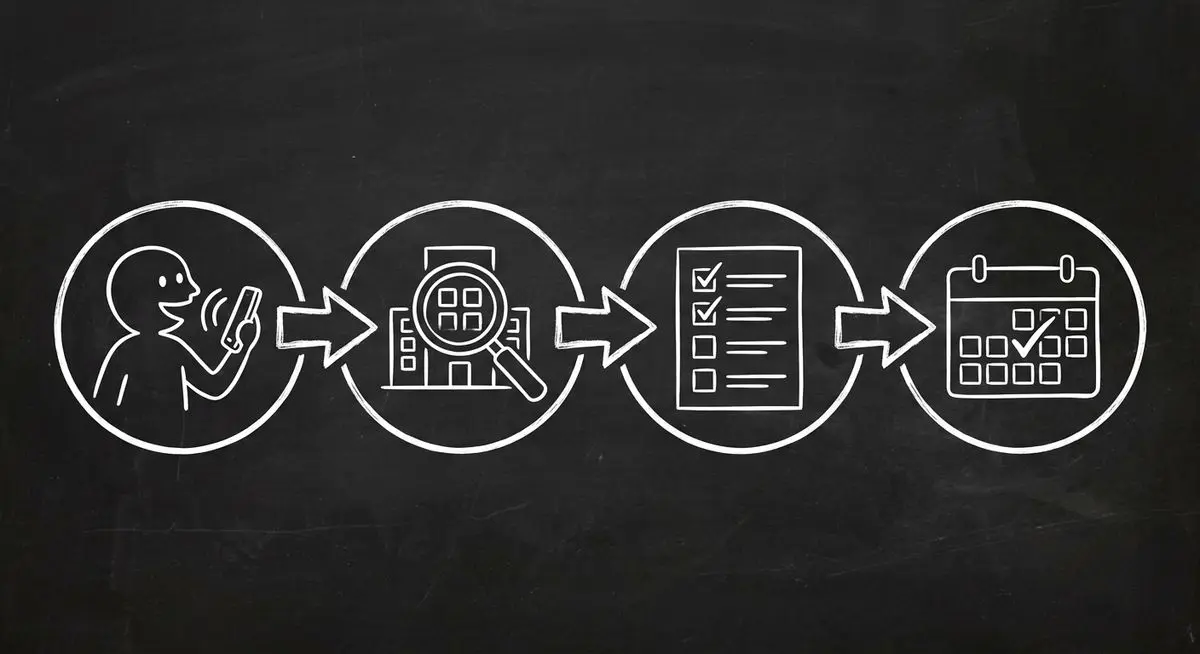
When an AI agent books a service on behalf of a consumer, it follows a clear four-step process:
Step 1: Discovery. The agent needs to find your business. This happens through multiple channels -- structured data on your website, business directories, marketplace registries, and machine-readable files like llms.txt and .well-known/mcp.json.
Step 2: Evaluation. The agent retrieves your business profile: what services you offer, pricing, location, availability, and languages spoken. It compares these against the consumer's criteria.
Step 3: Qualification. Before submitting a booking, the agent evaluates whether the consumer is a good fit for your business. Does their budget match your pricing? Is their location within your service area? Do you offer what they need?
Step 4: Booking. The agent submits a qualified lead or completes the booking programmatically. No form filling. No CAPTCHA. No human intermediary.
This flow is already possible with MCP-compatible platforms. Dashform's Agent Funnel feature turns any booking form into an MCP-accessible service -- AI agents can discover the business, browse services with pricing, run AI-powered lead qualification, and submit bookings. One toggle, no code required.
5 Things You Can Do Today to Become Agent-Bookable
You do not need to rebuild your website or hire a developer. Here are five actionable steps, ordered by impact:
1. Check Your AI Agent Readiness Score
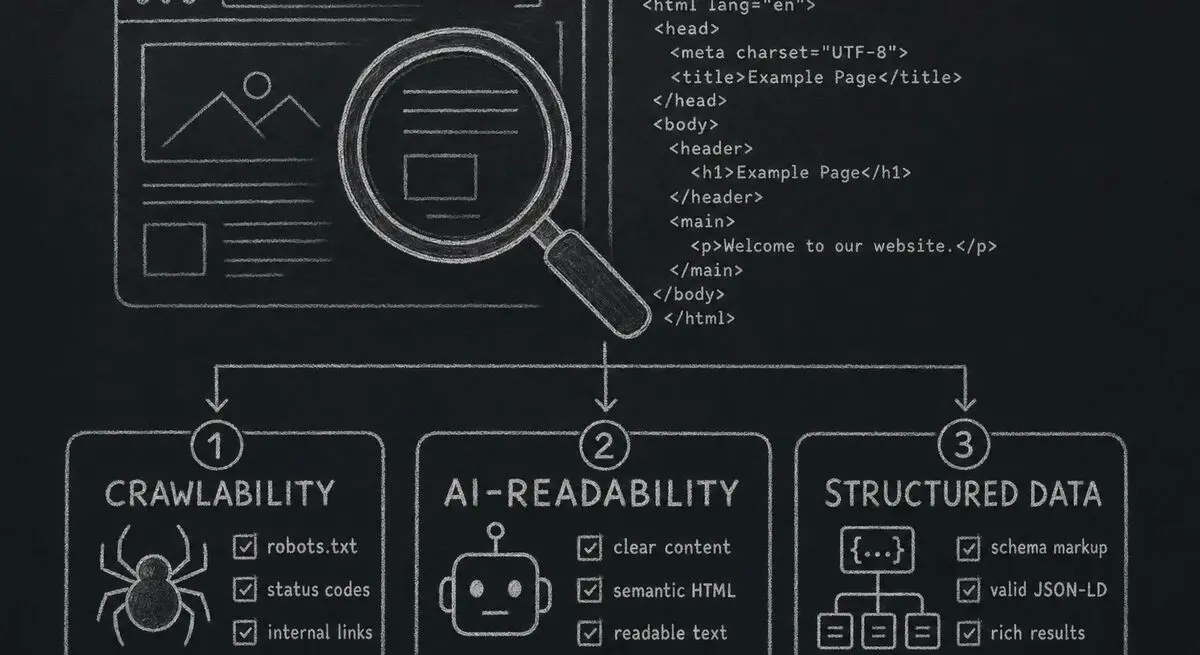
Before fixing anything, know where you stand. Dashform's free AX Audit tool scans your website and scores it on a 100-point scale across six dimensions: crawlability, structured data, content quality, agent interaction capability, discoverability, and security.
Think of it as Google Lighthouse, but for AI agents. Most businesses score below 30. The audit takes seconds and requires no signup.
2. Unblock AI Crawlers in Your robots.txt
Check if your robots.txt file is blocking these critical AI crawlers:
- GPTBot and ChatGPT-User (OpenAI)
- ClaudeBot and Claude-Web (Anthropic)
- Google-Extended and Gemini-Deep-Research (Google)
- PerplexityBot (Perplexity)
If you see "Disallow" rules for these user agents, remove them. Many website platforms and security tools block AI crawlers by default. Unblocking them is the single highest-impact action you can take.
3. Add Structured Data to Your Website
Add Schema.org JSON-LD markup that describes your business, services, and pricing in a format AI agents can parse. At minimum, include:
- LocalBusiness or relevant subtype (Spa, DentalClinic, HealthClub, etc.)
- Service markup with name, description, and price
- OpeningHoursSpecification for availability
- NAP (Name, Address, Phone) consistently formatted
This structured data tells AI agents what your business does, where you are, what you charge, and when you are open -- without requiring them to scrape and interpret your web pages.
4. Create an llms.txt File
The llms.txt file is the new robots.txt for AI models. It lives at the root of your domain (e.g., yourbusiness.com/llms.txt) and provides a plain-text summary of your business, services, and how AI agents should interact with you.
This is a simple text file that takes 10 minutes to write. It dramatically improves how AI assistants understand and recommend your business.
5. Enable Agent-Ready Booking
The biggest unlock is making your booking system programmatically accessible to AI agents. Traditional online booking forms (Calendly, Acuity, embedded website forms) require human interaction. AI agents cannot click buttons, select time slots, or solve CAPTCHAs.
Dashform's Agent Funnel solves this by adding an MCP (Model Context Protocol) layer to your booking funnel. When you enable it, any MCP-compatible AI agent -- Claude, ChatGPT, Gemini, and others -- can:
- Discover your business through six different discovery layers
- Browse your full service catalog with pricing
- Run AI-powered lead qualification (scoring leads 0-100 before they reach you)
- Submit qualified bookings programmatically
Setup takes under 5 minutes. You paste your website URL, the system auto-imports your business profile, and you toggle agent access on. Your services immediately become discoverable in Dashform's agent marketplace, where AI agents can browse by category, location, and keyword across 12 service categories.

What Happens If You Do Nothing
The data points to an acceleration, not a plateau. Consider:
- AI tool usage among consumers grew 7.5x in one year (BrightLocal)
- 54% of U.S. adults now use AI for personal tasks daily (PYMNTS)
- Automated (bot) traffic is growing 8x faster than human traffic (Search Engine Land)
- 74% of consumers expect 24/7 service availability (Zendesk)
The businesses that invest in AI agent readiness now will compound their advantage as agent-driven bookings grow. The ones that wait will find themselves competing for a shrinking pool of customers who still search the old way.
And the cost of getting started is essentially zero. Running an AX Audit is free. Updating your robots.txt takes 5 minutes. Adding structured data takes an afternoon. And enabling Agent Funnel is literally one toggle.
FAQ
Do AI agents actually book appointments right now?
Yes. MCP-compatible AI agents (including Claude, ChatGPT with plugins, and autonomous workflow agents) can already discover businesses, evaluate fit, and submit bookings through MCP endpoints. This is live technology, not a future concept.
Which AI assistants support MCP?
Claude (Anthropic), ChatGPT (OpenAI), Cursor, Windsurf, GitHub Copilot, Amazon Q, and dozens of developer tools support MCP. Google has announced MCP integration as well. The ecosystem is growing rapidly.
Will AI agents spam my booking system?
No. Agent Funnel includes AI-powered lead qualification that scores every lead from 0-100 before submission. Only qualified leads reach your inbox. Agent-sourced leads are actually higher quality than typical form fills because they are pre-screened against your specific criteria.
How much does it cost to make my business agent-bookable?
Dashform's Agent Funnel is included in all plans, starting with the free tier (1 funnel, 100 responses/month). Updating your robots.txt and adding structured data to your website costs nothing. Running an AX Audit is free with no signup required.
I already have Calendly/Acuity. Do I need to switch?
You do not need to replace your current booking tool. Dashform adds an agent-discovery and qualification layer on top of your existing workflow. Agent-submitted leads flow through your existing CRM, webhooks, and integrations (Google Sheets, Notion, Airtable, Zapier).
How do I track leads from AI agents?
Every lead submitted through an AI agent is tagged with source: "agent" in your Dashform dashboard. You can filter by source to compare agent-driven leads against direct form fills and see exactly which AI agents are driving business.
What industries benefit most from agent-ready booking?
Any service business that takes appointments or consultations: wellness spas, salons, dental clinics, fitness studios, real estate agents, home service providers, therapists, tutors, coaches, and consultants. If customers book you online, AI agents should be able to book you too.
The Bottom Line
45% of consumers are already using AI to find local services. That number is not going down. The businesses that AI agents can find, evaluate, and book will capture this growing demand. The ones that remain invisible to AI will not.
The good news: getting started takes minutes, not months. Check your AX Score, fix the basics (robots.txt, structured data, llms.txt), and enable agent-ready booking with Dashform's Agent Funnel. Your next customer might already be asking an AI assistant to find someone exactly like you.