
Key Takeaways
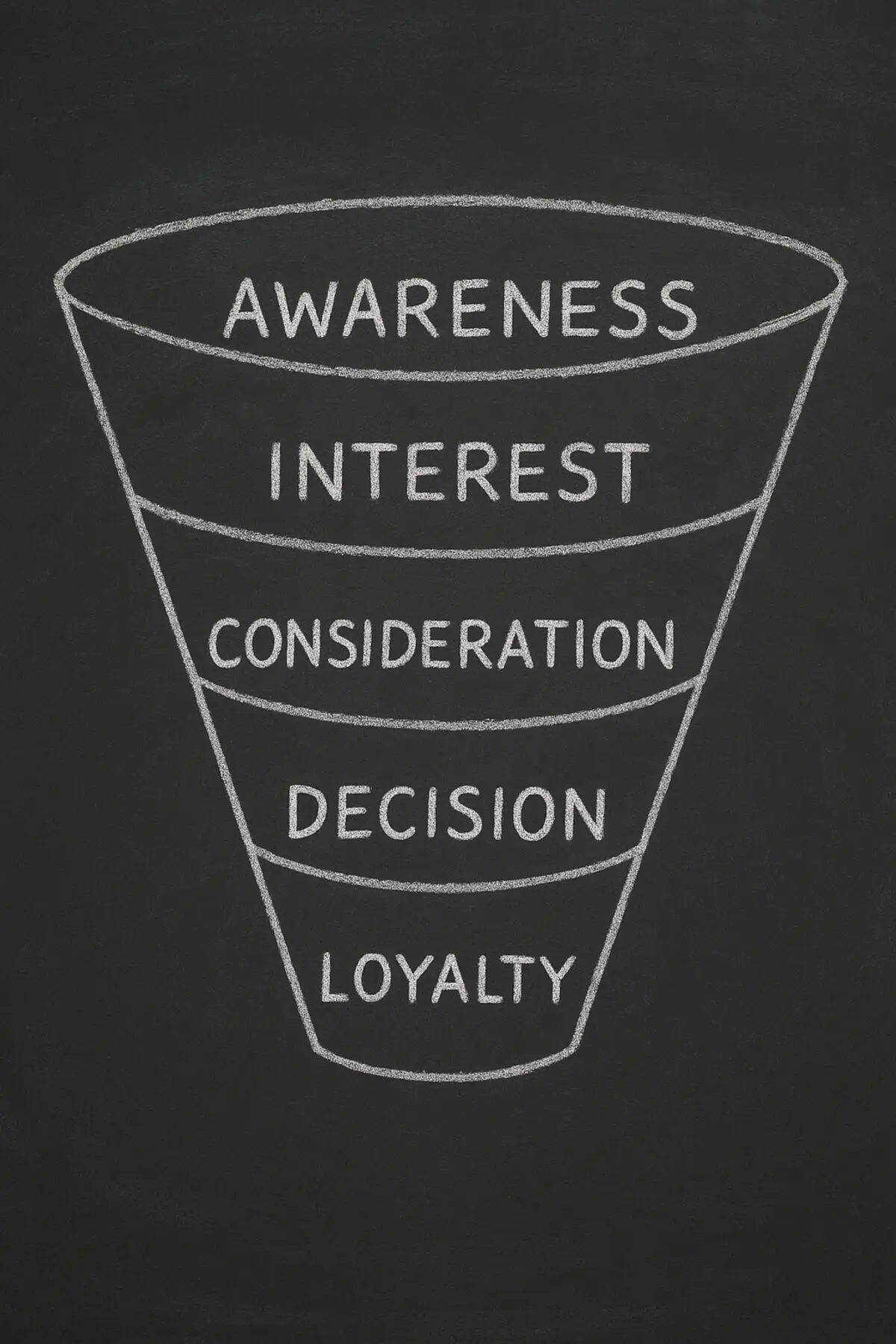
- A sales funnel maps the exact journey a stranger takes to become a paying customer — and then a loyal advocate
- The 5 core stages are: Awareness, Interest, Consideration, Decision, and Loyalty
- In 2026, AI-powered funnels that qualify leads automatically are outperforming traditional static landing pages by 2–3x
- The single biggest funnel mistake is treating every lead identically — segmentation and qualification are non-negotiable
- Tools like [Dashform](https://getaiform.com) now let you build intelligent, conversational lead qualification funnels in minutes, without code
Introduction
Every business has a sales funnel. Most businesses just don't know it yet.
Whether you're a SaaS startup sending cold emails, a life coach running Facebook ads, or an e-commerce brand running retargeting campaigns — every single touchpoint between "stranger" and "customer" is part of your funnel. The difference between businesses that scale predictably and businesses that struggle month-to-month almost always comes down to one thing: whether they've deliberately engineered that funnel or left it to chance.
This guide is the most comprehensive, practical resource on sales funnels published in 2026. We're not going to give you vague theory or generic advice. You'll walk away with a clear framework for understanding your funnel's stages, real-world examples across industries, a step-by-step build process, and a breakdown of how AI is fundamentally reshaping what "a funnel" even means.
If you've ever Googled "how do I build a sales funnel," you've probably landed on an article that gave you a pretty picture of a triangle and called it a day. This is not that article.
Let's build something real.
What Is a Sales Funnel?
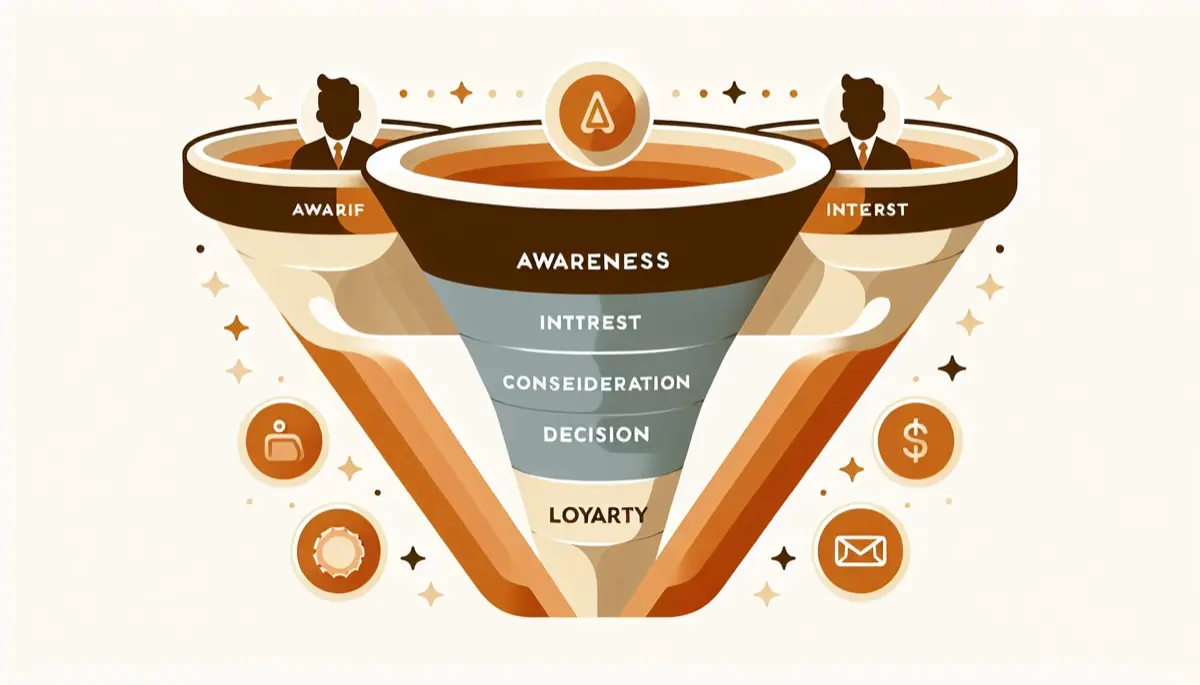
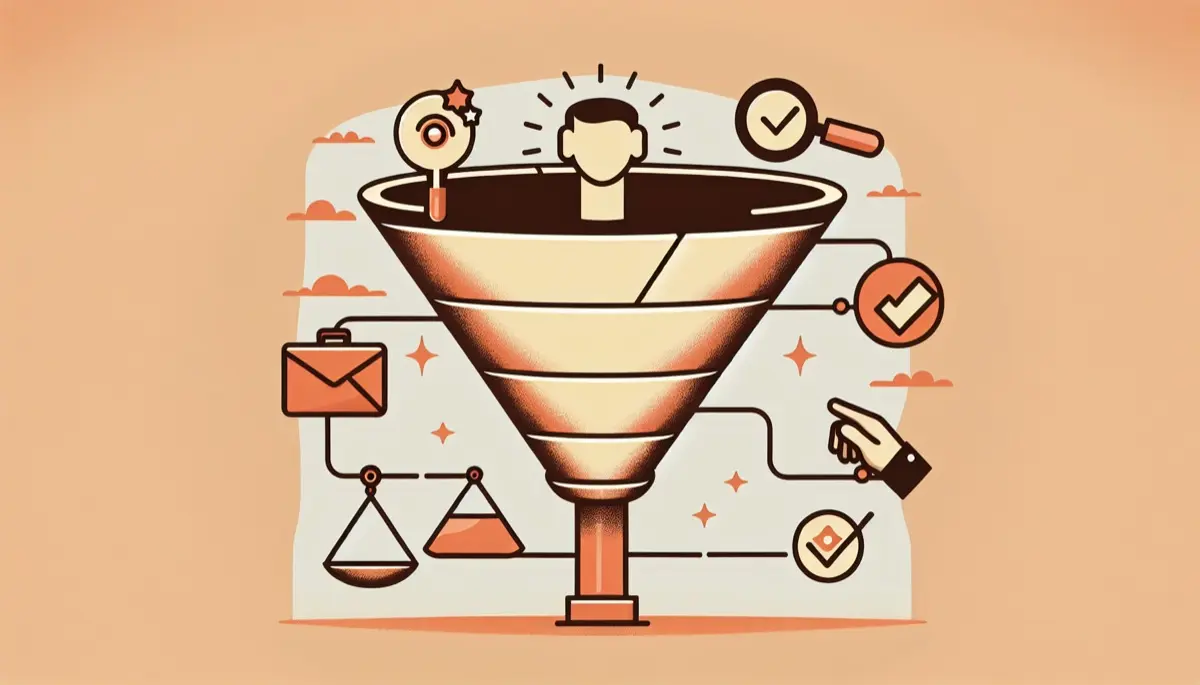
A sales funnel is a visual model that represents the journey a potential customer takes from first discovering your brand to making a purchase — and ideally, becoming a repeat buyer and advocate. It's called a "funnel" because the pool of people narrows at each stage: many people become aware of your brand, fewer express interest, fewer still evaluate your offer, and a subset of those actually buy.
The concept has been around since 1898, when advertising pioneer Elias St. Elmo Lewis developed the AIDA model (Awareness, Interest, Desire, Action). For over a century, this framework has been refined, debated, and adapted — but its core logic has never changed: people don't buy instantly. They move through a process.
What has changed dramatically, particularly in 2025–2026, is how that process works and how businesses can influence it. Today's buyers are more informed, more skeptical, and more impatient than ever. They research independently, compare options across multiple channels, and expect personalized experiences from the first touchpoint.
This is why the traditional funnel model is being augmented with AI — not replaced, but dramatically improved. Modern sales funnels don't just move people through stages. They qualify, segment, and personalize in real time.
The Classic Funnel at a Glance
- Top of Funnel (TOFU): Awareness-building content, ads, SEO, social media
- Middle of Funnel (MOFU): Lead capture, nurturing, education, qualification
- Bottom of Funnel (BOFU): Sales conversations, proposals, demos, offers
- Post-Funnel: Retention, upsell, referral
Understanding where your leads are in the funnel at any given moment is the key to sending the right message at the right time — and not burning your best prospects with premature hard sells.
Sales Funnel vs. Marketing Funnel: What's the Difference?
This is one of the most common points of confusion in the industry, and it matters because conflating the two leads to misaligned teams, muddled strategy, and unclear ownership.
Dimension | Marketing Funnel | Sales Funnel
Ownership | Marketing team | Sales team
Goal | Generate awareness & leads | Convert leads to customers
Starts at | First brand touchpoint | Lead capture / first contact
Ends at | Lead becomes a qualified prospect | Closed deal (or churn)
Key activities | SEO, content, ads, social, email nurture | Discovery calls, demos, proposals, follow-ups
Primary metrics | Impressions, clicks, CPL, MQL volume | SQL volume, win rate, deal velocity, revenue
Mindset | Broad-to-narrow attraction | Narrow-to-close conversion
Tools | SEMrush, HubSpot Marketing, social platforms | CRM, sales enablement, proposal software
The simplest way to think about it: the marketing funnel fills the top; the sales funnel converts what comes out of it.
In practice, the handoff between the two — the point where a Marketing Qualified Lead (MQL) becomes a Sales Qualified Lead (SQL) — is where most revenue leaks. It's the gap that bad lead qualification creates and that smart tools (like AI-powered forms) can bridge.
Why the Distinction Matters in 2026
With the rise of product-led growth, self-serve SaaS models, and AI-driven nurture sequences, the line between marketing and sales funnels is blurring. More and more companies are building unified revenue funnels where qualification happens automatically through tools and data, not through a human SDR making qualifying calls.
This is precisely why conversational lead qualification — where a smart form or quiz asks the right questions and routes leads automatically — has become one of the most powerful funnel strategies of 2026.
The 5 Stages of a Sales Funnel (Explained in Depth)
Stage 1: Awareness
The top of the funnel. Someone discovers your brand exists. They may not have a specific problem in mind, or they may be actively searching for a solution — but they're encountering you for the first time.
How people enter the awareness stage:
- Organic search (they Google a question, find your blog)
- Paid ads (they see your ad on LinkedIn, Meta, or Google)
- Social content (a video, post, or reel appears in their feed)
- Word of mouth (a colleague mentions your name)
- PR / earned media (you're featured in a publication)
- Podcasts, webinars, events
What you should be doing at this stage:
Your only job at the awareness stage is to be genuinely helpful and interesting enough to earn a second interaction. Don't sell. Educate, entertain, or solve a surface-level problem. The content that works here is broad, accessible, and optimized for discovery — SEO blog posts (like this one), short-form video, thought leadership, and PR.
Awareness stage KPIs: Impressions, organic sessions, social reach, branded search volume, ad frequency
Stage 2: Interest
The prospect knows you exist. Now they want to know more. They're reading your content more deeply, following you on social media, or exploring your website. They have a genuine interest in the problem you solve — and a growing curiosity about whether you might solve it for them.
What you should be doing at this stage:
Convert casual interest into a relationship. This usually means capturing an email address or some form of contact information in exchange for something valuable — a lead magnet, a webinar, a quiz, a free resource, a newsletter.
This is where lead capture happens, and it's one of the highest-leverage points in any funnel. A well-designed lead capture mechanism doesn't just collect an email; it starts the qualification process. A smart quiz or diagnostic tool, for example, can tell you whether this lead is a good fit before a human ever gets involved.
Interest stage KPIs: Email opt-in rate, lead magnet downloads, content engagement time, newsletter subscribers
Stage 3: Consideration
The prospect is now actively evaluating whether your solution is the right fit. They're comparing you to alternatives, reading reviews, watching demo videos, and potentially talking to peers who've used similar products.
This is the most cognitively intensive stage for the buyer — and the stage where most funnels leak badly because they stop communicating after the initial lead capture.
What you should be doing at this stage:
Nurture relentlessly with high-value, specific content. Case studies, comparison guides, ROI calculators, testimonials, webinars, and personalized email sequences all perform well here. The goal is to reduce perceived risk and increase perceived value.
This is also the stage where qualification becomes critical for your team. Not every lead who enters the consideration stage is a good fit. Scoring leads based on firmographic data, behavioral signals, and explicit answers to qualification questions (budget, timeline, use case) allows you to prioritize your highest-value opportunities.
Consideration stage KPIs: Email open/click rates, demo requests, content downloads, lead score distribution, time in stage
Stage 4: Decision
The prospect is ready to buy — or close to it. They've evaluated options and they're making a final choice. Price, onboarding ease, support quality, contract terms, and peer recommendations all factor in.
What you should be doing at this stage:
Remove friction aggressively. Make the path to purchase or commitment as simple as possible. Offer free trials, clear guarantees, strong social proof, and easy access to a sales person or a self-serve checkout. Follow up fast — research consistently shows that response time within 5 minutes of a demo request increases conversion rates dramatically.
Decision stage KPIs: Demo-to-close rate, trial-to-paid conversion, average contract value, sales cycle length
Stage 5: Loyalty (Post-Purchase)
Most funnel models stop at the sale. That's a massive missed opportunity. Your existing customers are your cheapest source of future revenue — through upsells, cross-sells, renewals, and referrals.
What you should be doing at this stage:
Onboard well, deliver on your promises, and create systematic moments of delight. Build referral programs, collect testimonials, and create an ongoing communication cadence that reminds customers why they chose you and surfaces opportunities to grow the relationship.
Loyalty stage KPIs: Net Revenue Retention (NRR), NPS score, referral rate, churn rate, expansion revenue
6 Types of Sales Funnels (With Real Examples)
Not all funnels look the same. The right funnel structure depends on your product, price point, sales cycle length, and audience. Here are the six most commonly used funnel types in 2026.
1. The Lead Magnet Funnel
How it works: Traffic → Lead magnet opt-in → Email nurture sequence → Sales offer
Best for: Service businesses, coaches, consultants, SaaS with longer sales cycles
Example: A marketing agency drives traffic to a blog post about Facebook ad performance. At the bottom of the post, they offer a free "Facebook Ad Audit Checklist" in exchange for an email. The new subscriber enters a 7-email nurture sequence that demonstrates expertise, before receiving an invitation to book a strategy call.
Why it works: By gating a high-value resource behind an email form, you capture people who are actively interested in the problem — not just casual browsers.
2. The Webinar Funnel
How it works: Ads/organic → Webinar registration → Live/automated webinar → Pitch → Follow-up sequence
Best for: High-ticket offers ($500+), B2B SaaS, education products
Example: A business consultant runs a "5 Systems to Scale Your Agency to $1M" webinar. Attendees who stay for the full presentation receive an invitation to book a 1:1 call for a $5,000 consulting package.
Why it works: Webinars compress the trust-building timeline. An hour of live, valuable content can do the relationship-building work of 6 months of email marketing.
3. The Product Launch Funnel
How it works: Pre-launch content → Waitlist/email capture → Launch sequence → Open cart period → Close cart
Best for: Digital products, course creators, new product lines
Example: A course creator spends 3 weeks publishing free training videos. Viewers can join a waitlist for a premium course launching at the end of the month. During a 5-day launch window, cart opens with a bonus package for early buyers.
Why it works: Creates urgency and social proof simultaneously. The pre-launch content builds trust before asking for money.
4. The Quiz/Assessment Funnel
How it works: Traffic → Interactive quiz → Results page → Personalized offer → Follow-up
Best for: Lead qualification, e-commerce personalization, coaches, consultants, SaaS
Example: A skincare brand drives traffic to a "What's Your Skin Type?" quiz. After 8 questions, respondents receive a personalized product recommendation set — with a discount code — and are segmented into email lists based on their skin concerns.
Why it works: Quiz funnels consistently achieve 40–50% opt-in rates, compared to 10–15% for standard lead magnet forms. People love personalized results, and brands love the rich qualification data.
This is the funnel type where Dashform shines. Its AI-powered conversational forms guide leads through a dynamic qualification process — adapting questions based on previous answers, scoring leads automatically, and routing hot prospects to the right follow-up experience instantly.
5. The Free Trial / Freemium Funnel
How it works: Traffic → Free trial/freemium signup → In-product activation → Upgrade prompt → Paid conversion
Best for: SaaS products, software tools, productivity apps
Example: A project management tool offers a 14-day free trial with no credit card required. Users who reach the "aha moment" (creating their first project with a team member) within 3 days have a 68% higher conversion rate, so the onboarding flow is specifically engineered to drive that action.
Why it works: Lets the product do the selling. Reduces the sales conversation to "you've already seen it works — want more of it?"
6. The High-Ticket Application Funnel
How it works: Traffic → Application form → Qualification → Sales call → Offer
Best for: Coaches, consultants, agencies, high-ticket courses ($3,000+)
Example: An executive coach advertises to C-suite leaders. Interested prospects must fill out a detailed application form (10–15 questions about their current business challenges, revenue, and goals). Only qualified applicants are invited to book a discovery call — protecting the coach's time and elevating the perceived value of working with them.
Why it works: Creates selectivity and perceived exclusivity. Applicants self-qualify, and the coach only spends time on people who are likely to close.
This funnel type lives and dies on the quality of the qualification form. A well-designed application form filters out tire-kickers and surfaces your ideal clients — which is exactly what a tool like Dashform is built to do. Its AI-driven logic can branch questions dynamically, score applicants, and even send instant follow-ups based on qualification criteria you define.
How to Build a Sales Funnel Step by Step (8 Steps)
Building a funnel isn't a one-day project, but it's also not as complicated as most "funnel experts" make it sound. Here's the framework that actually works.
Step 1: Define Your Ideal Customer Profile (ICP)
Before you build anything, you need to know exactly who you're building it for. Vague targeting produces vague results.
Your Ideal Customer Profile should include:
- Demographics: Age, gender, location, job title, company size
- Psychographics: Goals, fears, frustrations, aspirations, values
- Behavioral: Where they spend time online, how they consume content, how they prefer to buy
- Qualifying criteria: What makes someone a good fit vs. a bad fit for your offer (budget, timeline, technical requirements, etc.)
Document this rigorously. Your ICP is the foundation that every funnel decision gets made on top of.
Step 2: Map Your Current Customer Journey
Before optimizing, understand what's already happening. How do people currently find you? Where do they go on your website? When do they convert, and when do they leave?
Use tools like Google Analytics 4, Hotjar (heatmaps), and your CRM data to trace the actual path people take — not the path you think they take. You'll almost always find surprising drop-off points and unexpected high-conversion paths.
Step 3: Choose the Right Funnel Type
Based on your ICP, your offer, and your sales cycle, select the funnel type that makes the most strategic sense (see the six types above). Don't try to build everything at once. Pick the single funnel most likely to drive revenue in the next 90 days and build that one well.
Key decision criteria:
- High-ticket service? → Application or webinar funnel
- SaaS product? → Free trial funnel
- E-commerce? → Quiz/recommendation or lead magnet funnel
- Information product? → Webinar or product launch funnel
Step 4: Create Your Traffic Strategy
A funnel with no traffic is just an expensive set of web pages. You need a systematic way to drive qualified people into the top of your funnel.
Paid traffic options: Google Ads (high intent), Meta Ads (broad reach, good for visual products), LinkedIn Ads (B2B), YouTube Ads (great for high-ticket)
Organic traffic options: SEO content (this article is an example), YouTube videos, LinkedIn content, podcast guesting, partnerships
Recommendation: Don't try to be everywhere. Pick one paid and one organic channel and do them exceptionally well before expanding.
Step 5: Build Your Lead Capture Mechanism
This is the most critical conversion point in your funnel. Your lead capture should:
- Offer something genuinely valuable in exchange for contact information — not a generic "subscribe to our newsletter"
- Qualify leads as they enter — not just collect emails
- Match the traffic source — a person who clicked a very specific Google ad has different expectations than someone who downloaded a broad lead magnet
This is where most businesses underinvest — and where the biggest gains are. A static email opt-in form converts at 1–3%. A well-designed interactive quiz or diagnostic form converts at 30–50%. That's not a typo.
Dashform was built specifically to solve this problem. Instead of a generic contact form, you create a conversational AI-powered experience that asks smart, branching questions — gathering rich lead data while the prospect feels like they're getting value. The result: higher opt-in rates, better lead quality, and automatic segmentation without any manual work.
Step 6: Build Your Nurture Sequence
Most leads aren't ready to buy immediately. They need education, trust-building, and social proof before they'll commit. Your nurture sequence is the systematic process of providing that.
A solid email nurture sequence for most businesses includes:
- Email 1 (Day 0): Deliver the lead magnet/promised value. Set expectations.
- Email 2 (Day 2): Share your origin story or "why us" narrative
- Email 3 (Day 4): Case study or success story from a customer who started where they are
- Email 4 (Day 6): Address the top objection head-on
- Email 5 (Day 8): Provide another high-value resource (no pitch)
- Email 6 (Day 10): Social proof pile — testimonials, press mentions, numbers
- Email 7 (Day 12): Soft call to action — book a call, start a trial, explore pricing
The best nurture sequences feel personal, not promotional. Write them like you're sending an email to one specific person, not broadcasting to a list.
Step 7: Build the Conversion Mechanism
This is where the lead makes a decision. Depending on your funnel type, this could be:
- A sales call booked through Calendly
- A checkout page
- A trial activation
- An application submitted
The key at this stage is removing friction. Every extra click, every confusing form field, every moment of uncertainty is a reason for someone to not convert. Test your conversion flow with fresh eyes (or ask someone who hasn't seen it before to complete it and narrate their experience).
High-converting conversion mechanisms typically include:
- Clear, specific value proposition (not "Transform Your Business Today" — something specific)
- Social proof at the moment of decision (testimonials, logos, case study snippets)
- Risk reversal (guarantee, free trial, no credit card required)
- Urgency or scarcity (used ethically — real deadlines, limited spots)
- Simple next step (one CTA, not five options)
Step 8: Measure, Test, and Iterate
Your first funnel will not be your best funnel. The businesses that scale fastest are the ones that treat their funnel as a system to be continuously optimized, not a thing you build once and forget.
Establish your baseline metrics first (see the next section). Then run structured A/B tests, one variable at a time, starting with the highest-leverage points:
- Headline on your opt-in page (highest impact)
- Lead magnet offer itself
- Email subject lines in your nurture sequence
- The CTA and offer on your sales page
- Follow-up timing and sequence length
Document every test, track results rigorously, and roll out winners. Compound those gains over 12 months and the results are transformational.
Sales Funnel Metrics & KPIs to Track
You cannot improve what you don't measure. These are the metrics every funnel owner should have on their dashboard.
Top of Funnel (Awareness & Interest) Metrics
Metric | What It Measures | Target Benchmark
Website traffic | Total visitors entering the funnel | Baseline + growth trend
Traffic source breakdown | Where visitors come from | No single source >60%
Opt-in / conversion rate | % of visitors who become leads | 15–35% (quiz), 1–5% (standard form)
Cost Per Lead (CPL) | Ad spend ÷ new leads | Varies by industry; track vs. LTV
Lead magnet download rate | Quality signal for your offer | >50% of opt-ins
Email open rate | Deliverability + subject line quality | 25–45% for engaged lists
Middle of Funnel (Nurture & Qualification) Metrics
Metric | What It Measures | Target Benchmark
Email click-through rate (CTR) | Content relevance + CTA effectiveness | 3–7%
Lead score distribution | Quality breakdown of leads | Track % in "hot" tier
Time in stage | How long leads spend in consideration | Varies by sales cycle length
MQL-to-SQL conversion rate | Marketing-to-sales handoff quality | 13–25% (industry average)
Content engagement | Blog reads, video views, webinar attendance | Track by stage and persona
Demo/call request rate | MOFU → BOFU progression | 2–8% of total leads
Bottom of Funnel (Decision) Metrics
Metric | What It Measures | Target Benchmark
SQL-to-close rate | Sales effectiveness | 20–40% (varies significantly)
Average deal value (ACV) | Revenue quality per customer | Track vs. ICP definition
Sales cycle length | Efficiency of the decision process | Optimize for your model
Win rate by source | Which traffic channels produce best customers | Identify top channels
Trial-to-paid rate | Product funnel conversion | 15–30% for self-serve SaaS
Proposal acceptance rate | Pricing/value alignment | >50% is healthy
Post-Purchase (Loyalty) Metrics
Metric | What It Measures | Target Benchmark
Net Revenue Retention (NRR) | Expansion vs. churn net | >100% (growth signal)
Customer Lifetime Value (LTV) | Total revenue per customer | LTV:CAC ratio >3:1
Net Promoter Score (NPS) | Likelihood to refer | >40 is good, >70 is exceptional
Referral rate | Organic growth from existing customers | 10–30% of new leads
Churn rate | Monthly/annual customer loss | <2%/month for SaaS
Industry-Specific Sales Funnel Examples
Generic funnel advice only goes so far. Here's how the funnel model translates across five high-growth industries.
Coaches & Consultants
The Challenge: High-touch, high-ticket offers that require significant trust before a prospect commits. The coach's time is finite, so qualification is existential — one bad-fit client can derail the whole business.
The Funnel: Content (podcast, YouTube, LinkedIn) → Lead magnet (free guide or mini-course) → AI qualification quiz (budget, timeline, specific goals) → Strategy call (only with qualified leads) → High-ticket offer
Key Insight: The qualification step between lead magnet and sales call is where most coaches either win or lose. A 15-minute quiz that pre-qualifies budget, timeline, and fit can cut unqualified discovery calls by 60–70% — giving coaches their time back while actually improving the prospect experience (because qualified calls are better conversations).
Success metric to watch: Application-to-call rate and call-to-close rate. If your call-to-close is below 30%, you have a qualification problem, not a sales problem.
SaaS Companies
The Challenge: Long consideration cycles, multiple stakeholders, and the need to demonstrate ROI before purchase. Plus, self-serve vs. sales-assist creates a dual funnel to manage.
The Funnel (Self-Serve): SEO/ads → Free trial → In-product activation → Upgrade prompt → Paid subscription → Expansion
The Funnel (Sales-Assist): Content → Demo request → Lead qualification form → SDR routing → Discovery call → Technical evaluation → Champion letter → Close
Key Insight: The fastest-growing SaaS companies in 2025–2026 are using AI to score and route leads automatically. When a lead fills out a demo request form and the system instantly determines whether they're Enterprise, SMB, or self-serve — and routes them accordingly — sales teams become dramatically more efficient.
Success metric to watch: Trial activation rate (completing key setup actions in the first 3 days) and time-to-value. These predict paid conversion better than almost any other metric.
E-Commerce
The Challenge: High traffic volume, low average order values, and intense competition make every basis point of conversion rate improvement worth real money.
The Funnel: Paid social/SEO → Product discovery → Product recommendation quiz → Add to cart → Checkout → Post-purchase upsell → Retention email sequence → Repeat purchase
Key Insight: E-commerce brands using recommendation quizzes at the top of their funnel (before the product page) see dramatically higher conversion rates because they reduce decision paralysis. Instead of browsing 200 products, a customer answers 5 questions and gets 3 perfect recommendations. Personalization at scale is a superpower.
Success metric to watch: Revenue per visitor (RPV), which captures both conversion rate and average order value simultaneously.
Real Estate
The Challenge: Long, emotionally complex buying cycles. Buyers are highly informed but also highly anxious. Trust is everything. Agents' time is their inventory.
The Funnel: Ads/content → Home search or neighborhood guide download → Lead qualification quiz (budget, timeline, pre-approved, property type) → CRM segmentation → Personalized drip by buyer stage → Agent conversation → Property showings → Close
Key Insight: Real estate leads are notoriously inconsistent in quality. A buyer who's pre-approved and actively looking is worth 100x a person who's "just browsing." A qualification quiz that asks the right questions upfront — pre-approval status, timeline, must-haves — lets agents prioritize intelligently instead of spending 3 months nurturing someone who was never going to buy.
Success metric to watch: Lead-to-showing rate. If this is below 15%, your qualification is too loose.
Medical Spas & Aesthetic Clinics
The Challenge: High-consideration, high-anxiety purchase decisions. Potential clients want to feel understood and safe before committing to an aesthetic procedure. Personalization and trust are paramount.
The Funnel: Instagram/paid ads → Educational content → Skin assessment quiz → Personalized treatment recommendation → Email/SMS nurture → Consultation booking → Conversion → Retention
Key Insight: Med spas that use a "Skin Assessment" or "Find Your Treatment" quiz as their primary lead capture mechanism typically see 3–5x higher opt-in rates than those using a generic "Book a Consultation" form — because the quiz provides value first. The prospect feels understood before they've even spoken to a human.
Success metric to watch: Consultation show rate and consultation-to-treatment conversion. These tell you whether your nurture sequence is setting realistic expectations and building enough trust.
Common Sales Funnel Mistakes to Avoid
Understanding what not to do is often as valuable as knowing what to do. Here are the most common, costly funnel mistakes — and how to fix them.
Mistake 1: Building a Funnel for Everyone
The fastest way to fail is to try to appeal to everyone. Generic messaging resonates with no one. The moment you try to write copy that could apply to any type of business or any type of customer, you've created the world's most expensive wallpaper.
The fix: Get ruthlessly specific about your ICP. The more specific your funnel is — in its language, its examples, its pain points — the more qualified people will self-select in, and the more unqualified people will self-select out. That's a feature, not a bug.
Mistake 2: Treating Lead Capture as the Finish Line
Too many businesses celebrate when someone opts in and then essentially abandon them. An email address is not a customer. It's an invitation to begin a relationship.
The fix: Build a nurture sequence before you build your opt-in page. Know what happens the moment after someone joins your list, and make it great.
Mistake 3: No Lead Qualification
This is the silent killer of sales efficiency. When every lead gets treated identically regardless of fit, you end up with sales teams chasing unqualified prospects, high churn rates from bad-fit customers, and demoralized people on both sides of the transaction.
The fix: Build qualification into your funnel from the first touchpoint. Whether it's a quiz, an application form, or a set of behavioral triggers in your email sequence — know your minimum qualification criteria and use them consistently.
Mistake 4: Optimizing the Wrong Stage
Many businesses obsessively focus on top-of-funnel traffic while ignoring gaping holes in the middle and bottom. More traffic into a broken funnel just means more wasted spend.
The fix: Calculate your funnel conversion rates at each stage before deciding where to invest. Fix the biggest leaks first. Often, improving a 2% opt-in rate to 4% doubles your pipeline without spending an extra dollar on ads.
Mistake 5: No Follow-Up System
The research is definitive: 80% of sales require 5+ follow-up contacts. Most salespeople give up after 1–2. This gap between required follow-ups and actual follow-ups is where revenue dies.
The fix: Automate your initial follow-up sequence. Use your CRM or email marketing platform to ensure every lead receives a minimum number of contacts before being marked as "cold." Then build re-engagement campaigns for cold leads.
Mistake 6: Ignoring Mobile Experience
In 2026, over 65% of web traffic comes from mobile devices. A funnel that works beautifully on desktop but breaks on mobile is a funnel that's rejecting the majority of its audience.
The fix: Build and test mobile-first. Every opt-in form, every email, every landing page should be designed for a 390px screen width before being adapted for desktop.
Mistake 7: Measuring Vanity Metrics
Impressions, followers, email list size — these numbers feel good and mean very little. If you're not tracking conversion rates, cost per acquisition, and revenue, you don't actually know if your funnel is working.
The fix: Define your North Star Metric (the one number that best captures your funnel's health) and build your dashboard around it. For most businesses, this is either revenue generated, customers acquired, or revenue pipeline created.
Mistake 8: Building Once and Forgetting
A funnel that was built and never touched will gradually become irrelevant. Markets change. Messaging evolves. Competitors enter. Technology shifts.
The fix: Schedule a quarterly funnel review. Check your conversion rates, update your nurture copy, refresh your lead magnets, and test one new element per cycle.
How AI Is Transforming Sales Funnels in 2026
The sales funnel has existed conceptually for over 125 years. In the last 18 months, AI has done more to change how funnels work than the previous 100 years combined.
Here's what's actually shifting — not hype, but real, measurable changes in how the most sophisticated businesses are building and running their funnels.
AI-Powered Lead Qualification
Traditional qualification required a human. An SDR would ask qualifying questions on a call, or a complex lead scoring system would attempt to infer qualification from behavioral data. Both approaches were slow, expensive, and imprecise.
In 2026, AI-powered conversational forms can qualify leads as well as — and often better than — a human SDR, at a fraction of the cost and in real time. These tools ask branching questions that adapt based on previous answers, just like a skilled salesperson would. They process the responses instantly, score the lead, and route them to the appropriate follow-up.
A prospect who answers that they have a budget over $10,000 and need a solution within 30 days can be automatically routed to a "book a call" page. A prospect who's early-stage and exploring can be routed to a nurture sequence. This happens without anyone reviewing a spreadsheet or updating a CRM manually.
[Dashform](https://getaiform.com) is one of the leading tools enabling this shift. Built specifically for AI-powered lead qualification, Dashform lets you create conversational forms and quizzes that feel like interactions, not interrogations — gathering the exact data you need to qualify and route leads automatically.
Hyper-Personalization at Scale
A/B testing is a 20th-century approach to personalization. In 2026, AI enables dynamic content personalization that adjusts messaging, examples, and CTAs based on who's viewing them — in real time, without manual segmentation.
A SaaS company's landing page can now show different headlines to a VP of Marketing than to a CTO, based on inferred job role from their browsing behavior. A coach's email sequence can branch into 4 different paths based on the quiz answers a new subscriber provided. The result is that every lead feels like the funnel was built specifically for them — because, increasingly, it was.
Predictive Lead Scoring
Legacy lead scoring was rules-based: "if they visited the pricing page and opened 3 emails, score = 75." Predictive lead scoring uses machine learning to analyze historical conversion data and identify the patterns that actually predict purchase — which are often counterintuitive.
Businesses using predictive scoring consistently report 20–40% improvements in sales efficiency because their teams spend time on the leads most likely to close, not the leads that look most impressive on paper.
AI-Generated and AI-Optimized Content
Awareness and interest stages are being dramatically accelerated by AI's ability to generate, test, and optimize content at scale. Ad creative that would have required a week of design work can now be produced and A/B tested in hours. Email subject lines can be automatically optimized based on individual recipient behavior patterns.
This doesn't mean AI is replacing human creativity — the best-performing content in 2026 still has a distinct human voice and genuine strategic insight. But AI is compressing the time and cost of production and testing dramatically.
Conversational AI in the Middle of Funnel
Perhaps the most significant shift is in the middle of funnel, where AI chatbots and conversational tools are replacing static FAQ pages and generic email sequences. When a lead visits a pricing page and has a specific question at 11pm on a Saturday, an AI assistant can answer it accurately, gather qualifying information, and even book a sales call — without any human involvement.
Businesses that have deployed conversational AI in their MOFU are reporting significant reductions in the time it takes a lead to move from consideration to decision — because the friction of unanswered questions is removed in real time.
The Bottom Line for 2026
AI doesn't replace the funnel. It makes every stage of the funnel faster, more personalized, more efficient, and more data-rich. The businesses that are winning in 2026 are the ones that have integrated AI tools into each stage of their funnel — not as gimmicks, but as genuine operational infrastructure.
The question is no longer "should I use AI in my funnel?" It's "which AI tools should I prioritize first?"
Best Sales Funnel Tools in 2026
A strong funnel requires a stack of tools working together. Here are the categories and leading options, with an honest assessment of where each fits.
Lead Qualification & Conversational Forms
— The standout tool in this category for 2026. Dashform is an AI-powered form and quiz builder built specifically for lead qualification. Unlike generic form tools, Dashform's conversational interface uses branching logic and AI to ask the right questions, score leads automatically, and route them to personalized follow-up experiences. It's the tool of choice for coaches, consultants, SaaS companies, and e-commerce brands who want to capture higher-quality leads. Explore 100+ templates to get started quickly.
Typeform — The pioneer of conversational forms. Solid for general use cases, but lacks the AI qualification capabilities and lead routing intelligence that Dashform provides. Better for surveys and simple forms than complex qualification workflows.
Jotform — Highly capable form builder with strong integrations. More suited for data collection than lead qualification. Lacks conversational UX.
Landing Page Builders
Unbounce — The standard for conversion-optimized landing pages, with solid A/B testing capabilities and AI copywriting assistance. Ideal for TOFU paid traffic campaigns.
Webflow — More design flexibility than Unbounce, better for teams that want full control over the visual experience. Steeper learning curve but extremely powerful.
Carrd — For simple, single-page funnels where you need speed over sophistication. Excellent for coaches and solopreneurs on a budget.
Email Marketing & Nurture
ActiveCampaign — Best-in-class for complex automation workflows. Particularly strong for businesses with multi-stage nurture sequences and conditional logic. Integrates well with lead qualification tools.
Klaviyo — The standard for e-commerce email. Deep Shopify integration, strong behavioral triggers, excellent segmentation.
ConvertKit — Built for creators and coaches. Simpler than ActiveCampaign but with a cleaner UX and strong community. Good for lead magnet funnels.
CRM & Sales Pipeline Management
HubSpot CRM — The most comprehensive free CRM available. As you scale, the paid tiers offer powerful sales pipeline management, lead scoring, and reporting. Best for SMBs through enterprise.
Pipedrive — Sales-team-first CRM with an intuitive pipeline view. Excellent for businesses where a sales team is actively working deals. Less comprehensive on the marketing side.
Salesforce — Enterprise standard. Extremely powerful, extremely complex, and extremely expensive. Worth it at scale; overkill below $5M ARR for most businesses.
Analytics & Optimization
Google Analytics 4 (GA4) — Non-negotiable. Free, comprehensive, and increasingly powerful with predictive metrics. Every funnel needs GA4.
Hotjar — Heatmaps, session recordings, and user surveys that reveal exactly where and why your funnel is leaking. Invaluable for conversion rate optimization.
Heap — Automatic event tracking that captures every user interaction without manual tagging. Excellent for SaaS product funnels where in-product behavior drives conversion.
Scheduling & Conversion
Calendly — The standard for booking discovery calls and demos. Integrates with virtually every CRM and email tool. Essential for any funnel that includes a human sales step.
Chili Piper — More sophisticated than Calendly for enterprise sales teams. Instant booking, lead routing, and reminders. Particularly valuable for B2B SaaS with inbound demo requests.
FAQ: Sales Funnel Questions Answered
This FAQ is designed to answer the most common questions about sales funnels concisely and accurately.
What is a sales funnel in simple terms?
A sales funnel is the series of steps a potential customer goes through from first discovering your business to making a purchase. It's called a "funnel" because a large number of people enter at the top (awareness), and a smaller number make it through to the bottom (purchase). Every business has a funnel, whether deliberately designed or not.
How many stages does a sales funnel have?
The classic sales funnel has 4 stages: Awareness, Interest, Decision, and Action (AIDA). Modern frameworks typically use 5 stages by adding a Loyalty or Retention stage after the purchase. Some B2B models add more stages to account for complex, multi-stakeholder buying processes. The most important thing is that your funnel model reflects the actual journey your specific customers take.
What is the difference between a sales funnel and a marketing funnel?
The marketing funnel covers the journey from first brand awareness to lead generation — it's owned by the marketing team. The sales funnel covers the journey from lead to closed customer — it's owned by the sales team. In practice, the two overlap, and the handoff point (usually where a Marketing Qualified Lead becomes a Sales Qualified Lead) is one of the most important transitions to optimize in any revenue organization.
How do I build a sales funnel from scratch?
Building a sales funnel from scratch involves 8 key steps: (1) Define your Ideal Customer Profile, (2) Map the current customer journey, (3) Choose the right funnel type, (4) Create a traffic strategy, (5) Build a lead capture mechanism (form, quiz, or landing page), (6) Create an email nurture sequence, (7) Build the conversion mechanism (checkout, booking page, application), and (8) Measure results and iterate. Most businesses can have a functional first funnel live within 2–4 weeks.
What is a good sales funnel conversion rate?
Conversion rates vary significantly by stage and industry. As a general benchmark: top-of-funnel opt-in rates of 15–35% are solid for quiz funnels; 1–5% for standard lead magnet forms. MQL-to-SQL conversion rates of 13–25% are considered healthy. Sales close rates of 20–40% are typical across industries, with high-ticket offers often closing at lower rates (10–20%) and lower-ticket self-serve products converting higher (20–40% of trials to paid). The most important benchmark is your own historical data — optimize your funnel against itself.
What is a quiz funnel?
A quiz funnel is a type of sales funnel that uses an interactive assessment or quiz as the primary lead capture mechanism. Prospects answer a series of questions (typically 5–15) and receive personalized results based on their answers. This approach works because it provides immediate value to the prospect, generates rich qualification data for the business, and typically achieves opt-in rates 3–5x higher than standard forms. Quiz funnels are widely used by coaches, consultants, e-commerce brands, SaaS companies, and service businesses.
How long does it take to build a sales funnel?
A simple funnel — one landing page, one lead magnet, and a 5-email nurture sequence — can be built in 1–2 weeks with the right tools. A more complex funnel with multiple traffic sources, lead qualification logic, a sales call process, and full CRM integration typically takes 4–8 weeks to build and test. The design and copywriting usually take longer than the technical setup, particularly if you're starting without a clear Ideal Customer Profile defined.
What tools do I need to build a sales funnel?
At minimum, you need: (1) a way to drive traffic (SEO or paid ads), (2) a lead capture tool (a form, quiz, or landing page builder like [Dashform](https://getaiform.com)), (3) an email marketing platform for nurture (ActiveCampaign, ConvertKit, or Klaviyo), and (4) a way to track results (Google Analytics 4). As your funnel matures, you'll add a CRM, scheduling software, analytics tools, and more. Start simple and add complexity only when the data tells you where you need it.
How does AI improve a sales funnel?
AI improves sales funnels in several key ways: (1) Lead qualification — AI-powered forms and chatbots can qualify leads in real time, asking adaptive questions and routing prospects automatically; (2) Personalization — AI enables dynamic content that adjusts messaging based on who's viewing it; (3) Predictive scoring — machine learning identifies which leads are most likely to convert based on historical patterns; (4) Automated follow-up — AI tools can send personalized follow-ups triggered by specific behaviors; and (5) Content optimization — AI helps test and optimize funnel copy at scale. In 2026, AI is not optional for competitive funnel builders — it's the difference between a funnel that works and one that scales.
What is the biggest mistake businesses make with their sales funnel?
The most common and costly mistake is failing to qualify leads adequately. When every lead is treated the same regardless of fit — same email sequence, same sales call, same offer — it creates massive inefficiency: sales teams waste time on bad-fit prospects, marketing teams optimize for volume instead of quality, and conversion rates plateau. The fix is building qualification into the funnel as early as possible, ideally at the lead capture stage, using tools that gather and act on qualification data automatically.
Conclusion: Build Your Funnel Like It's 2026
The businesses that will dominate in the next five years are the ones that treat their sales funnel as a living system — not a one-time project. They'll be the ones who:
- Know their ideal customer better than anyone else in their market
- Build lead capture that qualifies, not just collects
- Nurture with precision — the right message, to the right segment, at the right time
- Iterate constantly based on data, not intuition
- Deploy AI to do the time-consuming, repetitive work of qualification and routing so humans can focus on the high-value, high-touch moments that actually require humanity
The good news is that building this kind of intelligent, AI-powered funnel has never been more accessible. You don't need a team of engineers or a six-figure marketing budget. You need clarity on your ICP, a smart tool for lead qualification, and the discipline to measure and improve.
Ready to build your AI-powered sales funnel?
Start with the highest-leverage piece: your lead capture and qualification layer. Dashform is the AI-powered form and quiz builder built specifically for this job — creating conversational, qualifying experiences that convert at 3–5x the rate of standard forms, while automatically sorting your leads by fit, routing hot prospects to your calendar, and giving you the data you need to nurture everyone else intelligently.
[Try Dashform free at getaiform.com](https://getaiform.com) and build your first AI-powered qualification funnel today.
Tags: sales funnel, sales funnel guide, how to build a sales funnel, sales funnel stages, marketing funnel, lead qualification, quiz funnel, AI sales funnel, sales funnel examples, sales funnel tools