A coaching intake form is what a new client fills out after they've said yes and before your first session. Its job is to save that first hour: you walk in knowing what they want, what's in the way, how they like to work, and what you've both agreed to.
It's not the same as the questions you ask before a discovery call. Those help you decide whether to work together, and we cover them in 15 coaching assessment questions. The intake comes after that decision.
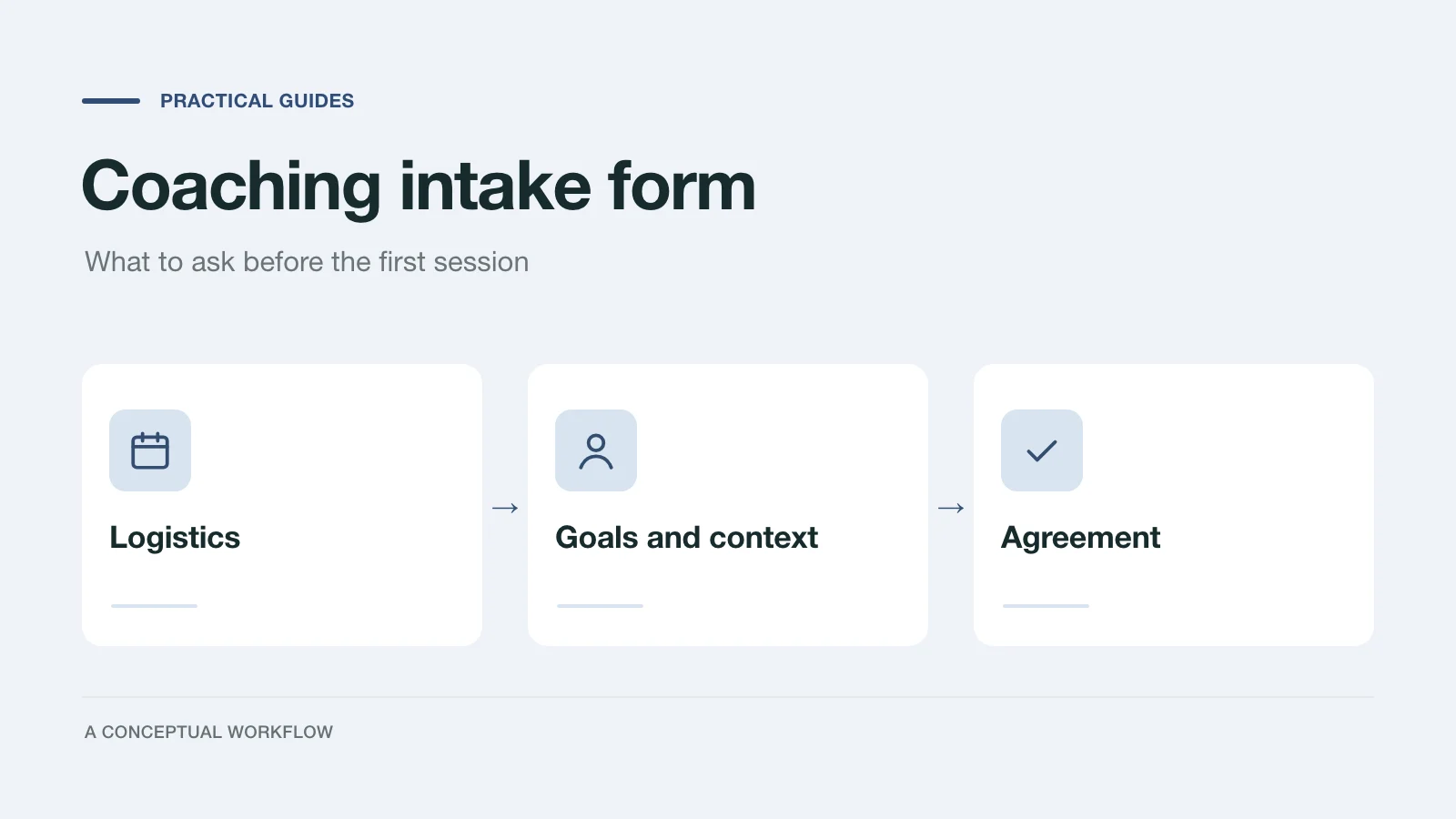
Below are 18 questions in four groups, with notes on which to make required and what to leave out. They suit life, career, executive, and business coaching. For health and nutrition coaching, see the variations near the end.
1. Logistics (required)
These are the questions you'd otherwise chase by email.
- What name would you like me to use?
- What's the best email for session notes and scheduling?
- What time zone are you in?
- How would you prefer to meet? Video, phone, or in person.
- Is anyone else involved in this coaching? For example, an employer paying for it, or a manager who expects updates. Leave this off if you only coach private clients.
Question 5 matters more than it looks. When a company pays, the client, the company, and you need the same understanding of what gets shared. The ICF Code of Ethics asks coaches to agree with clients and sponsors, before coaching begins, on roles, confidentiality, and what information is exchanged.
2. Goals (required, but keep them open)
- What made you decide to start coaching now?
- What would you like to be different six months from now?
- How will you know it's working? What would you notice, or what would someone else notice?
- Which one matters most if we can only focus on one thing at first?
The first answer to a goal question is usually vague ("more confidence," "better work-life balance"). That's fine on a form. Note it and dig in during the first session, or let the form ask one follow-up for a specific example.
3. Context (mostly optional)
- What's going on in your work or life right now that I should know about?
- What have you already tried, and what happened?
- What tends to get in the way when you try to change something?
- Are there topics you'd rather we didn't cover?
- How do you like to receive feedback? Directly, gently, with examples, in writing afterward.
- Are you currently working with a therapist, counselor, or other professional on related topics? Yes, No, or Prefer not to say.
Question 15 isn't there to screen people out. Coaching isn't therapy, and knowing about other support helps you stay within your role and notice when a different professional would serve the client better, as the ICF code asks. Keep it one question. A coaching intake form isn't the place for a detailed medical or mental health history.
4. Agreement (required)
- Please confirm you've read the coaching agreement, with a link to your terms: session length, rescheduling and cancellation, fees, and how confidentiality works.
- Do you agree to session notes being stored and handled as described in the agreement?
- Is there anything else you'd like me to know before we meet?
The last question gets the most useful answers on many intake forms. Keep it.
What to leave out
- Anything you won't use before the first session. Date of birth, home address, and job history can wait until you need them.
- Long personality assessments. If you use one, send it separately, so it doesn't swamp the intake.
- More reflective questions than the client will answer well. Five thoughtful answers beat fifteen rushed ones. Pick the context questions that matter for your niche and drop the rest.
- Health details you don't need. If you collect health information at all, collect only what your work needs and check which privacy rules apply where you and your clients are.
Variations for different kinds of coaching
Executive and business coaching. Add the sponsor's name and role, how progress will be shared with them, and the business outcome the company expects. Agree in writing what the sponsor will and won't hear.
Career coaching. Add current role, the role or change they're aiming for, and their timeline. A CV upload is useful here.
Health and wellness coaching. Add the health goals, current routines, and whether a doctor has given any guidance that limits what you can suggest. Our health coaching intake template is a starting point.
Nutrition coaching. Add dietary preferences, allergies, and current eating patterns. See the nutrition coaching intake template.
Fitness and personal training. Add training history, injuries, and available equipment. The personal trainer intake template covers these.
Build it as a form
To build this in Dashform, paste a prompt like this into the form generator:
Create a coaching intake form for new clients of a [type] coach.
Use these sections: logistics, goals, context, agreement.
Required: name, email, time zone, meeting preference, the four goal questions,
the agreement confirmation, and consent to storing session notes.
Optional: the context questions.
Include one plain question about other professional support,
with "Prefer not to say" as an option.
Link the agreement confirmation to [your terms URL].
End with: "Thanks, I'll read this before our first session."
Then read every question as your client would, cut anything you won't use, and send yourself a test reply before sharing the link. If you want the form to ask one follow-up when a goal is vague, use an AI funnel and allow one follow-up question. Our guide to conversational forms explains how that works.
To see how intake tools differ from assessment and booking tools, read our comparison of coaching tools. If a client's assistant fills out your form for them, here's what to expect.