

A prospect books a call and writes “I'd like some coaching.” You still don't know what they want to change or whether you offer the help they need. A longer booking form might solve that. A scored assessment might help too, but only if the score changes what you do next.
Choose the tool around that decision. The ten products below cover different parts of a coaching practice, so a scheduler and a scorecard builder should not receive competing “assessment scores.” This is a review of official product information checked September 8, 2026, not a claim that we ran a controlled test of all ten.
Pick the job before the product
| Tool | Start here when you need… | Check before choosing |
|---|---|---|
| Dashform | Questions drafted from your coaching offer and criteria for reviewing inquiries | Whether you want a fixed questionnaire or an adaptive conversation |
| ScoreApp | A scored assessment with a respondent-facing result | Score categories, report format, and response allowance |
| Typeform | A questionnaire with conditional paths and score or outcome logic | How your chosen plan handles responses and the required logic |
| CoachAccountable | Worksheets and progress tracking for ongoing clients | Whether you also need a separate public lead funnel |
| Practice Better | Forms and recurring workflows inside a wellness practice | Your practice's data requirements and the exact plan features |
| Paperbell | Intake connected to coaching packages and appointments | When each survey is sent and whether you need separate scoring |
| Google Forms | A simple intake or a quiz you can configure yourself | Whether grading with correct answers fits your assessment |
| Notion | Responses collected into a database your team already uses | Public sharing and permissions on the underlying records |
| Calendly | Qualifying and routing a visitor to a booking option | Routing availability on your plan and fallback rules |
| Acuity Scheduling | Intake questions connected to appointment booking | Which form belongs to which appointment type |
1. Dashform for an offer-specific discovery questionnaire
Describe who you coach, the problems you help with, and what you need to know before a call. Dashform drafts a form you can edit. A structured Logic Funnel is useful when everyone should answer the same core questions; an AI Funnel supports a more conversational exchange.
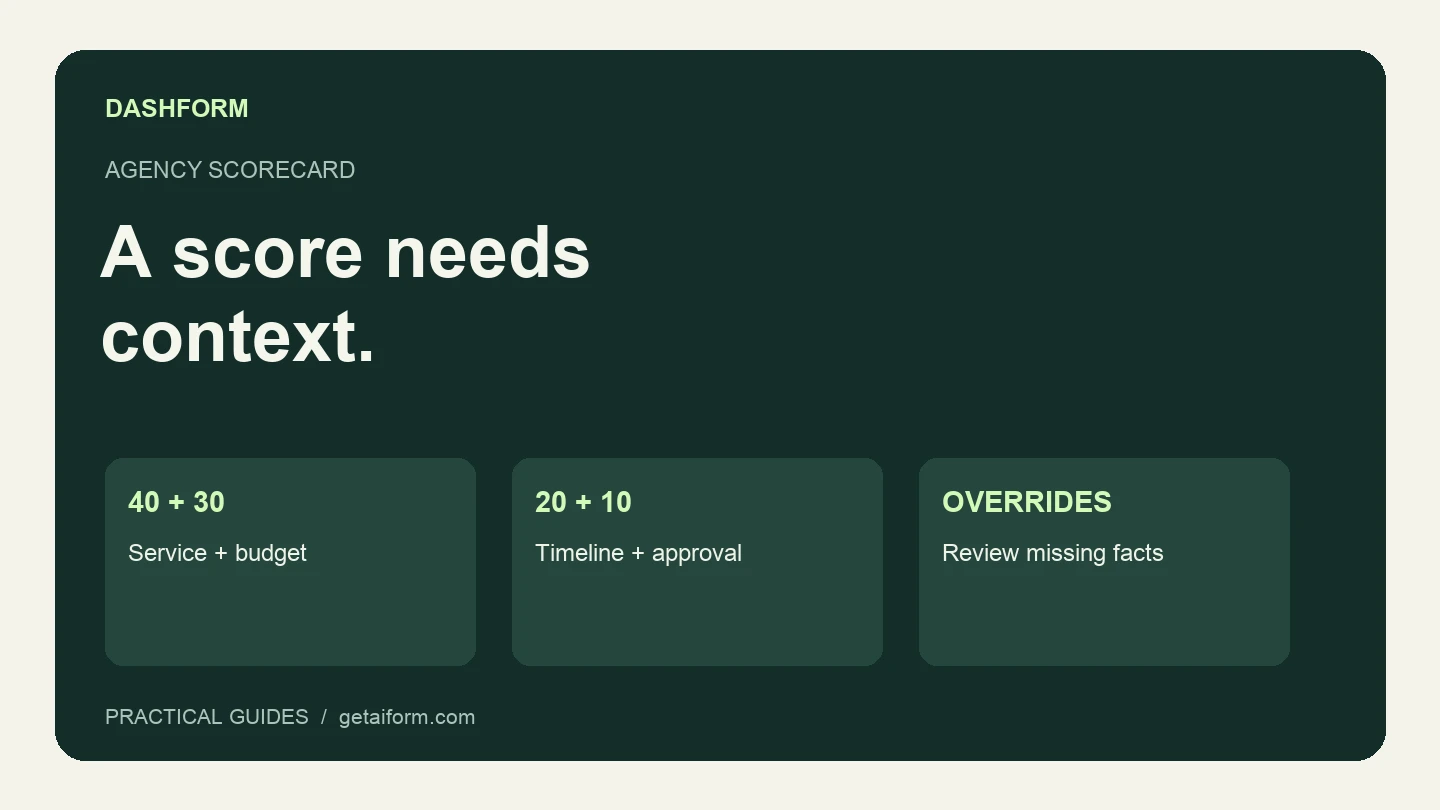
Dashform's lead scoring uses your hot, warm, and cold descriptions. Use it to assist your review of inquiries. If you promise clients an exact assessment score, verify a separate calculation and results workflow; an AI fit judgment is a different output.
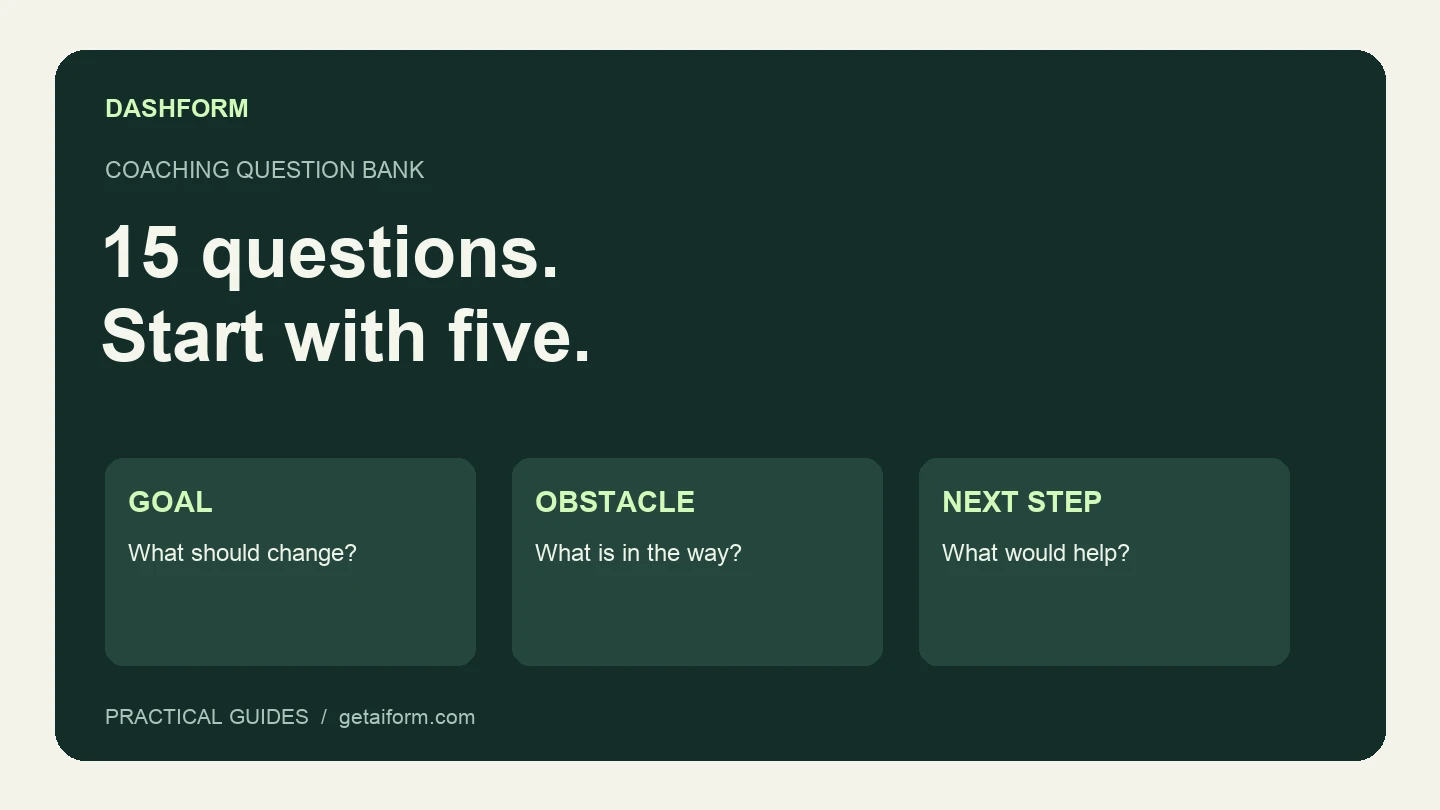
Start with the coaching question bank, choose five questions, and paste the included prompt into the form generator. See current plan limits before sending a campaign.
2. ScoreApp for an assessment that produces a scorecard
ScoreApp documents AI quiz creation, multiple calculated scores, jump logic, and dynamic results. It deserves a place on the shortlist when visitors expect a report they can learn from after answering.
Define the categories before building. A business coaching assessment might separate offer clarity from sales process readiness. A single total can hide that distinction. If you are considering a switch, use our Dashform and ScoreApp comparison to check the output you need.
3. Typeform for questionnaires with deliberate paths
Typeform supports score variables and calculation logic. It is inaccurate to say that it cannot score answers.
It is worth evaluating when your main work is designing question wording and conditional paths. Build one sample outcome before committing: confirm that the answers produce the result you intended and that the booking destination is appropriate. Use Typeform's pricing page to check the plan for your expected response volume.
4. CoachAccountable for work between sessions
CoachAccountable organizes ongoing coaching around tools including Actions, Metrics, Worksheets, and Session Notes. Its worksheet documentation shows how clients access assigned work.
This is a different buying decision from choosing a lead magnet. If the problem is that clients lose track of commitments after a session, improving the public intake form won't solve it. Evaluate the client's weekly experience inside the platform.
5. Practice Better for forms inside a practice workflow
Practice Better's template library includes forms and notes intended for practice workflows. It belongs on the list for coaches whose questionnaire is part of recurring client service.
Review the fields and access settings for your actual practice. The presence of an intake template doesn't establish that every questionnaire, business, or data type is appropriate for the platform. For a simple business coaching discovery form, a smaller setup may be enough.
6. Paperbell for intake at the right point in a package
Paperbell surveys can be tied to events such as a purchase or an appointment. That is useful when the same client should answer different questions at different stages.
Ask a prospective client about their goal before a discovery call. Save detailed preparation questions for after they buy a package. Putting both questionnaires in front of a new visitor makes the first step unnecessarily demanding.
7. Google Forms for a simple starting point
Google Forms supports quizzes with answer keys and points. For basic intake, you can also collect answers and review them yourself.
Use grading when there is a defensible correct answer. A client's uncertainty about their next career move is not an incorrect answer. If you only need context for a conversation, a plain questionnaire may be better than forcing points onto it.
8. Notion for a form connected to your working database
Notion Forms collect responses into a database and can accept responses from people outside your workspace, depending on sharing settings. Notion is therefore more than an internal notes tool.
It is a practical option if your team already reviews inquiries in Notion. Test the public form while signed out, then verify that respondents cannot browse other people's records. Keep the submission experience separate from access to your internal coaching notes.
9. Calendly for routing before a booking
Calendly Routing can use answers to direct a visitor to a suitable person or destination. Its setup guide explains the rules.
Consider it when the key decision is which coach or appointment type should receive the inquiry. Test the fallback for someone who fits none of your rules. They should receive a useful next step rather than a dead end.
10. Acuity Scheduling for appointment-linked intake
Acuity supports intake forms and agreements alongside scheduling. Evaluate it when booking and preparation belong in one flow.
Check whether questions should be answered for every appointment or only at the start of an engagement. Asking returning clients to repeat unchanged information creates work for both sides.
Use one sample inquiry to make the choice
Write down the five answers that would let you prepare a discovery call. Add an example that is a clear fit and one where you need more information. Put those through your two shortlisted tools and inspect the saved responses, the next-step message, and the work left for you.
Our recommendation for a solo coach is to start with a short questionnaire and manual review. Add scoring when you can explain which decisions it improves. Add a client-management platform when the problem moves into ongoing delivery.
The coaching assessment question bank includes the questions and a copyable prompt for that first questionnaire.