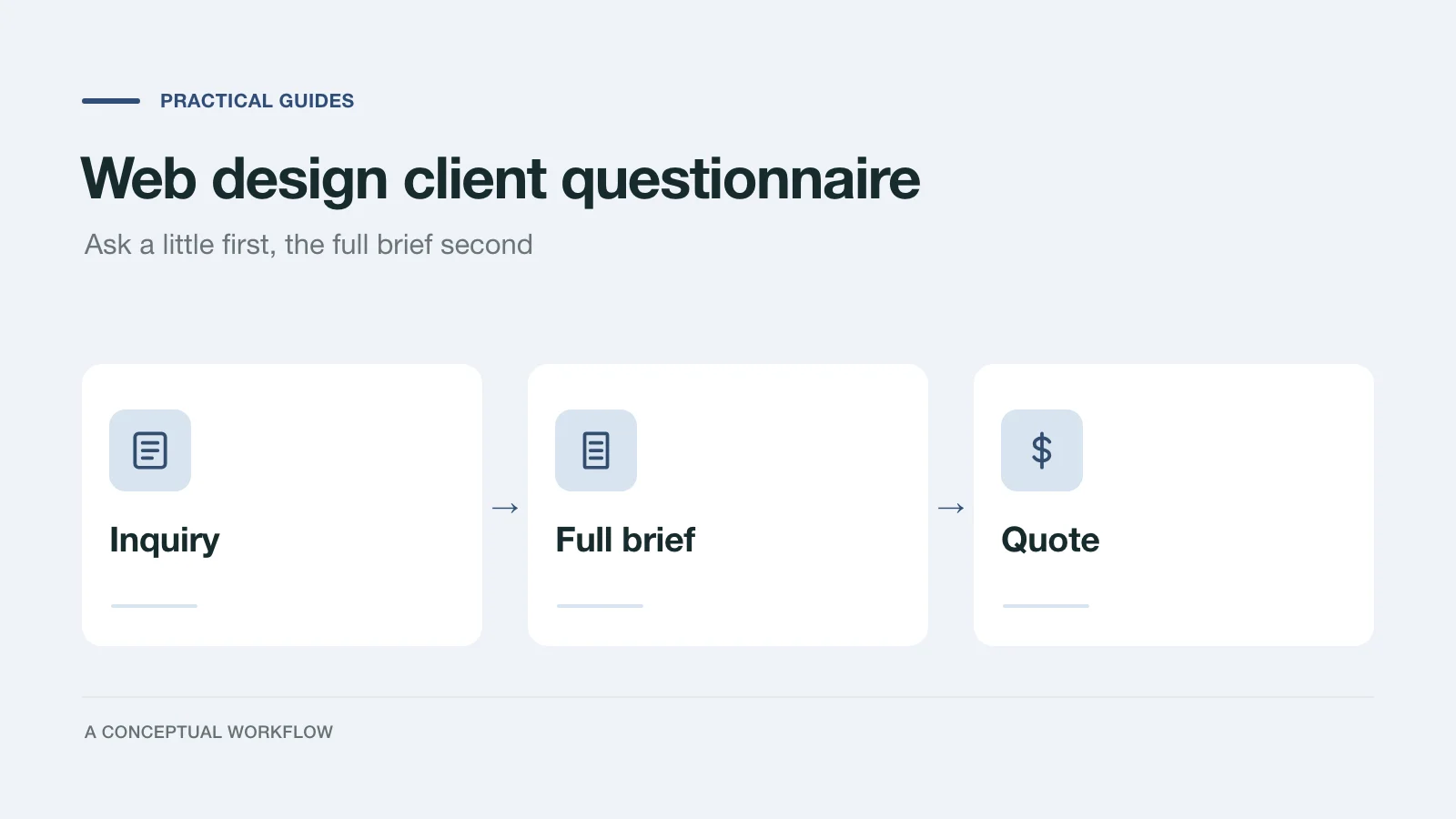
A web design client questionnaire collects what you need to quote a website accurately: what the site is for, who it's for, what it has to do, what already exists, and what the client can spend. The best ones come in two stages, because the questions that tell you whether to take a project are different from the questions that tell you how to price it.
Most questionnaires online are one long list. Sent to a new lead before you've spoken, a long list loses good clients and gets half-answered by everyone else. Ask a few questions first, and save the full brief for after the first call.
Stage 1: the inquiry form (before the first call)
Keep this to about eight questions. Its job is to tell you whether to book a call and what to prepare for it.
- Name, email, and company.
- Current website, if any.
- What do you need? A new website, a redesign of the current site, ongoing support, or not sure yet.
- What should the new site do better than what you have today?
- What budget range are you working with? Show your project minimum next to the question, and include "Not sure yet."
- When would you like it live? Include "No fixed date."
- Who approves the project?
- How did you hear about us?
We built this exact inquiry as a live demo for a fictional studio. You can try the demo form to see how it reads one question at a time. For how to score the answers and decide who gets a call, see our agency lead qualification scorecard.
Stage 2: the full questionnaire (after the call)
Send this once you both want to continue. Group the questions so the client can answer one section at a time, and say roughly how long it takes.
Business and goals
- What does your business do, in a sentence or two?
- What's the single most important thing the site should get visitors to do? Call, book, buy, sign up, apply.
- What other outcomes matter? Hiring, credibility with investors, fewer support emails.
- How will you judge whether the new site worked?
The answer to "single most important thing" shapes the whole design. If a client can't pick one, that's a conversation to have before you quote.
Audience
- Who are your main visitors, and what do they usually want when they arrive?
- What do they already know about you, and what do they need convincing of?
- Which competitors' sites do they compare you with?
Current site and content
- What works on your current site, and what doesn't?
- Which pages get the most use?
- Who will write the copy for the new site: you, us, or someone else?
- Do you have photos, video, and brand assets ready, or do they need to be created?
- What content has to move from the old site, such as blog posts, products, or case studies?
Content is where timelines slip most often. Find out early who owns it and when it'll be ready.
Pages and features
- Which pages do you expect to need?
- Which features does the site need? Contact or quote forms, booking, online payments, a store, a members area, a blog, multiple languages, search.
- Which tools must it connect to? Your CRM, email marketing, booking system, analytics.
- Do you need an inquiry or intake form that does more than collect a name and email? (If so, ask what should happen after someone submits it.)
Each feature on that list changes the quote, so it belongs in the questionnaire rather than in an email three weeks in.
Design
- Name two or three sites you like, and what you like about each.
- Name one you dislike, and why.
- Do you have brand guidelines, a logo, fonts, and colors we must use?
- What should a visitor feel in the first few seconds?
Ask why, not just which. "I like the Stripe site" tells you little. "I like how quickly it explains what they do" tells you a lot.
Technical and ownership
- Do you own your domain, and who manages it?
- Where is the current site hosted, and on what platform?
- Who will update the site after launch, and how comfortable are they with editing tools?
- Are there accessibility requirements? Many teams aim for the W3C's WCAG 2.2 guidelines; some organizations are required to.
- Are there legal pages or consent requirements we need to account for, such as a privacy policy or cookie notice?
Budget, timeline, and approval
- Has the budget range changed since we spoke?
- Is the launch date tied to anything, such as an event, a product launch, or a funding round?
- Who gives feedback, and who gives final approval?
- How many rounds of revisions do you expect?
Turn the answers into a quote
| If the answers say | What it changes |
|---|---|
| No copy or photos ready | Add copywriting or photography, or push the timeline |
| Store, booking, or members area | Price the feature separately; confirm the platform first |
| Several tools to connect | Scope each integration; ask who owns the accounts |
| Many people giving feedback | Name one decision-maker and limit revision rounds in the contract |
| Fixed launch date | Work back from it and agree what gets cut if content is late |
Read the full answers before the scoping call, and quote only after you've cleared up anything vague. A questionnaire that's fully answered but not read is just paperwork.
Build the inquiry form
Our web design quote generator gives you a ready-made starting point. Or describe your own to the Dashform form generator:
Create a project inquiry form for a web design studio.
Ask: name, email, company, current website (optional), service needed,
what the new site should do better, budget range, launch timing,
who approves the project, and how they heard about us.
Show our project minimum next to the budget question.
Include "Not sure yet" for budget and timing.
End with: "Thanks, we'll reply within two business days."
For the steps after someone submits, see our client intake process for agencies and how to turn a project brief into intake questions. Some clients now ask an AI assistant to fill out inquiry forms for them; our test shows what that looks like from the studio's side.