

“What would you like help with?” is a reasonable opening question. On its own, it often leaves a coach with too little context to prepare a discovery call. You need to understand the change someone wants, what is getting in the way, and whether your offer fits.
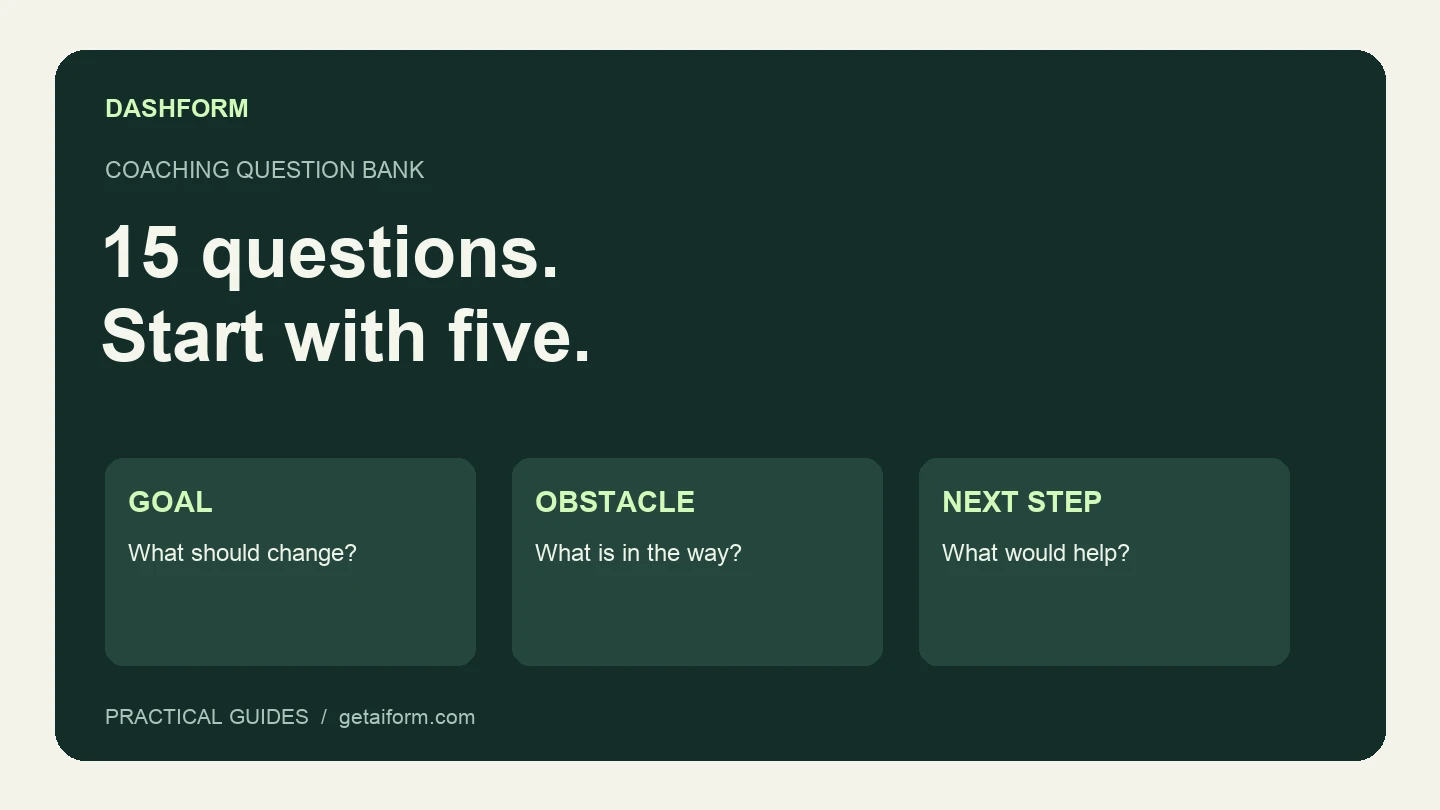
Use the fifteen questions below as a bank. Our recommendation is to start with five before a call and save the rest for the conversation or later intake. Asking every prospect to complete a full onboarding questionnaire makes the first step harder than it needs to be.
These are original example questions for business and career coaching. They are not a validated psychological assessment, and the example answers are fictional.
The five questions to put on the first form
| Question | Suggested input | What it helps you decide |
|---|---|---|
| What would you like to change in your work over the next three months? | Short written answer | Whether the desired outcome fits your coaching offer |
| What is the main thing making that difficult right now? | Short written answer | Which obstacle to explore on the call |
| What have you already tried, and what happened? | Optional written answer | Where the conversation should begin |
| When would you like to start working on this? | Now, within three months, later, or not sure | Whether to discuss an engagement or a future next step |
| What would make this discovery call useful for you? | Short written answer | What the prospect expects from the conversation |
Collect a name and contact email separately. If you already have a published offer and price, link to it before asking whether that offer suits them. Don't make someone guess what “ready to invest” means.
Ten more questions for the right moment
6. What would be different in a normal working week if this improved?
This makes a broad goal more concrete. “Be a better manager” may become “Delegate the weekly report without rewriting it on Sunday.” That gives you something useful to explore without promising that coaching will produce it.
7. Why does this matter to you now?
Ask when timing is relevant. A new role, a team change, or a decision deadline may change the conversation. Avoid wording that pressures someone to describe a crisis.
8. Which part of this can you influence directly?
Useful when the stated goal depends heavily on other people. A client can change how they prepare for a promotion discussion; they cannot guarantee that a role will be available.
9. What support do you already have?
This might be a manager, peer group, mentor, or another professional. It helps you understand where coaching could add something and where work is already covered.
10. What kind of support are you hoping a coach will provide?
Offer a few examples such as reflection, accountability, practice, or help organizing options, plus an open answer. If someone expects you to deliver a business service for them, clarify your role before proposing coaching.
11. Have you worked with a coach before, and what was useful or unhelpful?
Make this optional. Prior experience is context, not a prerequisite or a measure of how serious someone is.
12. What could you realistically make time for between sessions?
Ask about practical availability rather than demanding a particular answer. An overloaded founder may be a good fit for a small, specific commitment and a poor fit for a program with extensive homework.
13. How would you like to notice or track progress?
The answer might be a weekly reflection, a completed conversation, or a change in a work habit. Agree on an observable sign together before turning it into a dashboard metric.
14. Having read the program details, does the format and price fit what you are considering?
Use options such as “Yes,” “I have questions,” and “I need a different option.” Include the actual offer link. A question about the published package is more useful than a broad question about personal finances.
15. Is there anything you want me to know before we speak?
Keep this optional and open. It gives the prospect space to raise a practical concern your fixed questions missed. Don't request confidential records or details unrelated to the coaching inquiry.
Read the answers as context for a conversation
Consider these two fictional inquiries:
Example A: A new manager wants to delegate weekly reporting. They have tried giving verbal instructions, can make time between sessions, and want help preparing clearer handoffs. If that matches your offer, the call can focus on how you work and whether the format fits.
Example B: Someone wants a promotion but has not decided whether they want coaching, training, or help rewriting an application. They selected “not sure” for timing. Ask what support would be useful and clarify your offer. Missing certainty is not evidence that they are a bad client.
For an initial review, use practical labels:
| Review label | Example interpretation | Next action |
|---|---|---|
| Ready to discuss | The goal fits your offer and the prospect understands the format | Offer the appropriate discovery-call next step |
| Needs clarification | The goal could fit, but expectations or timing are unclear | Ask one focused follow-up question |
| Outside this offer | The requested service is something you do not provide | Explain the boundary and share an appropriate alternative if you have one |
These labels describe fit with a particular service. They should not become a score of a person's worth, motivation, or likelihood of success.
Build the short version in Dashform
Copy this prompt into the Dashform form generator, replacing the bracketed text with your offer:
Create a structured discovery-call questionnaire for [coaching offer].
Audience: [who the offer serves].

Use these five questions:
1. What would you like to change in your work over the next three months?
2. What is the main thing making that difficult right now?
3. What have you already tried, and what happened? Make this optional.
4. When would you like to start? Options: Now, Within three months,
   Later, Not sure yet.
5. What would make this discovery call useful for you?

Collect name and email. Do not add a required phone number.
Use a friendly, direct tone. Do not add diagnostic questions,
invent my pricing, or promise results.
End with: "Thanks for sharing. I will review your answers before
confirming the next step."
Save a draft so I can review the questions before publishing.
Review the wording and required fields in the editor. Keep the confirmation promise within what you can actually deliver. If you use Dashform's AI lead scoring, describe the three fit categories in your own words and review its judgments; don't imply that it has calculated a validated coaching score.
Before sharing, try the form as someone who knows exactly what they want and as someone who needs help describing it. Check that the second person still has a sensible way through. After publication, submit a labeled test and make sure the answers appear correctly in your dashboard.
Once a client says yes, the next form is the intake: see coaching intake form questions for what to ask before the first session. If you are still choosing a platform, the coaching tools comparison separates assessment tools from booking and ongoing client-management tools. If the questions are ready, create the five-question draft.