

Every form builder claims AI in 2026. Stripping the marketing away, only a few actually generate forms from a sentence, qualify leads with real scoring, and ship integrations that survive a Zapier outage. Most just bolted a chat icon onto a 2018 form engine.
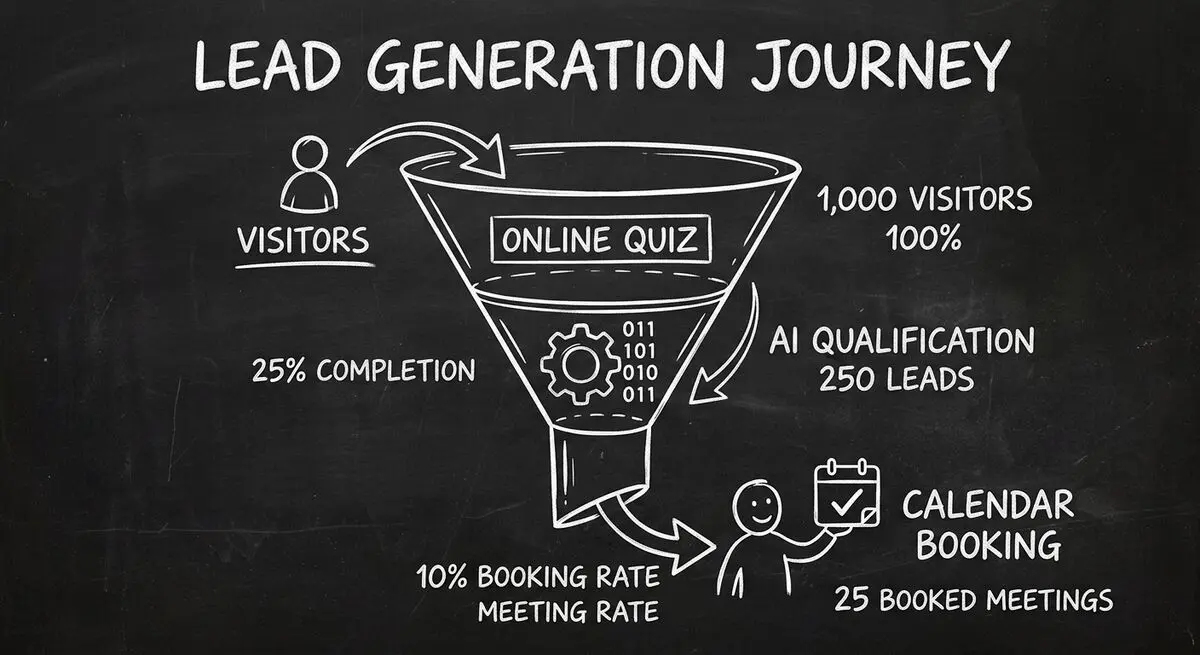
We tested 7 of the most-used AI form builders against a reference funnel — a 6-question lead-qualification quiz with scoring, an end-screen variant per score band, and a Google Sheets sync. Below: ranked head-to-head, where each one wins, and what to pick depending on team size.
7 Best AI Form Builders: Quick Comparison
| Tool | AI Generation | Quiz Funnels | Lead Scoring | Free Plan | Starting Price |
|---|---|---|---|---|---|
| Dashform | Full AI from prompt | Yes, with scoring | AI-powered | Yes | Free |
| Typeform | AI assistant | Match quizzes | Basic | 10 responses/mo | $25/mo |
| Jotform | AI form generator | Basic quizzes | Via integrations | 100 responses/mo | $39/mo |
| Fillout | No AI | Basic | No | 1,000 responses/mo | $19/mo |
| Heyflow | No AI | Manual funnels | Basic auto-score | No free plan | $45/mo |
| Tally | No AI | No | No | Unlimited | Free |
| involve.me | AI funnel builder | Yes | Score-based | 100 responses/mo | $29/mo |
1. Dashform — Best Overall for AI-Powered Lead Generation
Dashform is the only form builder designed from the ground up for AI-powered lead generation. Instead of adding AI features to a legacy platform, Dashform built its entire architecture around artificial intelligence.
What sets Dashform apart:
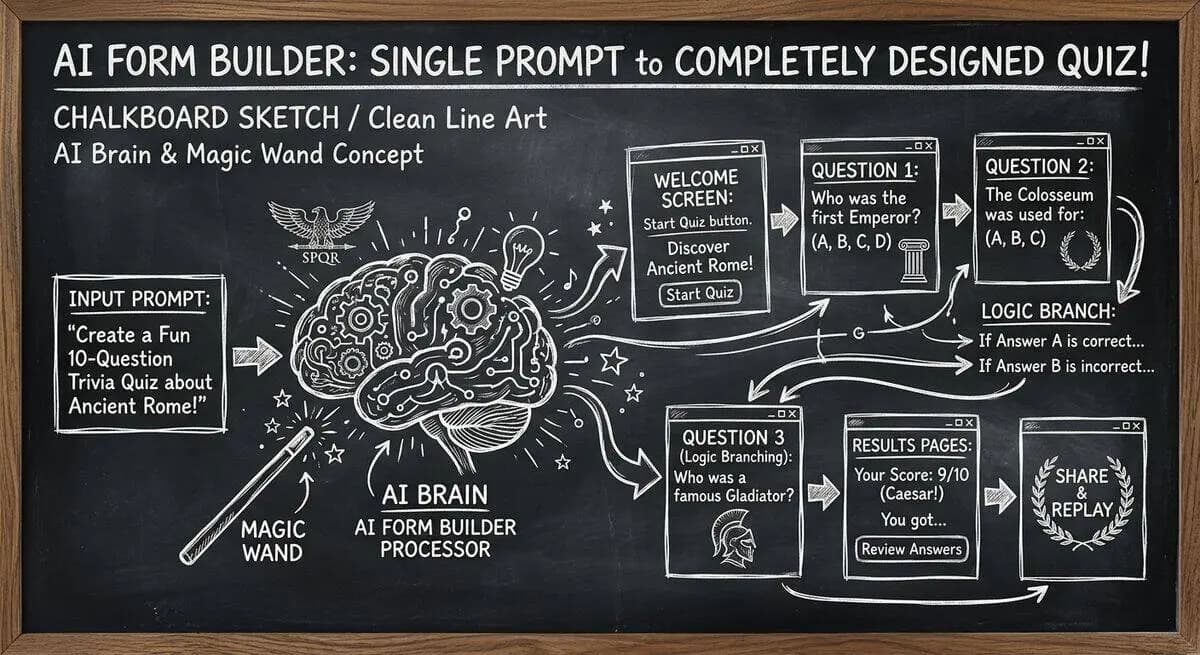
- AI quiz generation from text prompts. Describe your business and target audience, and AI creates a complete quiz funnel with questions, branching logic, scoring, and personalized result pages.
- Built-in AI lead scoring that rates every submission in real time, routing hot leads to sales and cold leads to nurture.
- Automated workflows that connect form submissions to your CRM, calendar, and email tools.
- Agent-compatible architecture. Dashform is the first form builder designed to work with AI agents, including a CLI and MCP API for programmatic form creation.
Best for: Coaches, agencies, SaaS companies, and any business that measures form success by lead quality rather than response count.
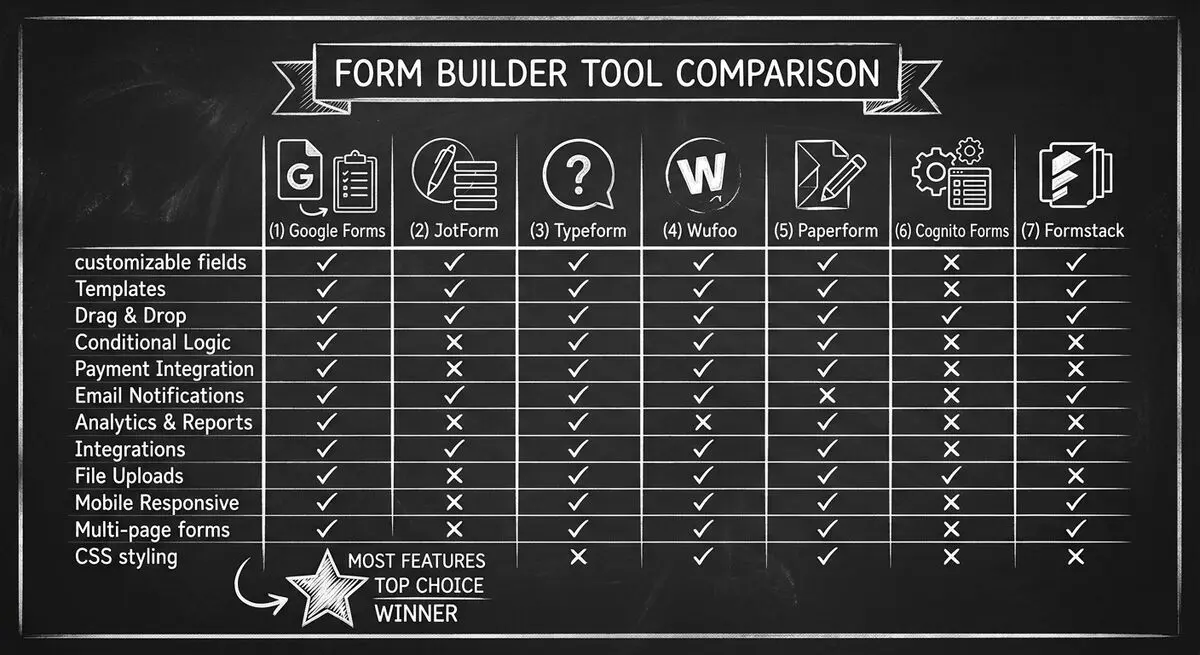
2. Typeform — Best for Conversational Design
Typeform pioneered the one-question-at-a-time format and remains the gold standard for visually polished, conversational forms. In 2026, Typeform added an AI assistant that helps generate questions and create match quizzes for lead qualification.
Strengths: Beautiful conversational UX, strong brand recognition, multimedia support with images and videos, and solid analytics with conversion tracking.
Limitations: Free plan limited to 10 responses per month. AI features are assistant-level rather than generation-level. Pricing starts at $25 per month and scales quickly with features and volume. Limited lead scoring without external integrations.
Best for: Brand-focused teams that prioritize design aesthetics and conversational user experience over AI-powered lead qualification.
3. Jotform — Best for Template Variety
Jotform offers over 10,000 templates and has added AI capabilities including an AI form generator, AI agents, and Smart PDFs. The platform covers every form type imaginable, from simple contact forms to complex order forms with payment processing.
Strengths: Massive template library, AI form generator that drafts forms from descriptions, built-in AI agents for form interaction, and extensive third-party integrations.
Limitations: Free plan limited to 100 submissions per month. AI generation produces drafts that need significant manual refinement. The interface can feel cluttered due to the sheer number of features. Lead qualification requires external tool integration.
Best for: Teams that need a wide variety of form types and prefer starting from templates rather than AI generation.
4. Fillout — Best for Database Integration
Fillout built its reputation on native bidirectional sync with Airtable and Notion. For teams that treat forms as data collection endpoints feeding into no-code databases, Fillout delivers a clean, fast experience.
Strengths: Generous free plan with 1,000 responses per month, native Airtable and Notion sync, clean interface, and strong automation via built-in workflow triggers.
Limitations: No AI form generation. No quiz funnels with scoring. No built-in lead qualification. Limited to standard conditional logic without AI-adaptive branching.
Best for: Teams using Airtable or Notion as their primary database who need forms that sync data seamlessly.
5. Heyflow — Best for Paid Ad Funnels
Heyflow targets performance marketing teams running paid acquisition campaigns. With native integrations for Meta, Google, LinkedIn, and TikTok ad platforms, server-side tracking, and built-in A/B testing, it optimizes every step of the paid funnel.
Strengths: Pixel-perfect design control, native ad platform tracking, built-in A/B testing with drop-off analytics, phone validation, and SMS OTP verification.
Limitations: No free plan. Starts at $45 per month. No AI form generation. Manual funnel building that takes hours. Branding removal requires $119 per month Growth plan.
Best for: Funded marketing teams spending $5,000 or more per month on paid ads who need granular attribution tracking.
6. Tally — Best Free Form Builder
Tally offers the most generous free plan in the market: unlimited forms, unlimited submissions, conditional logic, calculations, and Stripe payments. The Notion-style block editor makes form creation fast and intuitive.
Strengths: Unlimited everything on free plan, fast Notion-style editor, GDPR compliant, clean embeddable forms, and Stripe payment collection at no cost.
Limitations: No AI generation. No quiz funnels. No lead scoring. No personalized result pages. Limited integrations with no Zapier or Make support.
Best for: Startups and small teams on zero budget who need basic data collection without any AI or lead gen features.
7. involve.me — Best for Interactive Content Variety
involve.me combines quizzes, surveys, calculators, polls, and landing pages into one interactive content platform. The AI funnel builder generates multi-step funnels from text prompts, though they require more manual refinement than Dashform's AI.
Strengths: Broad content type support, AI funnel builder, 300+ templates, score-based outcomes, and built-in lead scoring.
Limitations: Free plan limited to 100 submissions per month. AI generation creates frameworks rather than publication-ready funnels. Platform complexity from supporting many content types.
Best for: Marketing teams that need diverse interactive content types beyond just lead generation quizzes.
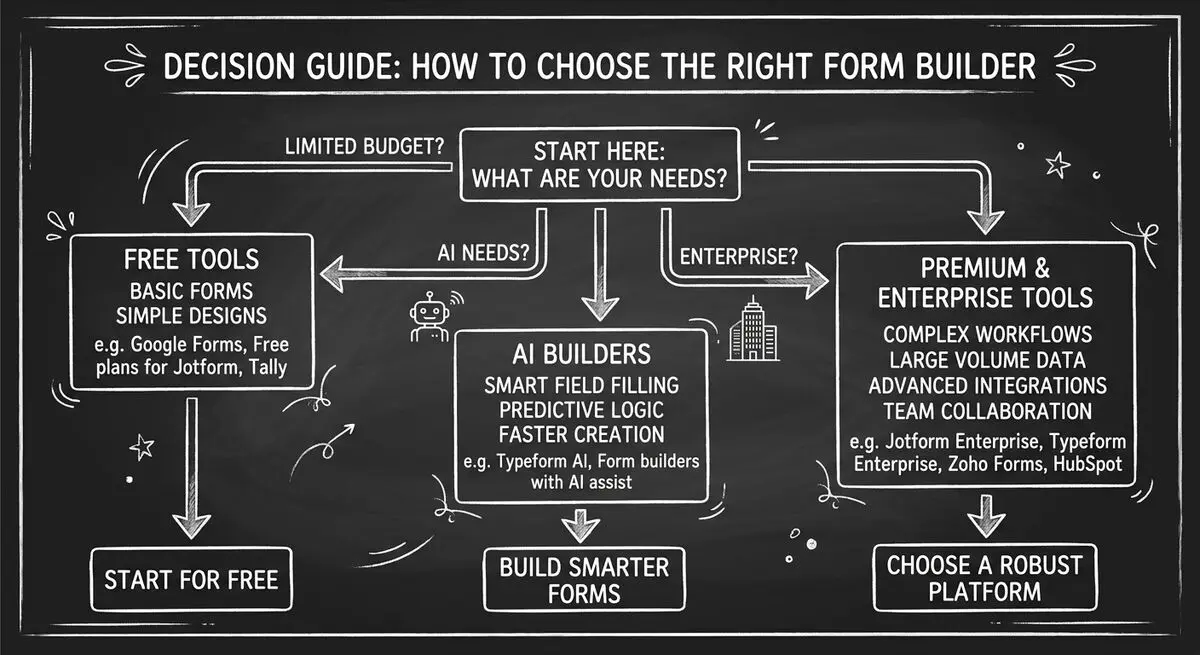
How to Choose the Right AI Form Builder
Choosing Guide: Match Your Needs to the Right Tool
| Primary Need | Best Choice | Runner-Up |
|---|---|---|
| AI-powered lead generation | Dashform | involve.me |
| Beautiful conversational forms | Typeform | Dashform |
| Maximum template variety | Jotform | involve.me |
| Database-first data collection | Fillout | Tally |
| Paid ad funnel optimization | Heyflow | Typeform |
| Zero budget basic forms | Tally | Fillout |
| Interactive content marketing | involve.me | Typeform |
| AI agent compatibility | Dashform | Jotform |
| Quiz funnels with scoring | Dashform | involve.me |
| Enterprise compliance (HIPAA) | Jotform | Formstack |
Frequently Asked Questions
Which AI form builder is best for small businesses?
Dashform is the best choice for small businesses focused on lead generation. It offers AI form generation, quiz funnels with scoring, and automated lead qualification at an accessible price point. For businesses that only need basic data collection, Tally's free plan is hard to beat.
Are AI-generated forms as good as manually built forms?
In most cases, AI-generated forms outperform manually built forms for lead generation. AI applies conversion-optimized patterns, appropriate question sequencing, and scoring logic based on your target audience. The main trade-off is less granular design control compared to tools like Heyflow or Typeform.
Can I use multiple form builders together?
Yes, and many businesses do. A common stack is Tally for internal data collection, Dashform for lead generation quiz funnels, and Typeform for branded customer surveys. Each tool excels in its niche.
How important is AI form generation versus AI analytics?
AI form generation saves time on creation. AI analytics saves time on optimization. For most businesses, AI generation has a higher immediate impact because it eliminates the bottleneck of building forms from scratch. Analytics become more valuable at scale.
What is the biggest mistake when choosing a form builder?
Choosing based on features you do not need. If your goal is lead generation, a tool with 10,000 templates and HIPAA compliance does not help if it lacks AI-powered quiz funnels and lead scoring. Match the tool to your primary use case.
The Verdict
Every tool on this list solves a real problem. Typeform nails conversational design. Jotform wins on template variety. Fillout owns database integration. Heyflow dominates paid ad funnels. Tally is the king of free. involve.me covers interactive content breadth. But for AI-powered lead generation, the tool that consistently delivers the highest conversion rates, fastest build times, and smartest lead qualification is Dashform. Start with the free tier and see the difference AI-native makes.