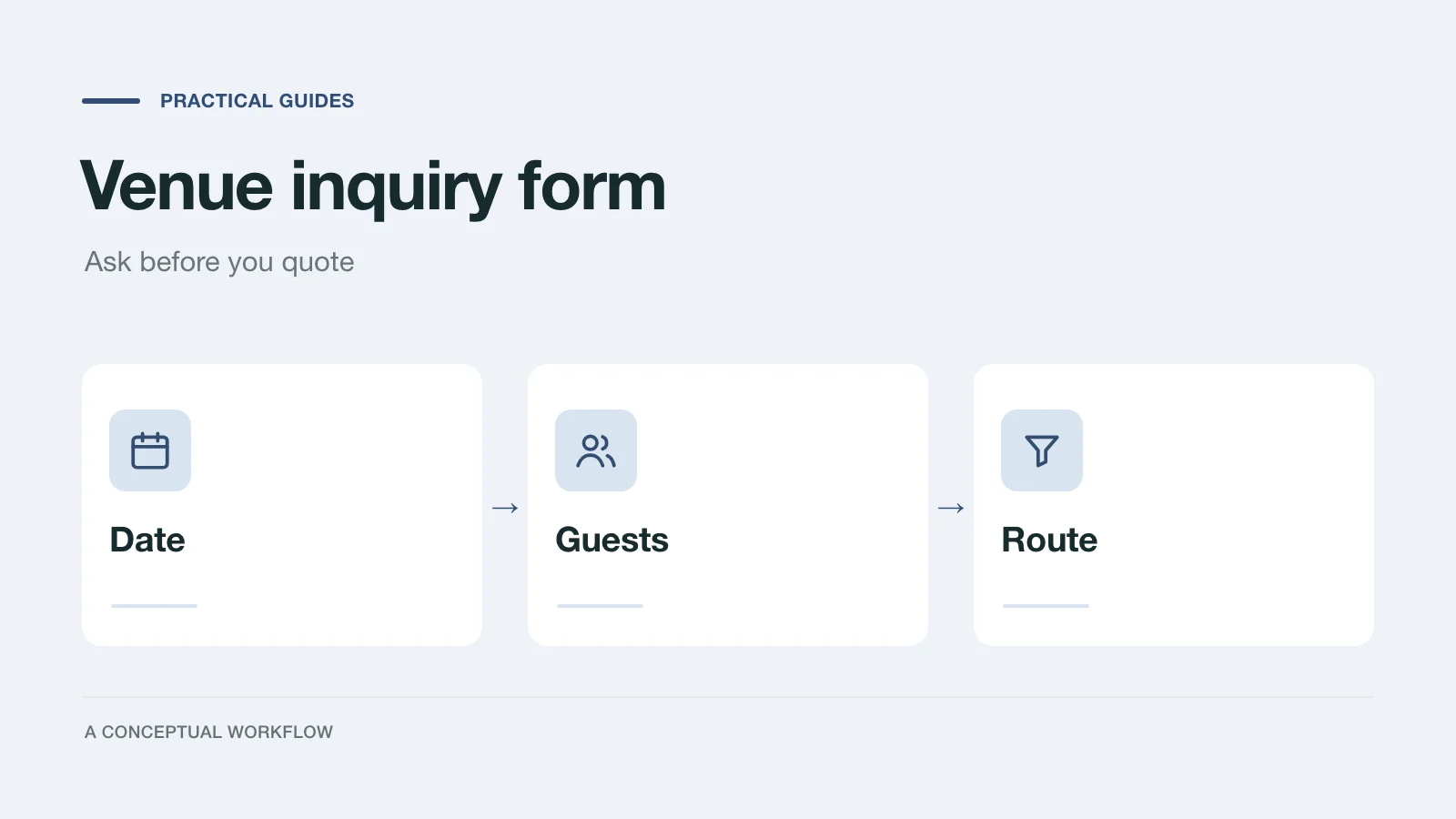
A venue inquiry that says "Hi, is June available? How much?" can't be quoted. You need the date, the guest count, the kind of event, and some idea of budget before a number means anything, so the first reply turns into a round of questions and the couple or event planner waits another day.
A good venue inquiry form asks those questions up front and tells you what to do with each answer. This post gives you a question list you can copy, three routing rules (instant quote, call, polite no), and a prompt to build the form in Dashform. The examples are fictional, and the thresholds are placeholders for your own capacity and prices.
What a quote actually depends on
Before writing questions, list what changes your price or your answer. For most venues it comes down to six things:
- Date and flexibility. A Saturday in peak season and a Tuesday in January are different quotes. Flexibility matters as much as the date itself, because a flexible inquiry can be moved to a date you have open.
- Guest count. It decides which room, how many staff, and whether the event fits at all. Ask separately about seated and standing if your capacity differs.
- Event type. A wedding, a corporate offsite, and a birthday party use the venue differently, and some types may need a different contract or deposit.
- Budget range. Not to haggle, but to see whether your minimum spend or package price is in reach before anyone visits.
- Catering and AV needs. In-house or outside catering, bar service, a projector, microphones, a stage. These are often the largest line items after the room.
- Decision timeline. Someone booking next month and someone "just starting to look" for next year need different follow-up.
Everything else (seating plans, menus, vendor lists) belongs in planning after the deposit, not on the first form.
The question list
Copy this, then replace the options with your own rooms, packages and policies.
- What kind of event are you planning? Wedding, corporate event or meeting, private party, nonprofit or fundraiser, other (please describe).
- What date are you hoping for? Date picker.
- How flexible is the date? Fixed date only / flexible within the same month / flexible on day of week / no date yet.
- About how many guests? Number. Add a short note: "a rough number is fine."
- Seated, standing, or a mix? Single choice. Skip this if your capacity is the same either way.
- What time of day, and roughly how long? Daytime, evening, full day, multi-day.
- What total budget are you working with for the venue? Ranges that match your own packages, plus "Not sure yet." Put your starting price or minimum spend right above this question so people can answer honestly.
- Catering. Our in-house catering / bringing an approved caterer / no food / not sure. Only offer the options your venue really allows.
- Bar service. Yes / no / not sure.
- Audio, visual, or staging needs. Multiple choice: microphones, projector or screen, live band or DJ, stage, none.
- When do you need to decide by? Within two weeks / within a month / within three months / just exploring.
- Anything else we should know? Open text, optional. Accessibility needs, a ceremony on site, a tight setup window.
- Name, email, phone. Ask for these last, after the person has told you about the event.
Keep it short where you can. If you only have one room and no AV, drop questions 5 and 10. Each question you keep should change what you quote or what you say next.
Rules: instant quote, call, or polite no
Write these rules down before the form goes live. They stop the team from deciding case by case at 10 p.m.
| Route | When it applies | What you send |
|---|---|---|
| Instant quote | Date is open (or flexible onto an open date), guest count fits a standard room, event type is one you host, budget is at or above your package price, no unusual AV or catering | Your standard package for that date and size, with a hold or deposit link if you use one |
| Call | Large or multi-day event, outside caterer, heavy AV, budget "not sure yet", date taken but flexible, or anything in "Anything else" that needs a conversation | A short reply offering two call times and saying what you'll cover |
| Polite no | Guest count is above your capacity, the date is booked and fixed, the event type is one you don't host, or the budget is clearly below your minimum | A kind reply that says why, plus another date, a smaller package, or a referral if you have one |
Apply the polite-no checks first. A big budget doesn't make a guest list fit a room that's too small for it. Then check for anything that needs a call. Whatever is left is a candidate for an instant quote, and someone still checks the calendar before sending it.
A few cases trip people up:
- "Not sure yet" on budget is common and fine. Route it to a call, or reply with your package prices and ask which range fits. Don't treat it as a no.
- A flexible date is worth more than a fixed one you can't offer. If the requested Saturday is gone, a reply with the open Fridays often wins the booking.
- "Just exploring" inquiries still get an answer, but a lighter one: your pricing sheet and an invitation to come back with a date.
Three fictional inquiries
These are made up to show how the rules work.
A. A corporate offsite. Weekday, fixed date that's open, 60 guests seated, in-house catering, projector and microphones, budget within your daytime package, deciding within two weeks. Nothing triggers a no or a call. Send the daytime package for that date and offer a site visit.
B. A wedding with a flexible date. Saturday requested but booked, flexible within the month, 90 guests, outside caterer, budget "not sure yet." Not a no, because the date is flexible. It needs a call: the outside caterer and the open budget both need a conversation. Reply with the open dates that month and two call times.
C. A birthday party for 95. Your largest room holds 70 standing. This is a polite no unless you have another space. Say so plainly, and if you know a venue that fits, name it.
Build the form in Dashform
The event planning inquiry template is a reasonable starting point: it already asks event type, guest count, date, venue, budget, and services. For a venue, you'll want to replace the venue question with date flexibility and your own catering and AV options.
Or start from a prompt. Paste this into the AI lead form generator and fill in the brackets:
Draft a venue inquiry form for [venue name], a [type of venue] in [city].
We host weddings, corporate events, private parties and fundraisers.
Our rooms hold up to [N] seated and [N] standing.
Ask, in this order: event type, preferred date, date flexibility,
guest count, seated or standing, time of day and length,
budget range (show our starting price above the question and
include "Not sure yet"), catering ([our options]), bar service,
audio and visual needs, decision timeline, anything else (optional),
then name, email and phone.
Keep the tone warm and short. Do not promise availability or a price.
The confirmation should say we check the calendar and reply within
[our real response time].
Save as a draft for review.
Review the draft before you publish. Check the budget ranges match your packages, the catering options match your contract, and the confirmation screen promises only what you'll actually do.
Dashform doesn't check your booking calendar, so the date question records a request, not a hold. Someone on your team confirms availability.
To help with sorting, Dashform's AI lead scoring reads each reply against high, medium and low priority criteria that you write in plain language, and explains its reasoning. You can describe the three routes there:
High priority: an event type we host, guest count within [N],
budget at or above [our package price], date fixed or flexible,
deciding within a month. Likely an instant quote.
Medium priority: budget "Not sure yet", outside caterer, multi-day,
heavy audio and visual needs, or special requests. Needs a call.
Low priority: guest count above [N], an event type we don't host,
or a budget clearly below our minimum. Polite no.
Never guess a missing budget or date. Flag it for a person.
Treat the result as a first sort, not a decision. The rules above are simple enough that a person reading the reply will agree or disagree in seconds, and that check is where you catch the exceptions. On plans that include native integrations (see pricing), you can also add an email Destination that only sends when a chosen answer matches, so wedding inquiries go to your wedding coordinator and corporate ones to whoever handles them.
Adjust after the first month
After a few weeks of real inquiries, look at where the routes were wrong. Did "call" inquiries mostly turn out to be standard packages? Loosen that rule. Did instant quotes go unanswered because the budget range was too wide? Split it. Did people skip the budget question? Move your starting price closer to it or reword it.
Change one thing at a time, and note the date, so you can tell what helped.
For the other forms an event business uses (registrations, RSVPs, waivers, feedback), see our event planning form templates. To build the inquiry form now, start from the AI lead form generator.