

Third-party cookies are dead. Google Chrome completed its deprecation in 2025, joining Safari and Firefox in blocking the tracking technology that powered digital advertising for over two decades. For marketers, this isn't just a technical shift — it's a fundamental change in how businesses find, understand, and convert customers.
The solution? Zero-party data — information that customers intentionally and proactively share with your brand. And the most effective way to collect it is through interactive forms, quizzes, and assessments.
In this guide, we'll walk you through everything you need to know about zero-party data collection in 2026: what it is, why it matters, and how to build a privacy-first lead generation strategy that actually converts.
What Is Zero-Party Data?
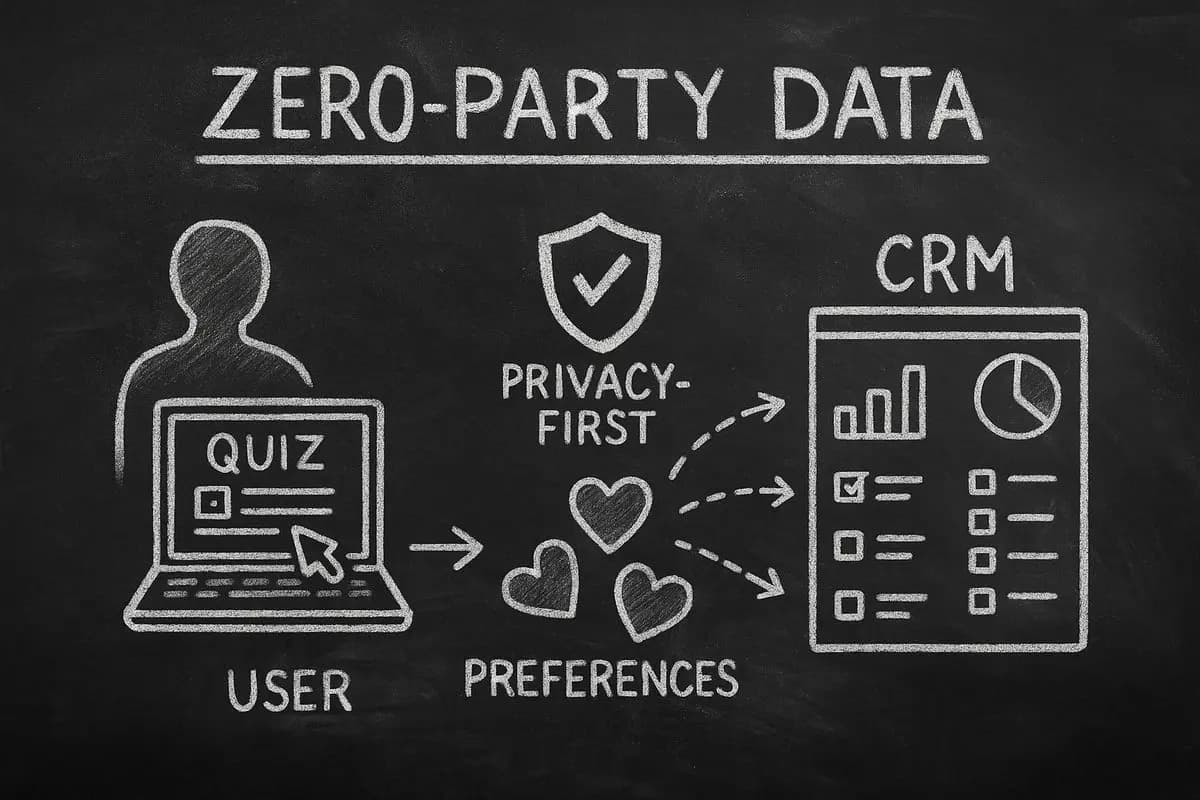
Zero-party data is information that a customer voluntarily shares with a brand. Unlike first-party data (which you observe from behavior) or third-party data (which you buy from brokers), zero-party data comes directly from the source — your customer tells you exactly what they want.
Examples include:
Quiz responses: "What's your skin type?" or "What's your budget range?"
Preference center selections: Communication frequency, content interests, product categories
Survey answers: Customer satisfaction, purchase intent, pain points
Registration form details: Industry, company size, role, goals
Calculator inputs: Budget, timeline, project scope
The key difference? Intent and transparency. When someone fills out your product recommendation quiz, they're explicitly telling you what they need. That signal is infinitely more valuable than a cookie trail.
Why Zero-Party Data Matters More Than Ever in 2026
The data landscape has shifted dramatically:
Chrome completed third-party cookie deprecation in 2025, eliminating cross-site tracking for 65% of web traffic
66% of marketers express serious concerns about cross-channel tracking capabilities
Customer acquisition costs have doubled for businesses dependent on third-party data targeting
GDPR, CCPA, and CPRA enforcement continues to tighten, with average fines increasing 42% year-over-year
Meanwhile, brands using zero-party data strategies report:
Zero-Party Data Performance Metrics (2026)
| Metric | Value | Source |
|---|---|---|
| Quiz/survey conversion rate | 61% | Demand Local |
| Quiz completion rate (optimized) | 80% | Digioh |
| Conversion lift vs third-party targeting | 3x higher | Email Conversion Lab |
| Customer acquisition cost reduction | 40% lower | Industry average |
| Andie Swim quiz ROI | 96X | Digioh |
| Trek product finder conversion lift | 200% | Salsify |
| CrazyBulk conversion rate increase | 141% | Digioh |
| Consumers willing to share data for personalization | 52% | SecurePrivacy |
The message is clear: the future of lead generation isn't about tracking people across the web. It's about earning their trust and asking the right questions.
Zero-Party Data vs. First-Party Data vs. Third-Party Data
Understanding the differences is critical to building the right strategy:
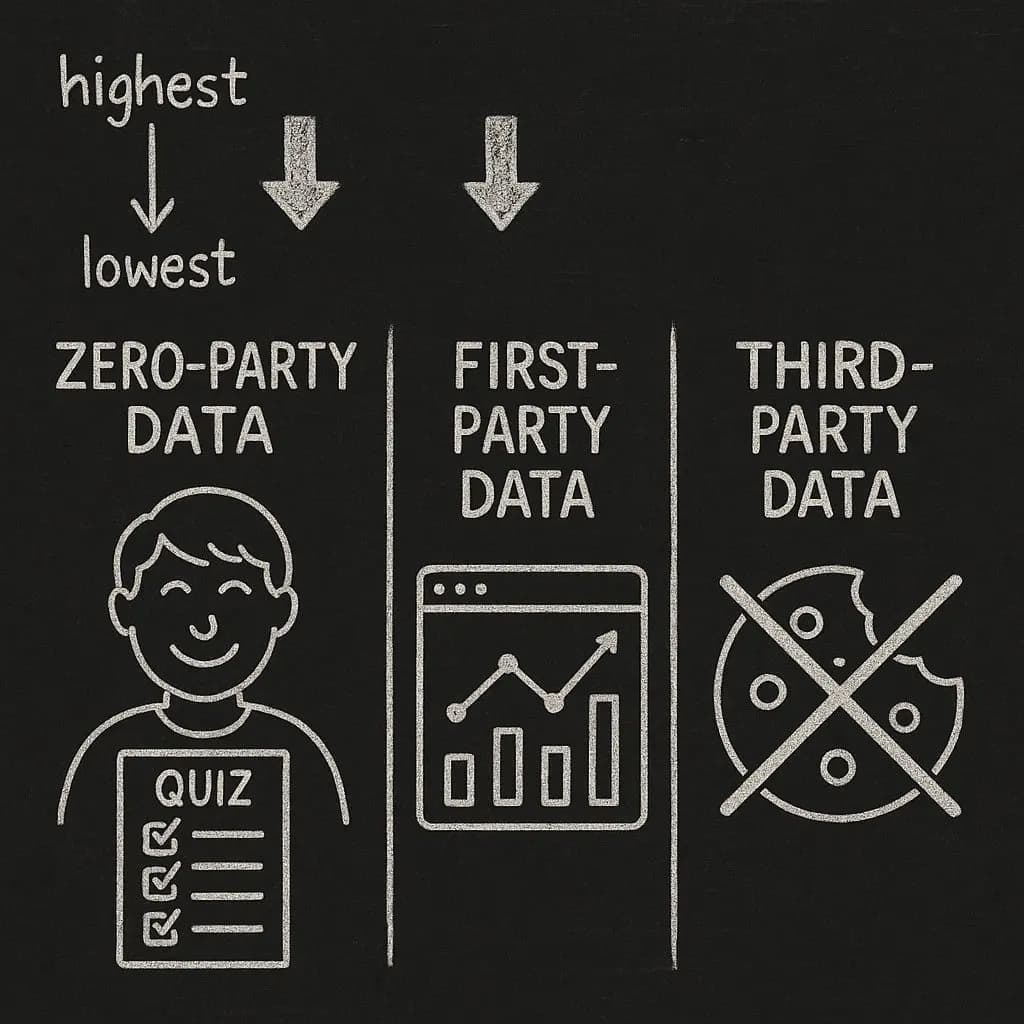
Data Types Comparison
| Attribute | Zero-Party Data | First-Party Data | Third-Party Data |
|---|---|---|---|
| Source | Customer voluntarily shares | Observed from behavior | Purchased from brokers |
| Examples | Quiz answers, preferences, surveys | Page views, purchase history, clicks | Cookie tracking, demographic databases |
| Accuracy | Highest — direct from source | High — based on real actions | Low — often outdated or inferred |
| Privacy | Fully compliant (explicit consent) | Compliant with disclosure | Increasingly restricted/illegal |
| Shelf Life | Needs periodic refreshing | Decays over time | Rapidly becoming useless |
| Cost | Low (tools + content) | Medium (analytics setup) | High (broker fees + compliance risk) |
The winning strategy in 2026 combines zero-party data (what customers tell you) with first-party data (what you observe) to create a complete picture — no third-party cookies required.
7 Proven Methods to Collect Zero-Party Data
1. Interactive Quizzes and Assessments
Quizzes are the single most effective zero-party data collection tool in 2026. They achieve 40-60% completion rates and generate 2-5x higher conversion rates than static forms.
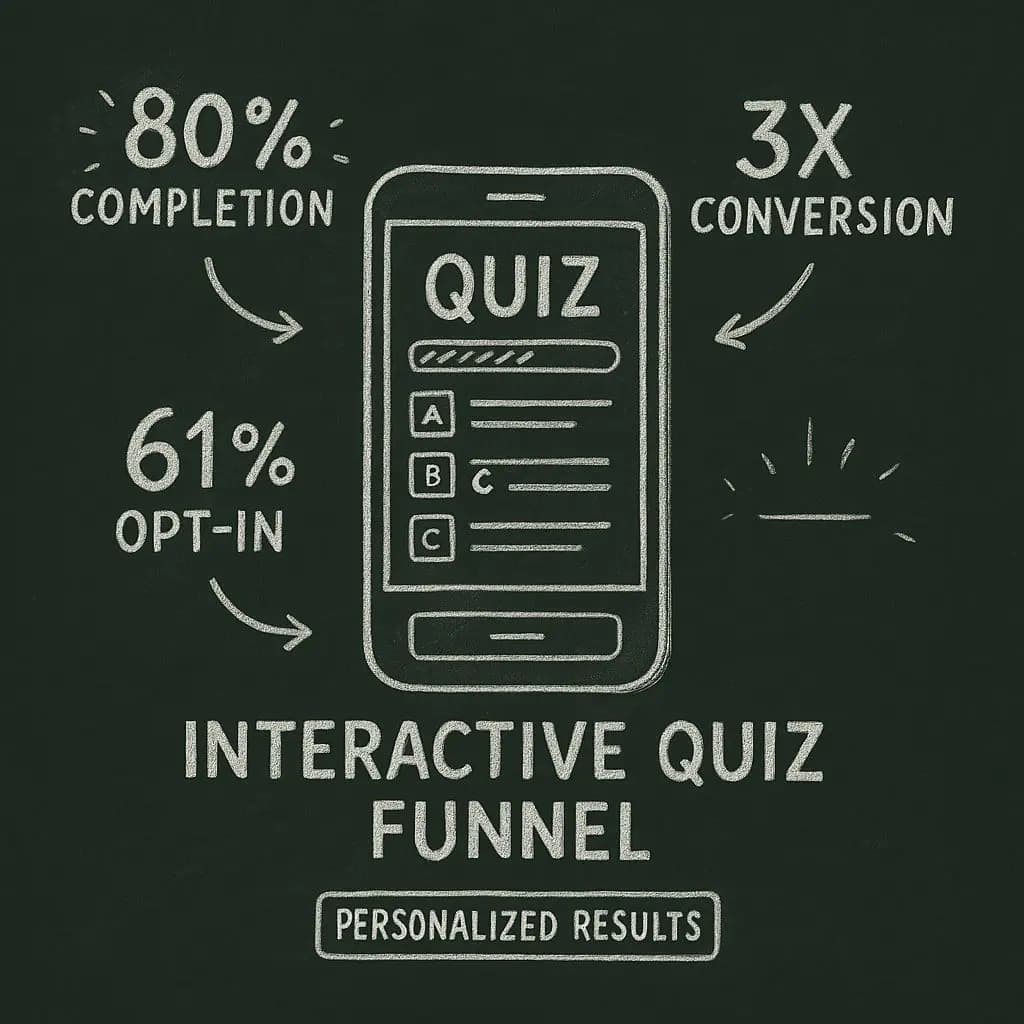
Why they work:
They feel like an experience, not a data grab. Users receive immediate value through personalized recommendations. Each question naturally collects preference data, and gamification drives completion.
Real-world examples:
Sephora uses skin type quizzes to personalize product recommendations. Ruggable asks about shape, color, and style preferences in their "Rug Quiz". Trek captures terrain preferences through product finder quizzes, achieving a 200% increase in conversions.
With tools like Dashform, you can create AI-powered quizzes that adapt questions in real-time based on previous answers — collecting richer data while keeping users engaged.
2. Preference Centers
Let customers control their experience by choosing communication frequency (daily, weekly, monthly), content topics they care about, product categories they're interested in, and preferred channels (email, SMS, push).
Pro tip: Don't bury your preference center in account settings. Feature it prominently in welcome emails and post-purchase flows.
3. Progressive Profiling
Instead of asking 15 questions upfront, collect data gradually across multiple interactions:
Visit 1: Name and email (via lead magnet). Visit 2: Industry and company size (via content gate). Visit 3: Budget and timeline (via consultation form). Visit 4: Specific needs (via assessment quiz).
Salesforce found that reducing form fields from six to three produced a 12% conversion lift. Progressive profiling gives you more data with less friction.
4. Product Recommendation Engines
Guided selling experiences ask customers about their needs and deliver personalized suggestions. Andie Swim implemented this approach and saw a 296% increase in conversion rate and 96X ROI.
Dashform's AI Product Recommendation Engine lets you build these experiences in minutes — no coding required.
5. Surveys and Feedback Forms
Post-purchase surveys, NPS scores, and satisfaction questionnaires collect valuable preference data while showing customers you care about their experience.
Keep surveys under 5 questions and always explain what you'll do with the feedback. Use Dashform's AI Survey Generator to create smart surveys that adapt based on responses.
6. Registration and Onboarding Forms
The sign-up process is a natural moment for data collection. Causal, a business planning platform, asks about job function, company size, and goals during onboarding — data that immediately personalizes the user experience.
With Dashform's AI Onboarding Form Tool, you can create conversational onboarding flows that feel helpful rather than invasive.
7. Interactive Calculators
ROI calculators, cost estimators, and savings calculators collect detailed business data while providing immediate value. Users willingly share budget ranges, team sizes, and business metrics when they receive a personalized calculation in return.
The Zero-Party Data Collection Funnel
Here's how to structure your entire lead generation strategy around zero-party data:
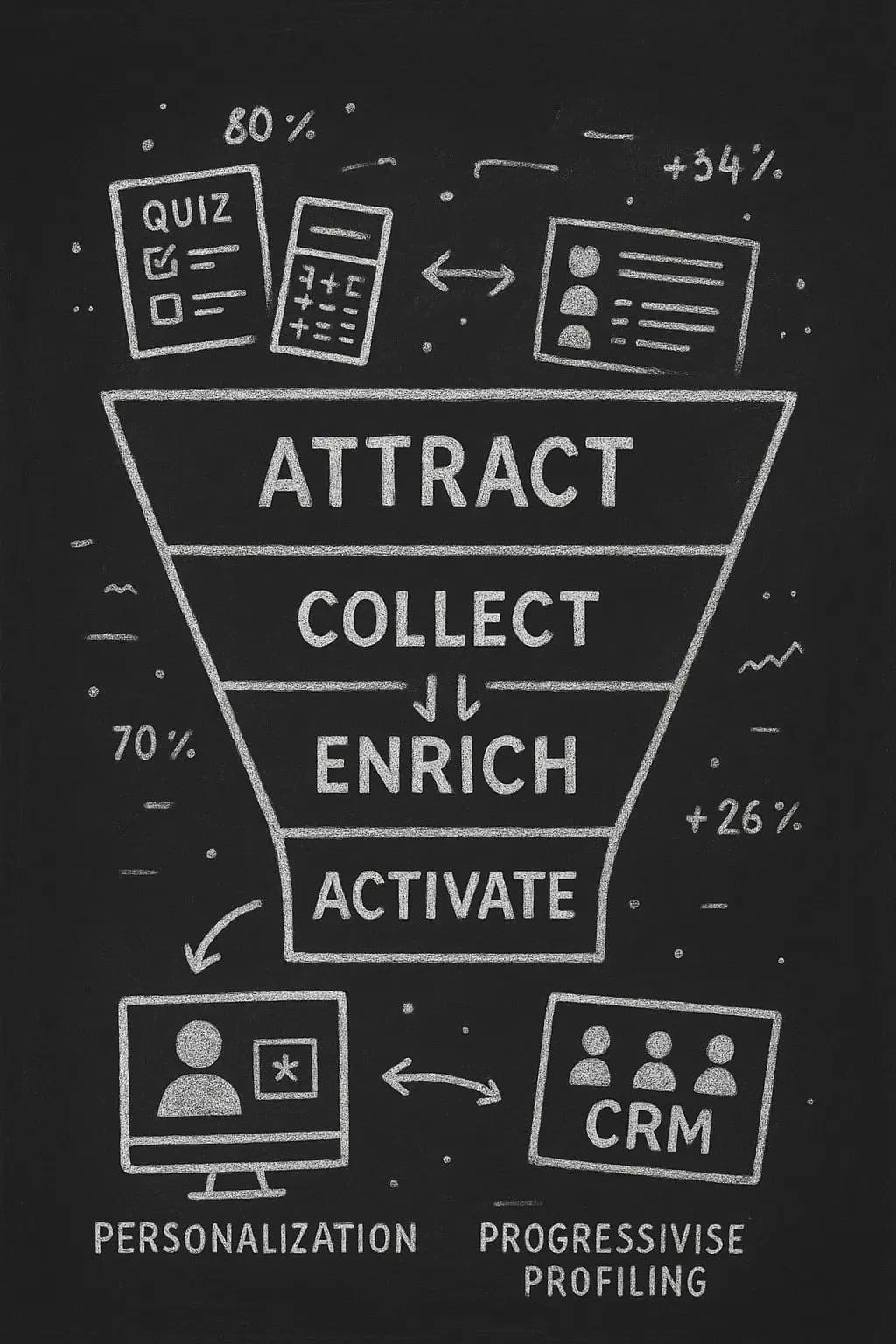
Stage 1: Attract with Interactive Content. Deploy quizzes, calculators, and assessments on landing pages. Use social media to promote interactive experiences. Target high-intent keywords with quiz-based content.
Stage 2: Collect Through Value Exchange. Every question should serve a clear purpose. Offer immediate results, recommendations, or insights. Be transparent about why you're asking.
Stage 3: Enrich with Progressive Profiling. Build deeper profiles over time across multiple touchpoints. Use follow-up emails to gather additional preferences. Let customers update their profiles through preference centers.
Stage 4: Activate with Personalization. Sync collected data to your CRM (HubSpot, Salesforce, Klaviyo). Trigger personalized email sequences based on quiz responses. Deliver custom landing pages based on stated preferences. Route hot leads to sales with full context.
Best Practices for Zero-Party Data Collection
Zero-Party Data Collection: Do's and Don'ts
| Do | Don't |
|---|---|
| Lead with value — every data request should come with a clear benefit | Don't ask for data you won't use — every question should map to a personalization action |
| Be transparent — tell users exactly why you're asking | Don't create friction without value — always give something back |
| Keep it short — 3-7 questions per interaction is the sweet spot | Don't forget mobile — 70%+ of quiz interactions happen on mobile |
| Make it visual — use images, progress bars, and interactive elements | Don't collect once and forget — preferences change over time |
| Test constantly — A/B test question order, wording, and incentives | Don't violate trust — never sell or misuse voluntarily shared data |
| Integrate immediately — connect forms to CRM for real-time activation | Don't skip the follow-up — use collected data to personalize every touchpoint |
From Cookie Tracking to Trust-Based Marketing
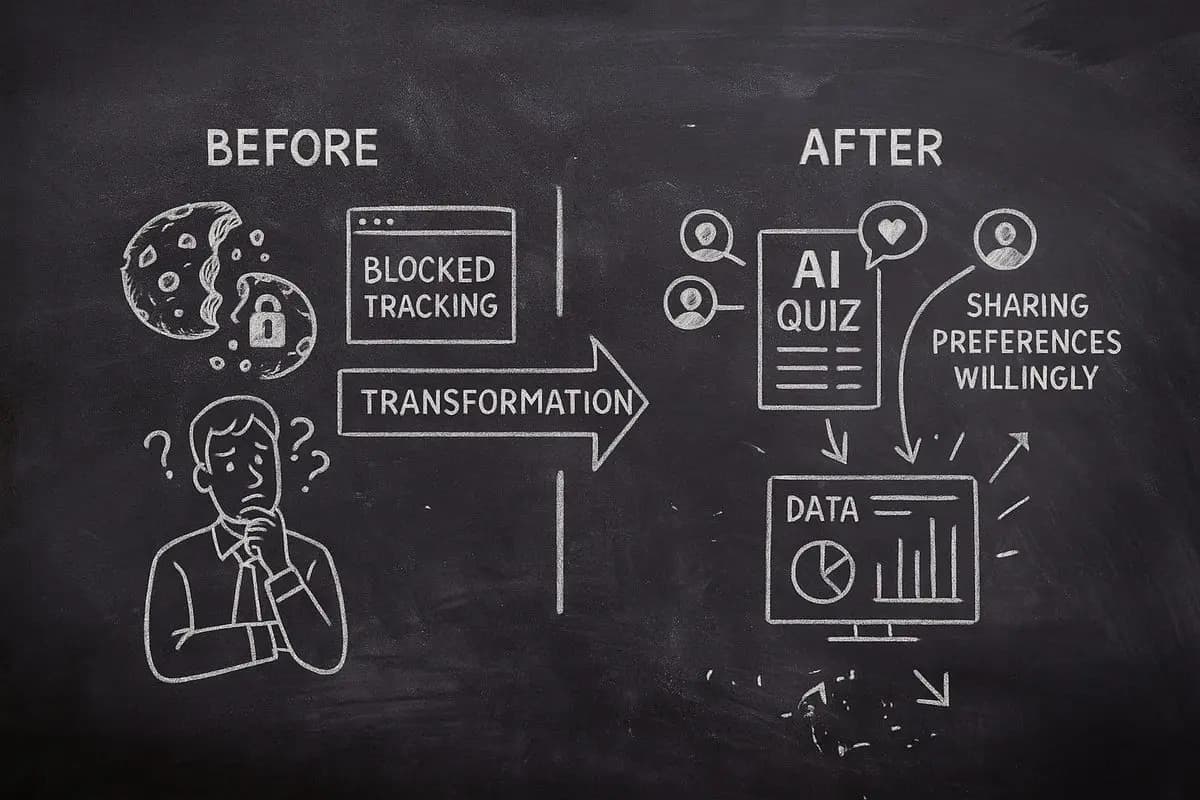
The shift from third-party cookies to zero-party data isn't just about compliance — it's about building better relationships with your customers.
When someone takes your quiz and tells you they're a small business owner looking for an affordable CRM, that's not just a data point. It's an invitation to help. And businesses that respond to that invitation with relevant, personalized experiences will win in 2026 and beyond.
52% of consumers are willing to share personal data in exchange for personalized product recommendations. The opportunity is massive — you just need the right tools to capture it.
How to Get Started with Dashform
Dashform is the fastest way to build AI-powered zero-party data collection experiences:
-
Create an AI Quiz — Use the AI Quiz Generator to build a personalized recommendation quiz in minutes.
-
Design Smart Forms — The AI Form Generator creates conversational forms that adapt based on responses.
-
Build Assessments — Help prospects self-qualify with interactive assessments that score and segment automatically.
-
Connect Your Stack — Integrate with HubSpot, Salesforce, Klaviyo, Mailchimp, and 100+ tools.
-
Analyze and Optimize — Track completion rates, drop-off points, and conversion metrics in real-time.
The best part? Dashform's AI handles the heavy lifting. Describe what you need in plain English, and it generates a fully functional, conversion-optimized quiz or form — complete with conditional logic, scoring, and personalized results pages.
Key Takeaways
Zero-party data is the most valuable data type in 2026 — it's accurate, privacy-compliant, and freely given
Interactive quizzes achieve 40-80% completion rates and 3x higher conversion compared to static forms
Progressive profiling reduces friction while building deeper customer profiles over time
The value exchange is everything: Give personalized recommendations, insights, or results in return for data
Integration is critical: Connect collected data to your CRM and marketing tools for real-time personalization
The death of third-party cookies isn't a crisis. It's an opportunity to build something better — a lead generation strategy based on trust, transparency, and genuine value.
Start building your zero-party data strategy with Dashform today.