


Twelve questions explore communication, disagreements, money, independence, support, and appreciation. "When you disagree, what usually happens?" invites you to consider conflict habits. Possible sample Endings include "Highly Compatible", "Balanced Partners", and "Growth Opportunity". The displayed Ending is chosen randomly and does not use your answers.
One of the listed results is selected at random. Your answers are not scored or used to choose the result.
Create engaging quizzes tailored to your brand. Our AI-powered quiz generator helps you build personalized assessments that capture attention and drive engagement.


Discover what your quiz results might reveal

This randomly displayed example is independent of your answers. It offers a discussion of Highly Compatible, not a finding about you. The example considers shared goals and reliable support. These are strengths worth discussing with your partner rather than assuming you both experience them identically. Keep making room for independent interests and name a recent moment of appreciation.

This randomly displayed example is independent of your answers. It offers a discussion of Balanced Partners, not a finding about you. The example considers different preferences that need discussion. Notice whether those differences involve money, social time, or personal goals. Agree on one practical compromise, and check that both people feel heard rather than treating compromise as one person always yielding.

This randomly displayed example is independent of your answers. It offers a discussion of Growth Opportunity, not a finding about you. Start with one specific concern, such as feeling unsupported or avoiding a decision, and describe the change you need. This result does not predict a breakup; if talking feels unsafe or repeatedly unproductive, seek suitable support.
Explore more quizzes in this category

Consider attraction to women, friendship, and future relationships through "When you imagine your ideal romantic relationship, who do you see yourself with?". "You Might Be a Lesbian" is randomly selected and cannot identify your orientation. Questions distinguish attraction from admiration and invite you to consider dating, close friendships, dreams, and the future you imagine. None of these answers proves a sexual orientation or controls the Ending. You can take time with uncertainty, use the terms that help you, or leave your feelings unlabeled.

Reflect on attraction and social pressure with "How often do you experience sexual attraction toward others?". "Possibly on the Asexual Spectrum" introduces terms to explore; the Ending is random, not inferred from answers. Other questions separate romantic connection from sexual attraction and ask about emotional bonds and attitudes toward sex. These experiences can differ: behavior, libido, and attraction are not interchangeable. Read the result themes as vocabulary for reflection, without treating them as an orientation test or a requirement to adopt a label.

Explore attraction across genders with "Have you ever experienced romantic or sexual attraction to more than one gender?". "Bisexual Identity Likely" is a random label, not a probability or finding about bisexuality. Questions cover imagined partners, fictional characters, past dating, and whether romantic and sexual feelings align. Attraction need not be equal across genders, and dating experience is not required for bisexuality. The three Ending titles offer topics to consider, while your answers do not calculate a likelihood or assign an identity.

Reflect on affection, openness, and future hopes through "How do you imagine your future with this person?". Even "Definitely in Love" is a random Ending, not confirmation of love, compatibility, or the other person's feelings. Choices ask how often you think about the person, how openly you share feelings, and how you respond to distance or other romantic interests. Jealousy and intensity alone are not proof of love or a healthy relationship. Use the prompts to reflect on care, boundaries, and communication; the answers do not select a relationship verdict.

Reflect on how dating fits your life through cancelled plans, conflict, commitment and vulnerability. "What does your personal life look like right now, honestly?" asks about the room you have for a partner alongside current responsibilities. Five possible Endings include "Still Healing" and "Happily, Deliberately Unready", separating lingering feelings from a deliberate preference to stay single. The displayed Ending is a randomly selected sample, independent of your answers. It does not assess you.

Twelve questions cover early dates, messages, attachment pace, and conversations about the relationship. "What do you look for first in a potential partner?" invites reflection on what you value before interpreting a connection. The Ending "The Loyal Partner" is one of three randomly selected themes. Answers are not summed to define a personality, measure attachment, or predict compatibility.
Tips, guides, and insights on quizzes and lead generation
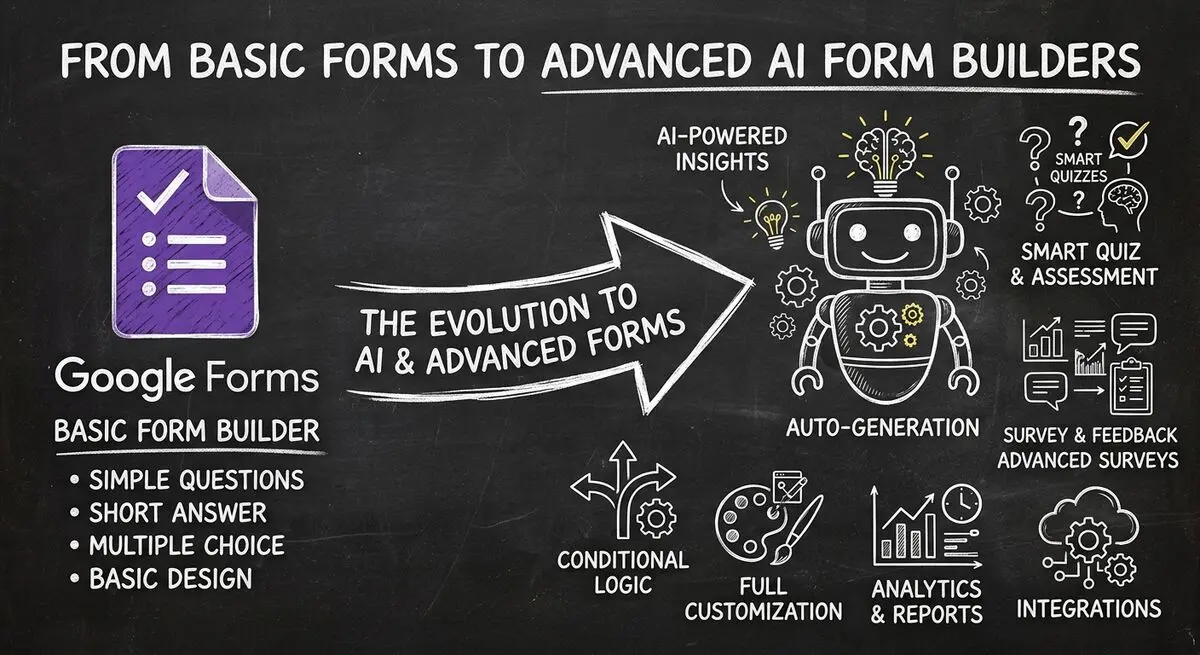
Google Forms 2026 features compared with Dashform: conditional logic, question types, AI generation, integrations. When Google Forms is enough, when to upgrade.
Many consumers now ask AI assistants for local recommendations as well as Google. Where that discovery happens, why traditional SEO alone cannot reach it, and how to make your business visible to AI agents.

GPT-5.4 can operate a computer the way a person does. How computer use AI agents can automate each stage of your sales funnel, from lead capture to client onboarding, without replacing your existing tools.
