


Your perfect weekend isn't just about introvert vs. extrovert — it's about what genuinely restores you when no one's watching. This quiz maps your energy, appetite for novelty, need for people, and relationship with the outdoors to one of five distinct weekend styles. Answer as you actually behave, not as you aspire to, and you'll land on a result that feels less like a horoscope and more like a plan. Whether you belong on a trail at dawn or on your couch at noon, let's find out.
One of the listed results is selected at random. Your answers are not scored or used to choose the result.
Create engaging quizzes tailored to your brand. Our AI-powered quiz generator helps you build personalized assessments that capture attention and drive engagement.
Discover what your quiz results might reveal

You recharge through stillness, and your ideal weekend is a deliberate exercise in doing less. Saturdays mean slow mornings, something absorbing to read or watch, and the specific satisfaction of having nowhere to be and no one to perform for. You're not antisocial — you know the difference between loneliness and solitude, and you've learned to protect the latter fiercely.

Your weekends run on people, full stop. Brunches that stretch into evenings, group chats that detour into impromptu plans, conversations that leave you genuinely buzzing — this is what recharges you, not depletes you. Your ideal two days ends with a slightly hoarse voice and a phone full of photos, and Monday feels better because of it.

You want your weekends to feel like they happened — a gallery you hadn't heard of last week, a restaurant on a street you'd never turned down, a show that's already sold out by Sunday. Novelty is the engine: familiar surroundings and repeated routines leave you quietly restless in a way that's hard to explain. Your ideal weekend gives you something specific to think about on the commute Monday morning.

You measure a good weekend in elevation, distance, or how long it takes your legs to recover. Getting outside isn't a nice-to-have — it's the mechanism by which you become yourself again after five days at a desk. No brunch, no box set, and no amount of sleep replicates what two hours on a trail does for your mood and your ability to tolerate the week ahead.

You want depth and variety, and you're good at building a weekend that delivers both. Your ideal two days has a shape: something productive in the morning, something social or cultural in the afternoon, and a real pocket of nothing that you protect like a meeting. You're not rigid — you just know that an unstructured weekend tends to evaporate, and you'd rather finish Sunday feeling like you chose how it went.
Explore more quizzes in this category

Revisit Schmidt and Jenko’s film missions through ten questions about cover identities, Captain Dickson, HFS, school activities and the sequel credits. "Who plays Eric Molson, the high-school drug dealer in 21 Jump Street?" checks a casting detail from the first film. "Jump Street Legend!" / "Undercover Agent" / "Jump Street Rookie". The displayed Ending is a randomly selected sample, independent of your answers. It does not assess you.

Ten questions about coffee, vacations, shows, clothing, and social media make a game of everyday clichés. "What's your go-to coffee order?" uses a familiar habit as a starting point. The Ending "Authentically Unbothered" invites you to enjoy routines without comparing authenticity. Four profiles are selected at random; coffee and clothing choices do not determine the profile or provide an objective originality score.

Ten questions invite you to compare messages, one-to-one plans, remembered details, and direct statements about dating. The illustrative Ending “Signs Worth Discussing” offers a conversation theme, not evidence that she likes you. Her own words and boundaries remain the best guide.

Explore ten questions about letter anatomy, spacing, and type history, including "What is kerning in typography?". Other prompts cover Helvetica, the baseline, ligatures, Futura, and early Macintosh fonts. A sample title such as "Type Enthusiast" is displayed randomly, independently of answers. No answers are graded and no typography knowledge level is measured.

Practice ten elementary science ideas: photosynthesis, solid matter, the Sun, the water cycle, herbivores, Earth's crust, gravity, the heart, cells, and solar energy. "Which state of matter has a definite shape and definite volume?" asks you to distinguish states of matter by shape and volume. The playful Endings "Science Star!", "Good Job!", and "Keep Learning!" encourage further study. The displayed Ending is chosen randomly and does not use your answers.

Ten Hunter x Hunter prompts explore imagined combat, teamwork, and learning. After completion, "Enhancer", "Emitter", "Transmuter", or "Conjurer" is selected randomly; answers are not scored or used to choose the Ending. The quiz includes four of the fictional setting’s six categories and cannot identify real powers or personality.
Tips, guides, and insights on quizzes and lead generation
Turn a fictional agency brief into a reviewed Dashform draft using Claude Code, with copyable prompts, a field map, and a publication checklist.
A practical coaching question bank with a five-question discovery form, example answers, follow-up guidance, and a copyable Dashform prompt.
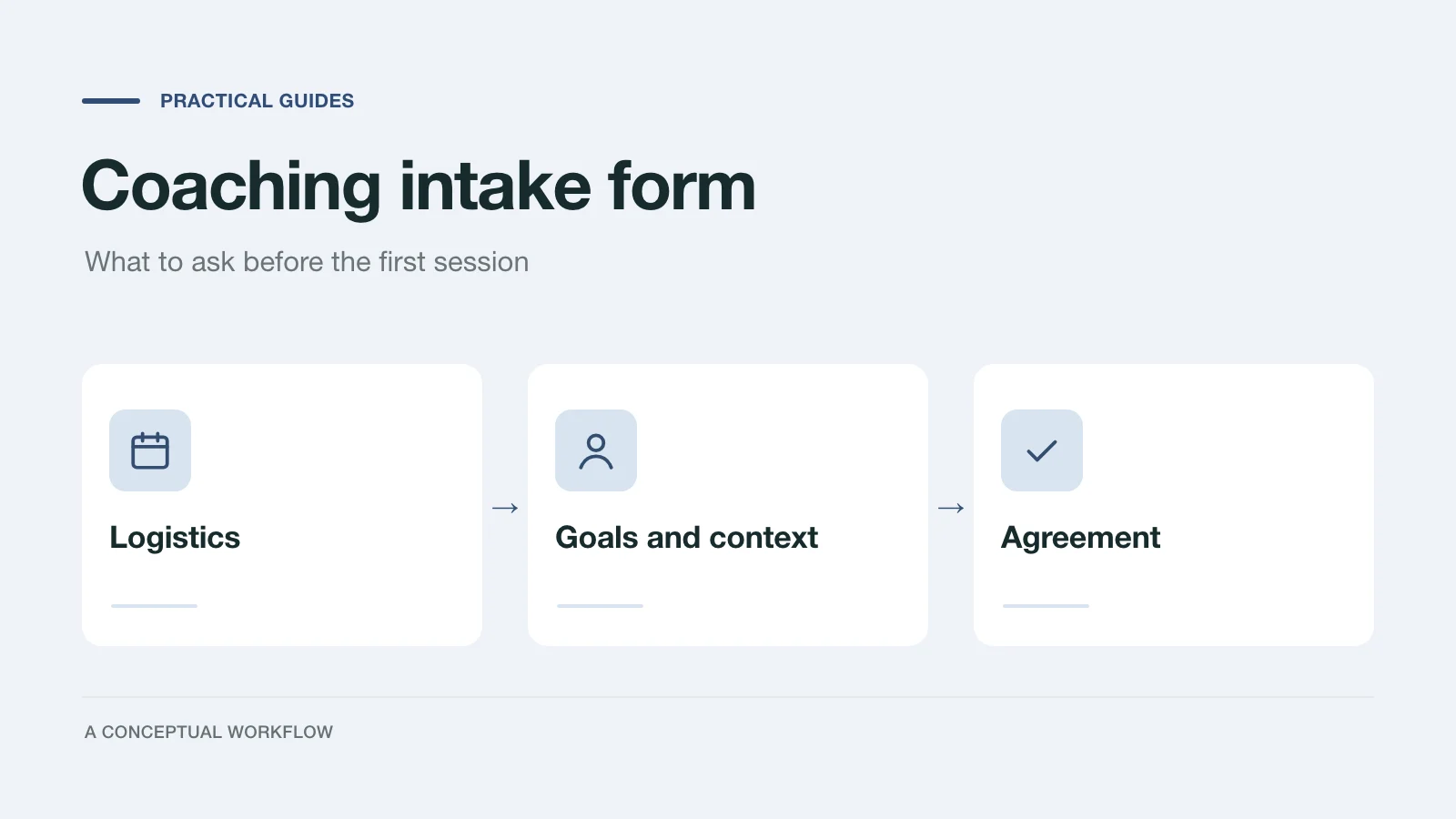
The questions to ask a new coaching client before the first session, grouped by purpose, with which to make optional, what to leave out, and a template to start from.
